
利用新型咪唑并吡嗪酮底物构建的深海虾荧光素酶报告基因。
Engineered luciferase reporter from a deep sea shrimp utilizing a novel imidazopyrazinone substrate.
机构信息
Promega Corporation, Madison, Wisconsin 53711, United States.
出版信息
ACS Chem Biol. 2012 Nov 16;7(11):1848-57. doi: 10.1021/cb3002478. Epub 2012 Aug 30.
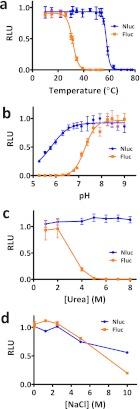
Bioluminescence methodologies have been extraordinarily useful due to their high sensitivity, broad dynamic range, and operational simplicity. These capabilities have been realized largely through incremental adaptations of native enzymes and substrates, originating from luminous organisms of diverse evolutionary lineages. We engineered both an enzyme and substrate in combination to create a novel bioluminescence system capable of more efficient light emission with superior biochemical and physical characteristics. Using a small luciferase subunit (19 kDa) from the deep sea shrimp Oplophorus gracilirostris, we have improved luminescence expression in mammalian cells ~2.5 million-fold by merging optimization of protein structure with development of a novel imidazopyrazinone substrate (furimazine). The new luciferase, NanoLuc, produces glow-type luminescence (signal half-life >2 h) with a specific activity ~150-fold greater than that of either firefly (Photinus pyralis) or Renilla luciferases similarly configured for glow-type assays. In mammalian cells, NanoLuc shows no evidence of post-translational modifications or subcellular partitioning. The enzyme exhibits high physical stability, retaining activity with incubation up to 55 °C or in culture medium for >15 h at 37 °C. As a genetic reporter, NanoLuc may be configured for high sensitivity or for response dynamics by appending a degradation sequence to reduce intracellular accumulation. Appending a signal sequence allows NanoLuc to be exported to the culture medium, where reporter expression can be measured without cell lysis. Fusion onto other proteins allows luminescent assays of their metabolism or localization within cells. Reporter quantitation is achievable even at very low expression levels to facilitate more reliable coupling with endogenous cellular processes.
生物发光方法因其高灵敏度、宽动态范围和操作简单而非常有用。这些功能主要是通过对来自不同进化谱系的发光生物的天然酶和底物进行逐步适应来实现的。我们设计了一种酶和一种底物的组合,创造了一种新型生物发光系统,能够以更有效的发光效率和更优越的生化和物理特性来实现发光。我们使用来自深海虾 Oplophorus gracilirostris 的一个小的荧光素酶亚基(19 kDa),通过优化蛋白质结构并开发一种新型咪唑并吡嗪酮底物(furimazine),将哺乳动物细胞中的发光表达提高了约 250 万倍。这种新的荧光素酶 NanoLuc 产生辉光型发光(信号半衰期>2 h),其比萤火虫(Photinus pyralis)或 Renilla 荧光素酶的比活性高约 150 倍,这些酶同样被配置用于辉光型测定。在哺乳动物细胞中,NanoLuc 没有证据表明存在翻译后修饰或亚细胞分区。该酶表现出很高的物理稳定性,在 55°C 孵育或在 37°C 的培养基中孵育超过 15 小时后仍保留活性。作为遗传报告基因,NanoLuc 可以通过附加降解序列来减少细胞内积累,从而配置为高灵敏度或响应动力学。附加信号序列允许 NanoLuc 被输出到培养基中,无需细胞裂解即可测量报告基因的表达。融合到其他蛋白质上可以对其代谢或在细胞内的定位进行发光检测。即使在非常低的表达水平下也可以实现报告基因的定量,从而更可靠地与内源性细胞过程相耦合。




 Zotero 插件