
癌症相关成纤维细胞和肿瘤起始细胞的蛋白标志物揭示了新鲜分离的卵巢癌腹水中的亚群。
Protein markers of cancer-associated fibroblasts and tumor-initiating cells reveal subpopulations in freshly isolated ovarian cancer ascites.
机构信息
Department of Oncology-Pathology, Cancer Center Karolinska CCK R8:03 Karolinska Institutet, Stockholm S-171 76, Sweden.
出版信息
BMC Cancer. 2012 Aug 18;12:359. doi: 10.1186/1471-2407-12-359.
BACKGROUND
In ovarian cancer, massive intraperitoneal dissemination is due to exfoliated tumor cells in ascites. Tumor-initiating cells (TICs or cancer stem cells) and cells showing epithelial-mesenchymal-transition (EMT) are particularly implicated. Spontaneous spherical cell aggregates are sometimes observed, but although similar to those formed by TICs in vitro, their significance is unclear.
METHODS
Cells freshly isolated from malignant ascites were separated into sphere samples (S-type samples, n=9) and monolayer-forming single-cell suspensions (M-type, n=18). Using western blot, these were then compared for expression of protein markers of EMT, TIC, and of cancer-associated fibroblasts (CAFs).
RESULTS
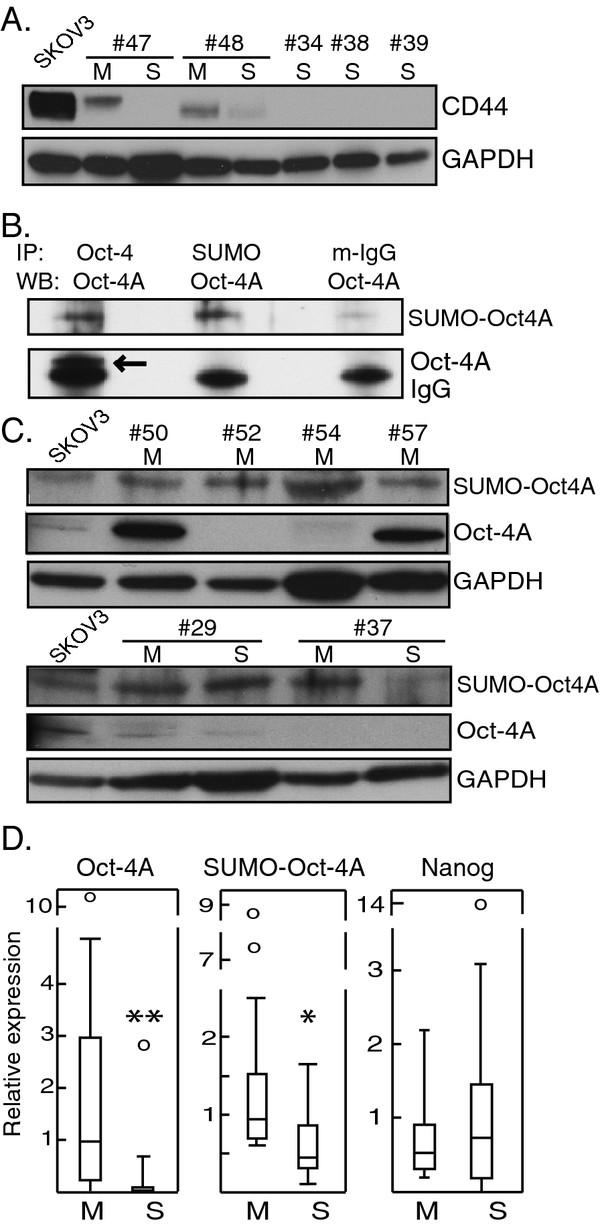
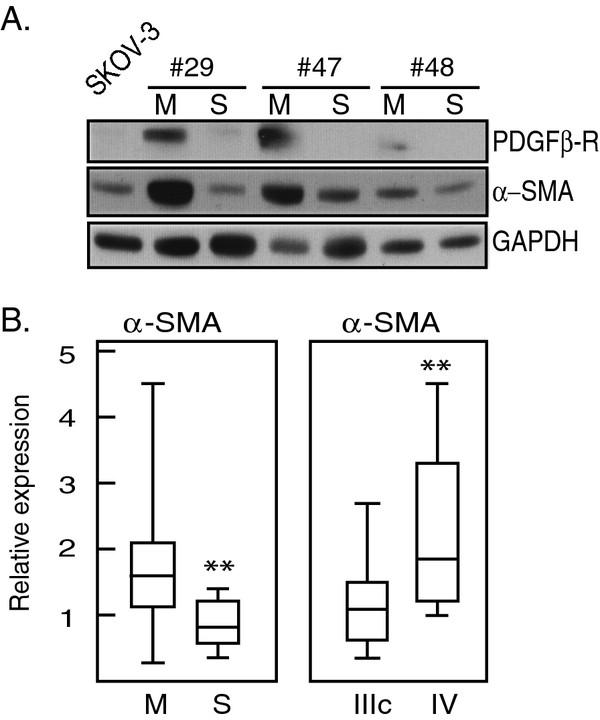
S-type cells differed significantly from M-type by expressing high levels of E-cadherin and no or little vimentin, integrin-β3 or stem cell transcription factor Oct-4A. By contrast, M-type samples were enriched for CD44, Oct-4A and for CAF markers. Independently of M- and S-type, there was a strong correlation between TIC markers Nanog and EpCAM. The CAF marker α-SMA correlated with clinical stage IV. This is the first report on CAF markers in malignant ascites and on SUMOylation of Oct-4A in ovarian cancer.
CONCLUSIONS
In addition to demonstrating potentially high levels of TICs in ascites, the results suggest that the S-type population is the less tumorigenic one. Nanog(high)/EpCAM(high) samples represent a TIC subset which may be either M- or S-type, and which is separate from the CD44(high)/Oct-4A(high) subset observed only in M-type samples. This demonstrates a heterogeneity in TIC populations in vivo which has practical implications for TIC isolation based on cell sorting. The biological heterogeneity will need to be addressed in future therapeutical strategies.
背景
在卵巢癌中,大量的腹腔内播散是由于腹腔内脱落的肿瘤细胞所致。肿瘤起始细胞(TIC 或癌症干细胞)和表现出上皮间质转化(EMT)的细胞尤其与此相关。有时会观察到自发形成的球形细胞聚集,但尽管与体外 TIC 形成的细胞相似,但它们的意义尚不清楚。
方法
从恶性腹腔积液中分离的新鲜细胞被分离成球体样本(S 型样本,n=9)和单层形成的单细胞悬液(M 型,n=18)。然后通过 Western blot 比较这些样本中 EMT、TIC 和癌症相关成纤维细胞(CAF)的蛋白标志物表达。
结果
S 型细胞与 M 型细胞显著不同,表现为高水平的 E-钙黏蛋白,而无或很少表达波形蛋白、整合素-β3 或转录因子 Oct-4A。相比之下,M 型样本富含 CD44、Oct-4A 和 CAF 标志物。与 M-和 S-型无关,TIC 标志物 Nanog 和 EpCAM 之间存在强烈相关性。CAF 标志物α-SMA 与临床分期 IV 相关。这是首次报道恶性腹腔积液中的 CAF 标志物和卵巢癌中 Oct-4A 的 SUMO 化。
结论
除了证明腹水 TIC 水平可能较高外,结果表明 S 型细胞群体的致瘤性较低。Nanog(高)/EpCAM(高)样本代表了一个 TIC 亚群,它可能是 M 型或 S 型,与仅在 M 型样本中观察到的 CD44(高)/Oct-4A(高)亚群不同。这证明了体内 TIC 群体的异质性,这对基于细胞分选的 TIC 分离具有实际意义。在未来的治疗策略中,需要解决这种生物学异质性。

 Zotero 插件