
未富先老:中国甘肃和浙江两省中老年人健康服务利用不平等。
Growing old before growing rich: inequality in health service utilization among the mid-aged and elderly in Gansu and Zhejiang Provinces, China.
机构信息
Center for Health Management and Policy, Shandong University, Shandong, China.
出版信息
BMC Health Serv Res. 2012 Sep 4;12:302. doi: 10.1186/1472-6963-12-302.
BACKGROUND
China's recent growth in income has been unequally distributed, resulting in an unusually rapid retreat from relative income equality, which has impacted negatively on health services access. There exists a significant gap between health care utilization in rural and urban areas and inequality in health care access due to differences in socioeconomic status is increasing. We investigate inequality in service utilization among the mid-aged and elderly, with a special attention of health insurance.
METHODS
This paper measures the income-related inequality and horizontal inequity in inpatient and outpatient health care utilization among the mid-aged and elderly in two provinces of China. The data for this study come from the pilot survey of the China Health and Retirement Longitudinal Study in Gansu and Zhejiang. Concentration Index (CI) and its decomposition approach were deployed to reflect inequality degree and explore the source of these inequalities.
RESULTS
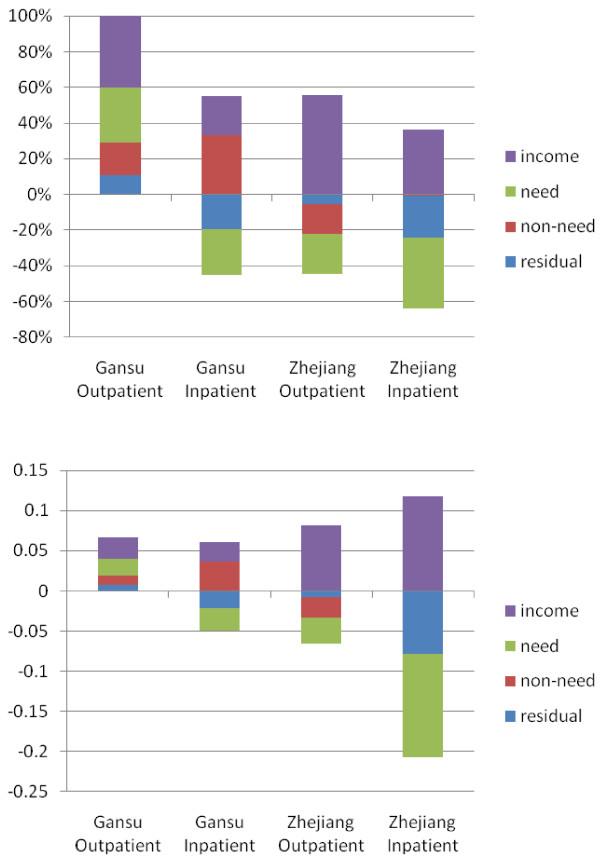
There is a pro-rich inequality in the probability of receiving health service utilization in Gansu (CI outpatient = 0.067; CI inpatient = 0.011) and outpatient for Zhejiang (CI = 0.016), but a pro-poor inequality in inpatient utilization in Zhejiang (CI = -0.090). All the Horizontal Inequity Indices (HI) are positive. Income was the dominant factor in health care utilization for out-patient in Gansu (40.3 percent) and Zhejiang (55.5 percent). The non-need factors' contribution to inequity in Gansu and Zhejiang outpatient care had the same pattern across the two provinces, with the factors evenly split between pro-rich and pro-poor biases. The insurance schemes were strongly pro-rich, except New Cooperative Medical Scheme (NCMS) in Zhejiang.
CONCLUSIONS
For the middle-aged and elderly, there is a strong pro-rich inequality of health care utilization in both provinces. Income was the most important factor in outpatient care in both provinces, but access to inpatient care was driven by a mix of income, need and non-need factors that significantly differed across and within the two provinces. These differences were the result of different levels of health care provision, different out-of-pocket expenses for health care and different access to and coverage of health insurance for rural and urban families. To address health care utilization inequality, China will need to reduce the unequal distribution of income and expand the coverage of its health insurance schemes.
背景
中国近期的收入增长分配不均,导致相对收入均等化水平迅速下降,对卫生服务的可及性产生了负面影响。城乡卫生服务利用不平等且差距较大,这是由于社会经济地位的差异不断扩大所致。本研究关注医疗保险,旨在探讨中老年人群服务利用的不平等。
方法
本研究采用集中指数(CI)及其分解方法,对中国两省中老年人群的门诊和住院卫生服务利用的收入相关不平等和水平不公平进行了测量。本研究数据来自中国健康与养老追踪调查(CHARLS)甘肃和浙江的试点调查。
结果
甘肃门诊(CI=0.067)和浙江门诊(CI=0.016)就诊的可能性存在有利于富人的不平等,但浙江住院利用存在有利于穷人的不平等(CI=-0.090)。所有水平不公平指数(HI)均为正。收入是甘肃(40.3%)和浙江(55.5%)门诊服务利用的主要决定因素。非需求因素对甘肃和浙江门诊服务利用不公平的贡献在两省具有相同的模式,这些因素在贫富两方面的偏向程度相当。除了浙江的新型农村合作医疗(NCMS)外,保险计划明显有利于富人。
结论
对于中老年人群,两省的卫生服务利用存在很强的有利于富人的不平等。收入是两省门诊服务利用的最重要因素,但住院服务利用受收入、需求和非需求因素的共同驱动,这些因素在两省之间以及省内均存在显著差异。这些差异是由于卫生服务提供水平、卫生保健自付费用以及农村和城市家庭对医疗保险的获得和覆盖程度的不同造成的。为了解决卫生服务利用的不平等问题,中国需要减少收入分配的不平等,并扩大其医疗保险计划的覆盖范围。
 Zotero 插件