
枯草芽孢杆菌医院分离株的生物膜可保护金黄色葡萄球菌免受杀菌剂的作用。
Biofilms of a Bacillus subtilis hospital isolate protect Staphylococcus aureus from biocide action.
机构信息
INRA, UMR 1319 MICALIS, Jouy-en-Josas, France.
出版信息
PLoS One. 2012;7(9):e44506. doi: 10.1371/journal.pone.0044506. Epub 2012 Sep 4.
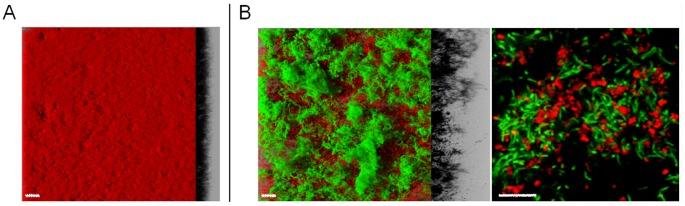
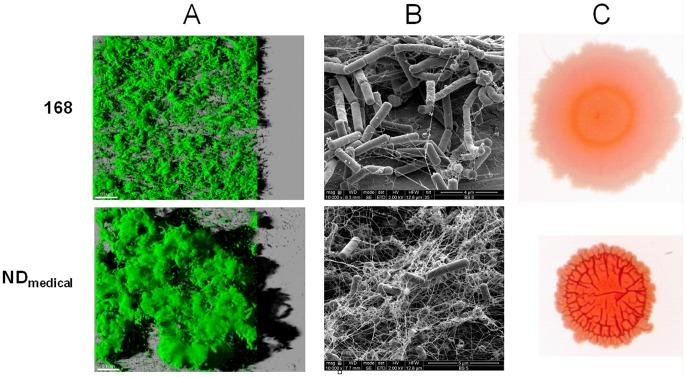
The development of a biofilm constitutes a survival strategy by providing bacteria a protective environment safe from stresses such as microbicide action and can thus lead to important health-care problems. In this study, biofilm resistance of a Bacillus subtilis strain (called hereafter ND(medical)) recently isolated from endoscope washer-disinfectors to peracetic acid was investigated and its ability to protect the pathogen Staphylococcus aureus in mixed biofilms was evaluated. Biocide action within Bacillus subtilis biofilms was visualised in real time using a non-invasive 4D confocal imaging method. The resistance of single species and mixed biofilms to peracetic acid was quantified using standard plate counting methods and their architecture was explored using confocal imaging and electronic microscopy. The results showed that the ND(medical) strain demonstrates the ability to make very large amount of biofilm together with hyper-resistance to the concentration of PAA used in many formulations (3500 ppm). Evidences strongly suggest that the enhanced resistance of the ND(medical) strain was related to the specific three-dimensional structure of the biofilm and the large amount of the extracellular matrix produced which can hinder the penetration of peracetic acid. When grown in mixed biofilm with Staphylococcus aureus, the ND(medical) strain demonstrated the ability to protect the pathogen from PAA action, thus enabling its persistence in the environment. This work points out the ability of bacteria to adapt to an extremely hostile environment, and the necessity of considering multi-organism ecosystems instead of single species model to decipher the mechanisms of biofilm resistance to antimicrobials agents.
生物膜的形成是细菌的一种生存策略,它为细菌提供了一个安全的保护环境,使其免受杀菌剂等压力的影响,因此可能导致重要的医疗保健问题。在这项研究中,我们研究了一种最近从内镜清洗消毒器中分离出来的枯草芽孢杆菌(称为 ND(医学))菌株对过氧乙酸的生物膜抗性,并评估了其在混合生物膜中保护病原体金黄色葡萄球菌的能力。使用非侵入性的 4D 共聚焦成像方法实时观察枯草芽孢杆菌生物膜内的杀菌作用。使用标准平板计数方法定量测定了单种和混合生物膜对过氧乙酸的抗性,并使用共聚焦成像和电子显微镜探索了它们的结构。结果表明,ND(医学)菌株能够形成大量的生物膜,并且对许多配方中使用的过氧乙酸浓度(3500 ppm)具有超抗性。有证据强烈表明,ND(医学)菌株的增强抗性与其生物膜的特定三维结构和大量产生的细胞外基质有关,这些基质可以阻碍过氧乙酸的渗透。当与金黄色葡萄球菌在混合生物膜中生长时,ND(医学)菌株能够保护病原体免受过氧乙酸的作用,从而使其在环境中得以持续存在。这项工作指出了细菌适应极其恶劣环境的能力,并且有必要考虑多生物体生态系统,而不是单一物种模型,以破译生物膜对抗生素药物的抗性机制。

 Zotero 插件