
Bax/Mcl-1 平衡影响间歇性低氧和阻塞性睡眠呼吸暂停中的中性粒细胞存活:p38MAPK 和 ERK1/2 信号的影响。
Bax/Mcl-1 balance affects neutrophil survival in intermittent hypoxia and obstructive sleep apnea: effects of p38MAPK and ERK1/2 signaling.
机构信息
The Lloyd Rigler Sleep Apnea Research Laboratory, The Ruth and Bruce Rappaport Faculty of Medicine, Technion-Israel Institute of Technology, Haifa, Israel.
出版信息
J Transl Med. 2012 Oct 22;10:211. doi: 10.1186/1479-5876-10-211.
BACKGROUND
Prolonged neutrophil survival is evident in various cardiovascular and respiratory morbidities, in hypoxic conditions in-vitro and in patients with obstructive sleep apnea (OSA) characterized by nightly intermittent hypoxia (IH). This may lead to persistent inflammation, tissue injury and dysfunction. We therefore investigated by a translational approach the potential contribution of the intrinsic stress-induced mitochondrial pathway in extending neutrophil survival under IH conditions. Thus, neutrophils of healthy individuals treated with IH in-vitro and neutrophils of OSA patients undergoing nightly IH episodes in-vivo were investigated. Specifically, the balance between pro-apoptotic Bax and anti-apoptotic Mcl-1 protein expression, and the potential involvement of p38MAPK and ERK1/2 signaling pathways in the control of Mcl-1 expression were investigated.
METHODS
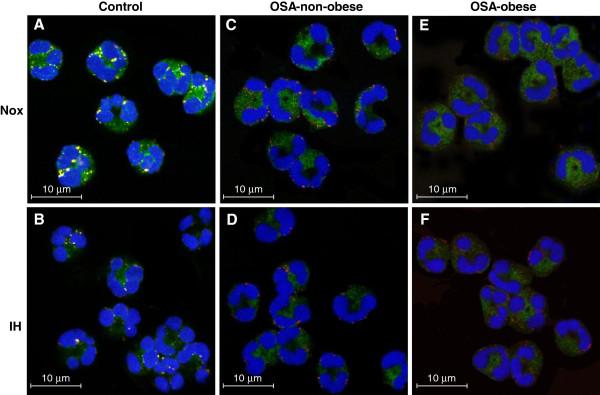
Purified neutrophils were exposed to IH and compared to normoxia and to sustained hypoxia (SH) using a BioSpherix-OxyCycler C42 system. Bax and Mcl-1 levels, and p38MAPK and ERK1/2 phosphorylation were determined by western blotting. Also, Bax/Mcl-1 expression and Bax translocation to the mitochondria were assessed by confocal microscopy in pre-apoptotic neutrophils, before the appearance of apoptotic morphology. Co-localization of Bax and mitochondria was quantified by LSM 510 CarlZeiss MicroImaging using Manders Overlap Coefficient. A paired two-tailed t test, with Bonferroni correction for multiple comparisons, was used for statistical analysis.
RESULTS
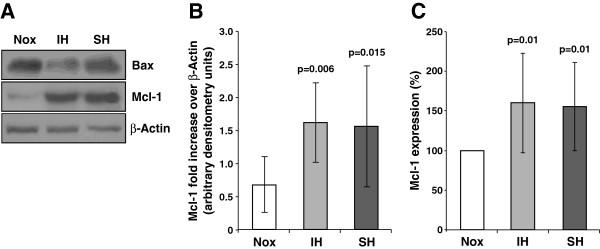
Compared to normoxia, IH and SH up-regulated the anti-apoptotic Mcl-1 by about 2-fold, down-regulated the pro-apoptotic Bax by 41% and 27%, respectively, and inhibited Bax co-localization with mitochondria before visible morphological signs of apoptosis were noted. IH induced ERK1/2 and p38MAPKs phosphorylation, whereas SH induced only p38MAPK phosphorylation. Accordingly, both ERK and p38MAPK inhibitors attenuated the IH-induced Mcl-1 increase. In SH, only p38MAPK inhibition decreased Mcl-1 expression. Similar to neutrophils of healthy subjects exposed to IH (0.97± 0.2), in OSA neutrophils, Bax/Mcl-1 ratio was significantly lower compared to normoxic controls (1.0±0.5 vs.1.99±0.3, p=0.015), and Bax did not co-localize with mitochondria.
CONCLUSIONS
These findings suggest that decreased Bax/Mcl-1 balance promotes neutrophil survival in IH in-vitro as well as in OSA patients. Moreover, Bax/Mcl-1 protein function in IH and SH might be regulated by different signal transduction pathways, highlighting a novel regulatory function through ERK1/2 signaling in IH.
背景
在各种心血管和呼吸系统疾病、体外缺氧条件下以及在以夜间间歇性缺氧(IH)为特征的阻塞性睡眠呼吸暂停(OSA)患者中,明显存在中性粒细胞存活时间延长的现象。这可能导致持续的炎症、组织损伤和功能障碍。因此,我们通过转化方法研究了内源性应激诱导的线粒体途径在 IH 条件下延长中性粒细胞存活的潜在贡献。因此,研究了体外接受 IH 治疗的健康个体的中性粒细胞和体内经历夜间 IH 发作的 OSA 患者的中性粒细胞。具体而言,研究了促凋亡 Bax 和抗凋亡 Mcl-1 蛋白表达之间的平衡,以及 p38MAPK 和 ERK1/2 信号通路在控制 Mcl-1 表达中的潜在作用。
方法
使用 BioSpherix-OxyCycler C42 系统,将纯化的中性粒细胞暴露于 IH 中,并与常氧和持续缺氧(SH)进行比较。通过 Western blot 测定 Bax 和 Mcl-1 水平以及 p38MAPK 和 ERK1/2 的磷酸化。此外,在出现凋亡形态之前,通过共聚焦显微镜评估前凋亡中性粒细胞中 Bax/Mcl-1 表达和 Bax 向线粒体的易位。使用 Manders 重叠系数通过 LSM 510 CarlZeiss MicroImaging 对 Bax 与线粒体的共定位进行量化。采用配对双侧 t 检验,并用 Bonferroni 校正进行多重比较,进行统计学分析。
结果
与常氧相比,IH 和 SH 将抗凋亡 Mcl-1 上调约 2 倍,将促凋亡 Bax 下调 41%和 27%,并在出现可见凋亡形态之前抑制 Bax 与线粒体的共定位。IH 诱导 ERK1/2 和 p38MAPKs 磷酸化,而 SH 仅诱导 p38MAPK 磷酸化。因此,ERK 和 p38MAPK 抑制剂均可减弱 IH 诱导的 Mcl-1 增加。在 SH 中,只有 p38MAPK 抑制可降低 Mcl-1 表达。与体外接受 IH(0.97±0.2)的健康个体的中性粒细胞类似,在 OSA 中性粒细胞中,与常氧对照组相比(1.0±0.5 对 1.99±0.3,p=0.015),Bax/Mcl-1 比值明显更低,并且 Bax 与线粒体不共定位。
结论
这些发现表明,在体外 IH 以及 OSA 患者中,Bax/Mcl-1 平衡的降低促进了中性粒细胞的存活。此外,在 IH 和 SH 中 Bax/Mcl-1 蛋白的功能可能由不同的信号转导途径调节,突出了通过 ERK1/2 信号转导在 IH 中的新的调节功能。



 Zotero 插件