
耳鸣患者的畸变产物耳声发射与扩展高频测听的关系。第 1 部分:单侧耳鸣的听力正常患者。
The relationship between distortion product otoacoustic emissions and extended high-frequency audiometry in tinnitus patients. Part 1: normally hearing patients with unilateral tinnitus.
机构信息
Institute of Physiology and Pathology of Hearing, Warsaw, Poland.
出版信息
Med Sci Monit. 2012 Dec;18(12):CR765-70. doi: 10.12659/msm.883606.
BACKGROUND
The aim of this study was to evaluate distortion product otoacoustic emissions (DPOAEs) and extended high-frequency (EHF) thresholds in a control group and in patients with normal hearing sensitivity in the conventional frequency range and reporting unilateral tinnitus.
MATERIAL/METHODS: Seventy patients were enrolled in the study: 47 patients with tinnitus in the left ear (Group 1) and 23 patients with tinnitus in the right ear (Group 2). The control group included 60 otologically normal subjects with no history of pathological tinnitus. Pure-tone thresholds were measured at all standard frequencies from 0.25 to 8 kHz, and at 10, 12.5, 14, and 16 kHz. The DPOAEs were measured in the frequency range from approximately 0.5 to 9 kHz using the primary tones presented at 65/55 dB SPL.
RESULTS
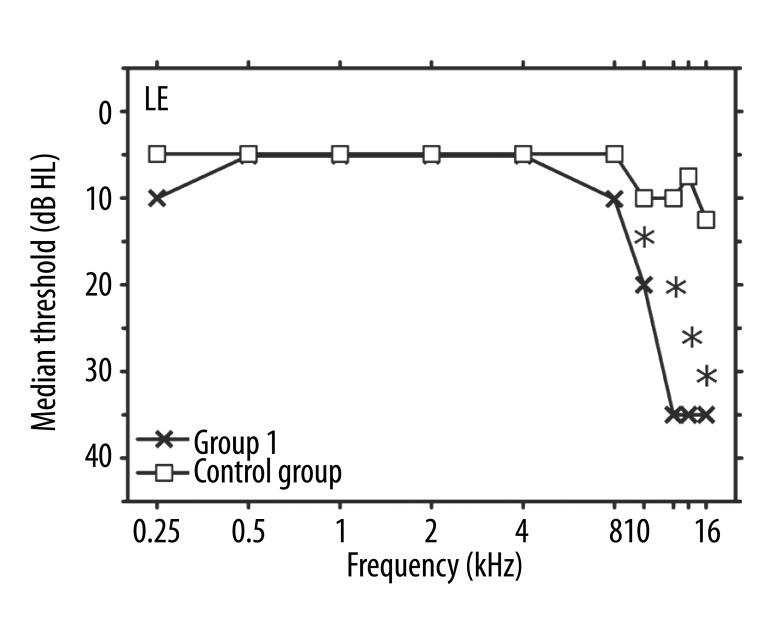
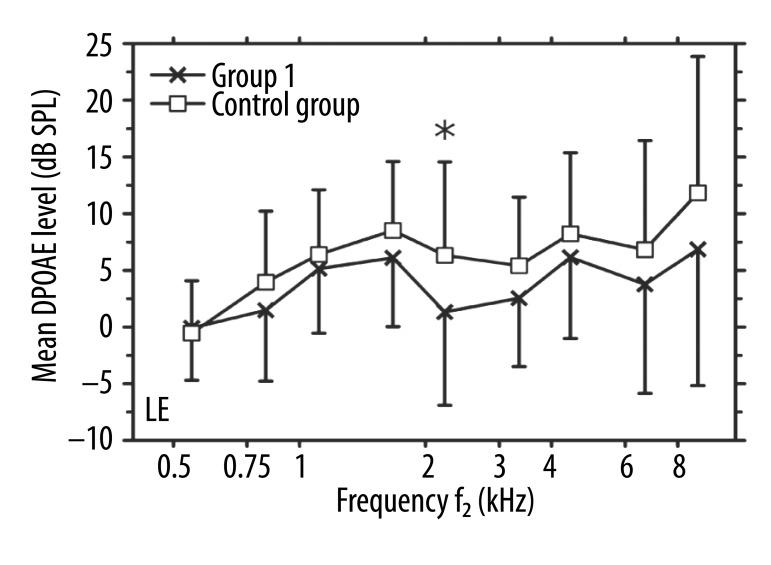
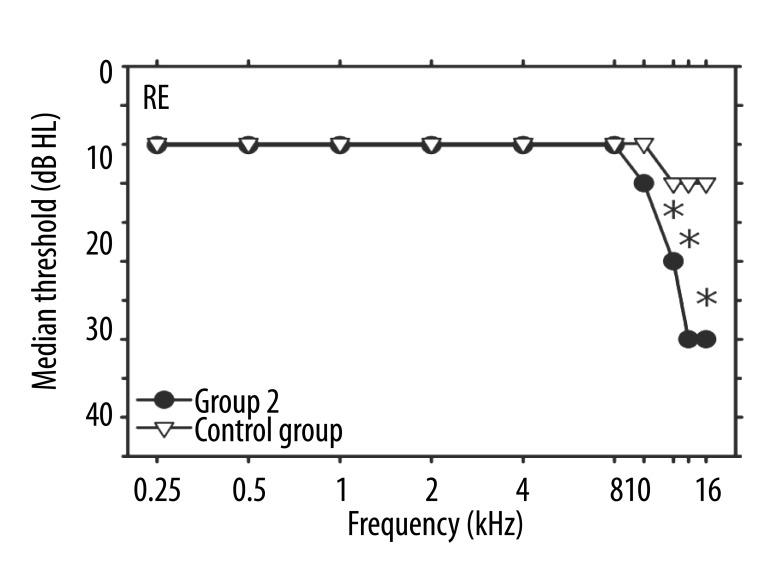
The left ears of patients in Group 1 had higher median hearing thresholds than those in the control subjects at all 4 EHFs, and lower mean DPOAE levels than those in the controls for almost all primary frequencies, but significantly lower only in the 2-kHz region. Median hearing thresholds in the right ears of patients in Group 2 were higher than those in the right ears of the control subjects in the EHF range at 12.5, 14, and 16 kHz. The mean DPOAE levels in the right ears were lower in patients from Group 2 than those in the controls for the majority of primary frequencies, but only reached statistical significance in the 8-kHz region.
CONCLUSIONS
Hearing thresholds in tinnitus ears with normal hearing sensitivity in the conventional range were higher in the EHF region than those in non-tinnitus control subjects, implying that cochlear damage in the basal region may result in the perception of tinnitus. In general, DPOAE levels in tinnitus ears were lower than those in ears of non-tinnitus subjects, suggesting that subclinical cochlear impairment in limited areas, which can be revealed by DPOAEs but not by conventional audiometry, may exist in tinnitus ears. For patients with tinnitus, DPOAE measures combined with behavioral EHF hearing thresholds may provide additional clinical information about the status of the peripheral hearing.
背景
本研究旨在评估在常规频率范围内听力正常但单侧耳鸣的患者的畸变产物耳声发射(DPOAE)和扩展高频(EHF)阈值,并与对照组进行比较。
材料/方法:共纳入 70 名患者,其中 47 例左耳耳鸣(组 1),23 例右耳耳鸣(组 2)。对照组包括 60 名无病理性耳鸣史的听力正常者。纯音阈值在所有标准频率(0.25 至 8 kHz)和 10、12.5、14 和 16 kHz 处进行测量。使用初级音(65/55 dB SPL)在约 0.5 至 9 kHz 的频率范围内测量 DPOAE。
结果
组 1 患者的左耳在所有 4 个 EHF 处的中位听力阈值均高于对照组,在几乎所有初级频率处的平均 DPOAE 水平均低于对照组,但仅在 2 kHz 处有显著差异。组 2 患者的右耳在 EHF 范围内(12.5、14 和 16 kHz)的中位听力阈值高于对照组。组 2 患者的右耳在大多数初级频率处的平均 DPOAE 水平低于对照组,但仅在 8 kHz 处具有统计学意义。
结论
在常规频率范围内听力正常但有耳鸣的患者的 EHF 区域的听力阈值高于无耳鸣的对照组,这表明基底区域的耳蜗损伤可能导致耳鸣的感知。总体而言,耳鸣耳的 DPOAE 水平低于非耳鸣耳,这表明在耳鸣耳中可能存在有限区域的亚临床耳蜗损伤,这些损伤可以通过 DPOAE 而不是常规听力测试来揭示。对于耳鸣患者,DPOAE 测量结合行为 EHF 听力阈值可能提供有关外周听力状态的额外临床信息。

 Zotero 插件