
血管外肺水和肺血管通透性指数在诊断和鉴别肺水肿中的临床应用:一项关于急性肺损伤/急性呼吸窘迫综合征定量鉴别诊断定义的前瞻性多中心研究。
The clinical usefulness of extravascular lung water and pulmonary vascular permeability index to diagnose and characterize pulmonary edema: a prospective multicenter study on the quantitative differential diagnostic definition for acute lung injury/acute respiratory distress syndrome.
作者信息
Kushimoto Shigeki, Taira Yasuhiko, Kitazawa Yasuhide, Okuchi Kazuo, Sakamoto Teruo, Ishikura Hiroyasu, Endo Tomoyuki, Yamanouchi Satoshi, Tagami Takashi, Yamaguchi Junko, Yoshikawa Kazuhide, Sugita Manabu, Kase Yoichi, Kanemura Takashi, Takahashi Hiroyuki, Kuroki Yuichi, Izumino Hiroo, Rinka Hiroshi, Seo Ryutarou, Takatori Makoto, Kaneko Tadashi, Nakamura Toshiaki, Irahara Takayuki, Saito Nobuyuki, Watanabe Akihiro
出版信息
Crit Care. 2012 Dec 11;16(6):R232. doi: 10.1186/cc11898.
INTRODUCTION
Acute lung injury (ALI)/acute respiratory distress syndrome (ARDS) is characterized by features other than increased pulmonary vascular permeability. Pulmonary vascular permeability combined with increased extravascular lung water content has been considered a quantitative diagnostic criterion of ALI/ARDS. This prospective, multi-institutional, observational study aimed to clarify the clinical pathophysiological features of ALI/ARDS and establish its quantitative diagnostic criteria.
METHODS
The extravascular lung water index (EVLWI) and the pulmonary vascular permeability index (PVPI) were measured using the transpulmonary thermodilution method in 266 patients with PaO2/FiO2 ratio ≤ 300 mmHg and bilateral infiltration on chest radiography, in 23 ICUs of academic tertiary referral hospitals. Pulmonary edema was defined as EVLWI ≥ 10 ml/kg. Three experts retrospectively determined the pathophysiological features of respiratory insufficiency by considering the patients' history, clinical presentation, chest computed tomography and radiography, echocardiography, EVLWI and brain natriuretic peptide level, and the time course of all preceding findings under systemic and respiratory therapy.
RESULTS
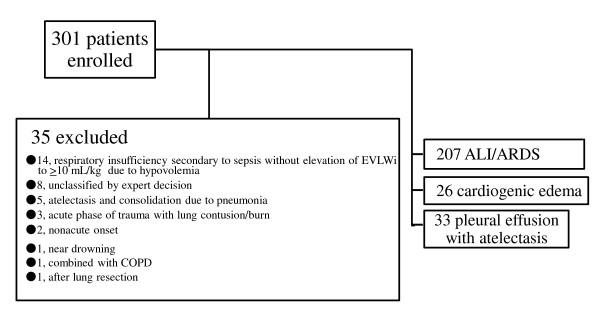
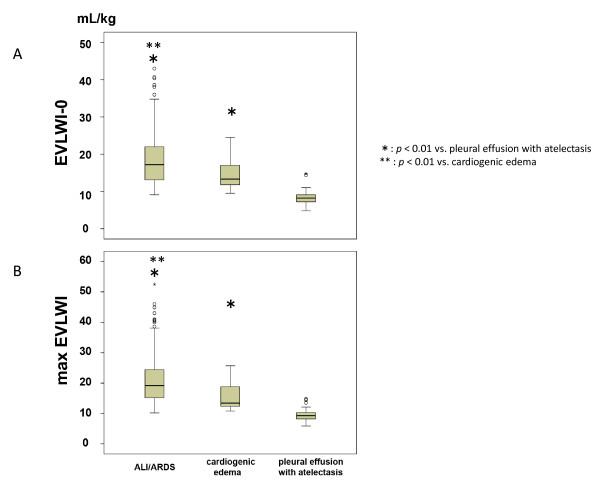
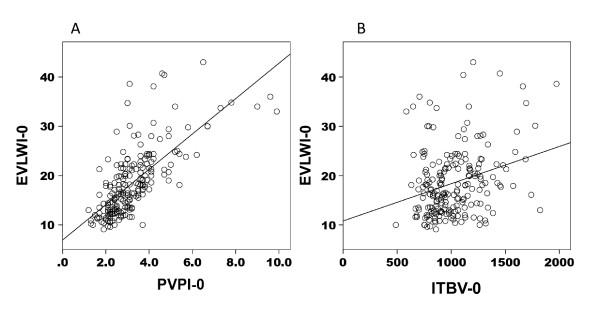
Patients were divided into the following three categories on the basis of the pathophysiological diagnostic differentiation of respiratory insufficiency: ALI/ARDS, cardiogenic edema, and pleural effusion with atelectasis, which were noted in 207 patients, 26 patients, and 33 patients, respectively. EVLWI was greater in ALI/ARDS and cardiogenic edema patients than in patients with pleural effusion with atelectasis (18.5 ± 6.8, 14.4 ± 4.0, and 8.3 ± 2.1, respectively; P < 0.01). PVPI was higher in ALI/ARDS patients than in cardiogenic edema or pleural effusion with atelectasis patients (3.2 ± 1.4, 2.0 ± 0.8, and 1.6 ± 0.5; P < 0.01). In ALI/ARDS patients, EVLWI increased with increasing pulmonary vascular permeability (r = 0.729, P < 0.01) and was weakly correlated with intrathoracic blood volume (r = 0.236, P < 0.01). EVLWI was weakly correlated with the PaO2/FiO2 ratio in the ALI/ARDS and cardiogenic edema patients. A PVPI value of 2.6 to 2.85 provided a definitive diagnosis of ALI/ARDS (specificity, 0.90 to 0.95), and a value < 1.7 ruled out an ALI/ARDS diagnosis (specificity, 0.95).
CONCLUSION
PVPI may be a useful quantitative diagnostic tool for ARDS in patients with hypoxemic respiratory failure and radiographic infiltrates.
TRIAL REGISTRATION
UMIN-CTR ID UMIN000003627.
引言
急性肺损伤(ALI)/急性呼吸窘迫综合征(ARDS)的特征不仅仅是肺血管通透性增加。肺血管通透性与血管外肺水含量增加相结合,一直被视为ALI/ARDS的定量诊断标准。这项前瞻性、多机构、观察性研究旨在阐明ALI/ARDS的临床病理生理特征,并建立其定量诊断标准。
方法
在23家学术性三级转诊医院的重症监护病房中,对266例动脉血氧分压/吸入氧分数值(PaO2/FiO2)≤300 mmHg且胸部X线表现为双侧浸润影的患者,采用经肺热稀释法测量血管外肺水指数(EVLWI)和肺血管通透性指数(PVPI)。肺水肿定义为EVLWI≥10 ml/kg。三位专家通过考虑患者的病史、临床表现、胸部计算机断层扫描和X线检查、超声心动图、EVLWI和脑钠肽水平,以及全身和呼吸治疗下所有先前检查结果的时间进程,回顾性地确定呼吸功能不全的病理生理特征。
结果
根据呼吸功能不全的病理生理诊断差异,将患者分为以下三类:ALI/ARDS、心源性肺水肿和伴有肺不张的胸腔积液,分别有207例、26例和33例患者。ALI/ARDS和心源性肺水肿患者的EVLWI高于伴有肺不张的胸腔积液患者(分别为18.5±6.8、14.4±4.0和8.3±2.1;P<0.01)。ALI/ARDS患者的PVPI高于心源性肺水肿或伴有肺不张的胸腔积液患者(分别为3.2±1.4、2.0±0.8和1.6±0.5;P<0.01)。在ALI/ARDS患者中,EVLWI随着肺血管通透性的增加而增加(r = 0.729,P<0.01),并且与胸腔内血容量弱相关(r = 0.236,P<0.01)。ALI/ARDS和心源性肺水肿患者的EVLWI与PaO2/FiO2比值弱相关。PVPI值为2.6至2.85可明确诊断ALI/ARDS(特异性为0.90至0.95),而值<1.7可排除ALI/ARDS诊断(特异性为0.95)。
结论
PVPI可能是低氧性呼吸衰竭和影像学浸润患者ARDS的一种有用的定量诊断工具。
试验注册号
UMIN-CTR ID UMIN000003627。



 Zotero 插件