
结合敌人——NET 捕获中性粒细胞使促炎单钠尿酸盐晶体失活。
Bonding the foe - NETting neutrophils immobilize the pro-inflammatory monosodium urate crystals.
机构信息
Institute for Clinical Immunology and Rheumatology, Department of Internal Medicine III, University of Erlangen-Nuremberg Erlangen, Germany.
出版信息
Front Immunol. 2012 Dec 10;3:376. doi: 10.3389/fimmu.2012.00376. eCollection 2012.
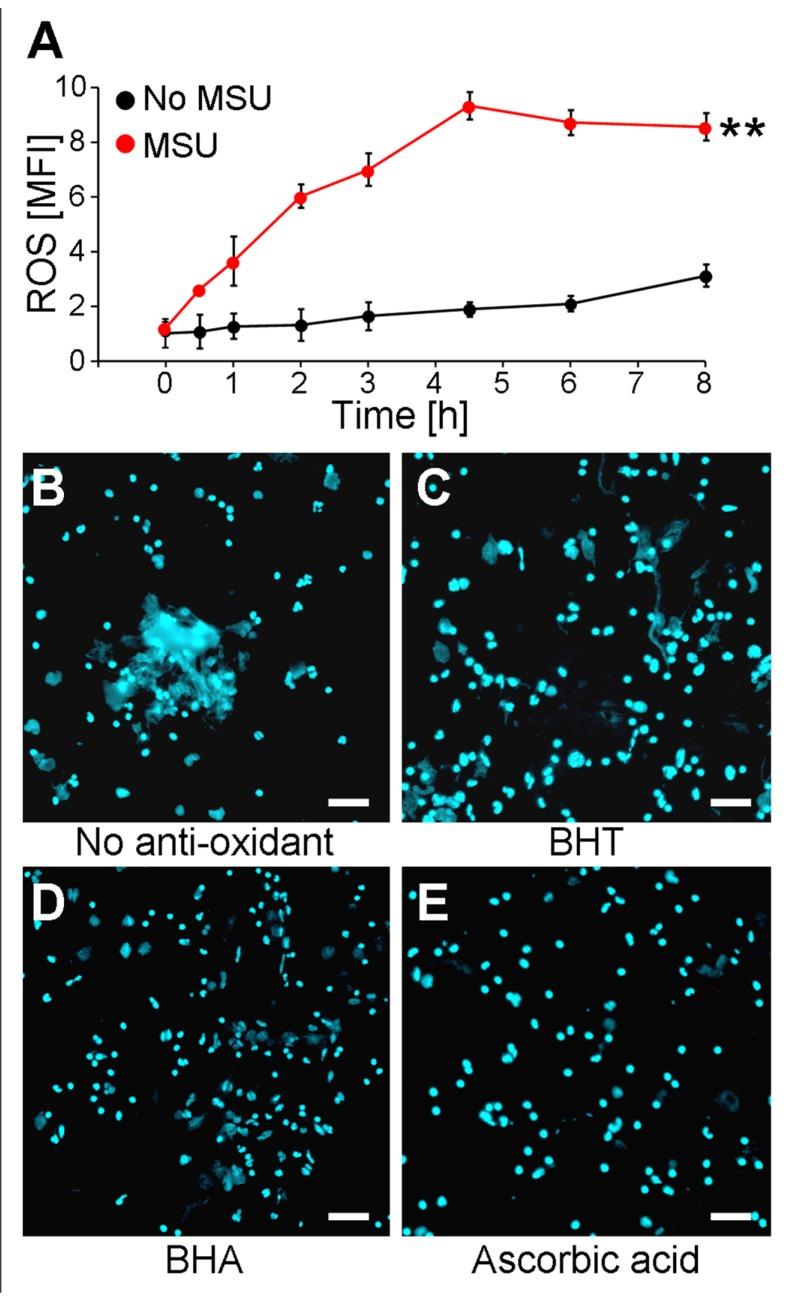
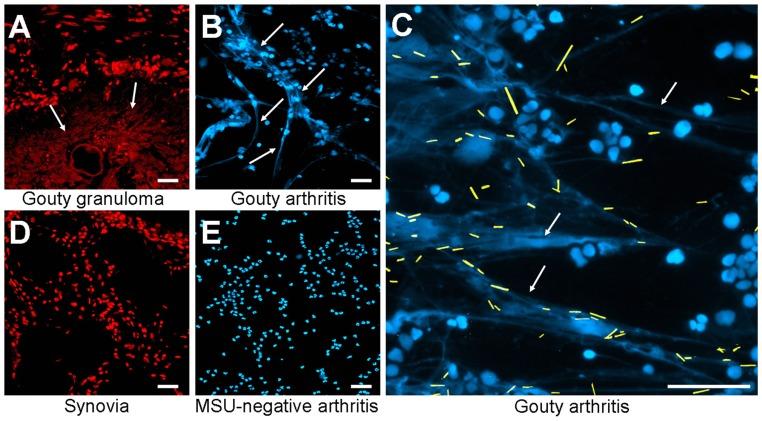
In the presence of sodium, uric acid from purine metabolism precipitates as monosodium urate (MSU) needles and forms renal calculi or causes gouty arthritis in kidneys and joints, respectively. The latter is characterized by red, hot, and swollen arthritic joints. Here we report the in vitro effect of MSU crystals on blood granulocytes and analyze their contribution to granuloma formation and neutrophil extracellular traps (NETs) formation (NETosis) in synovial fluid of patients with gouty arthritis in vivo. We observed that MSU crystals induce NETosis in vitro in a reactive oxygen species (ROS)-dependent manner. Indeed, blocking ROS (e.g., the oxidative burst) by various anti-oxidants partially inhibited NETosis induced by MSU crystals. Analyses of synovial fluids and of tissue sections of patients suffering from gout revealed that NETs are also formed in vivo, especially during acute gouty flares and/or granuloma formation. Since prolonged exposure to NETs carries the risk for the development of chronic inflammation we also studied the opsonization of NETs, as a prerequisite for their clearance. The established dead cells' opsonins C3b, galectin-9, and CRP decorated the residual dead cells' corpses and opsonized these for disposal. Surprisingly, all three soluble pattern recognizing molecules spared the spread NET structures. We conclude that (i) MSU crystals are strong inducers of ROS-dependent NETosis and (ii) that the prolonged presence of NET-pathogen or NET-crystal aggregates observed in patients with systemic autoimmunity, especially in those with low serum DNase-1 activity, cannot be compensated by CRP, complement, and galectin-mediated phagocytic clearance.
在钠存在的情况下,嘌呤代谢产生的尿酸以单钠尿酸盐(MSU)针的形式沉淀,并分别在肾脏中形成肾结石或导致痛风性关节炎在肾脏和关节中。后者的特征是红、热、肿胀的关节炎。在这里,我们报告了 MSU 晶体对血液粒细胞的体外影响,并分析了它们对痛风性关节炎患者关节滑液中肉芽肿形成和中性粒细胞胞外陷阱(NETs)形成(NETosis)的贡献。我们观察到 MSU 晶体以活性氧物质(ROS)依赖的方式在体外诱导 NETosis。事实上,通过各种抗氧化剂阻断 ROS(例如氧化爆发)部分抑制了 MSU 晶体诱导的 NETosis。对患有痛风的患者的关节滑液和组织切片的分析表明,NETs 也在体内形成,特别是在急性痛风发作期间和/或肉芽肿形成期间。由于 NET 延长暴露会导致慢性炎症的发展,因此我们还研究了 NET 的调理作用,作为其清除的前提。已建立的死亡细胞调理素 C3b、半乳糖凝集素-9 和 CRP 修饰残余死亡细胞的尸体,并调理这些细胞以进行处理。令人惊讶的是,所有三种可溶性模式识别分子都避免了 NET 结构的扩散。我们得出结论,(i)MSU 晶体是 ROS 依赖性 NETosis 的强诱导剂,(ii)在系统性自身免疫性疾病患者中观察到的 NET-病原体或 NET-晶体聚集体的延长存在,特别是在血清 DNase-1 活性低的患者中,不能通过 CRP、补体和半乳糖介导的吞噬清除来补偿。

 Zotero 插件