
γδ T 淋巴细胞在过敏反应期间协调嗜酸性粒细胞浸润。
γδ T Lymphocytes Coordinate Eosinophil Influx during Allergic Responses.
机构信息
Department Pharmacology, Farmanguinhos, Oswaldo Cruz Foundation Rio de Janeiro, Brazil.
出版信息
Front Pharmacol. 2012 Dec 3;3:200. doi: 10.3389/fphar.2012.00200. eCollection 2012.
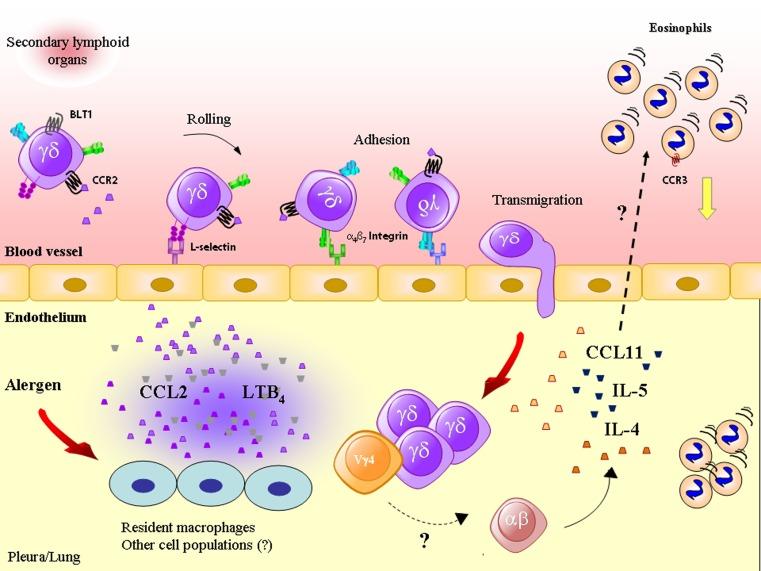
Tissue eosinophil infiltration, which is a hallmark of allergic and helminthic diseases, is mainly coordinated by T lymphocytes, via the production of eosinophilotactic chemokines. Among T lymphocyte subsets, lymphocytes expressing γδ T cell receptor have been determined as a key factor for eosinophil accumulation via direct and indirect mechanisms. This knowledge is strongly supported by the fact that, in different experimental models of eosinophilic airway inflammation and helminth-induced Th2 lung inflammation, an evident tissue accumulation of γδ T lymphocytes is observed. In addition, the depletion of γδ T lymphocytes is correlated with the impairment of eosinophil accumulation in inflamed tissue. γδ T lymphocytes are non-conventional T lymphocytes, which comprise a minor T lymphocyte subset, mainly distributed in the tissue, and present crucial roles in innate and acquired immune responses. γδ T lymphocytes recognize several danger- and pathogen-associated molecular pattern molecules and stress antigens in a MHC-independent fashion and can provide rapid tissue-specific responses, via the production of a wide range of chemical mediators capable to modulate other cell populations. These mediators include chemoattractant cytokines and chemokines that attract eosinophils into the tissue by either direct recognition (such as IL-5, CCL11/eotaxin), or indirect mechanisms via the modulation of αβ T lymphocytes and macrophages (through the production of interferon-γ, IL-4, and CCL2/Monocyte chemoattractant protein-1, MCP-1, for example). The present review presents an overview of how γδ T lymphocytes coordinate eosinophil accumulation in allergy, by focusing on their role in airway inflammation and by discussing the involvement of cytokines and chemokines in this phenomenon.
组织嗜酸性粒细胞浸润是过敏和寄生虫疾病的标志,主要由 T 淋巴细胞通过产生嗜酸性粒细胞趋化因子来协调。在 T 淋巴细胞亚群中,表达 γδ T 细胞受体的淋巴细胞通过直接和间接机制被确定为嗜酸性粒细胞聚集的关键因素。这一知识得到了强有力的支持,即在不同的嗜酸性气道炎症和寄生虫诱导的 Th2 肺炎症的实验模型中,观察到 γδ T 淋巴细胞在组织中的明显积累。此外,γδ T 淋巴细胞的耗竭与炎症组织中嗜酸性粒细胞积累的损害有关。γδ T 淋巴细胞是非常规 T 淋巴细胞,构成了一个较小的 T 淋巴细胞亚群,主要分布在组织中,在先天和获得性免疫反应中起着至关重要的作用。γδ T 淋巴细胞以 MHC 非依赖性的方式识别几种危险和病原体相关的分子模式分子和应激抗原,并能通过产生广泛的化学介质来快速提供组织特异性反应,这些介质能够调节其他细胞群体。这些介质包括趋化因子细胞因子和趋化因子,它们通过直接识别(如 IL-5、CCL11/eotaxin)或通过调节 αβ T 淋巴细胞和巨噬细胞(通过产生干扰素-γ、IL-4 和 CCL2/单核细胞趋化蛋白-1、MCP-1 等)将嗜酸性粒细胞吸引到组织中。本综述通过关注 γδ T 淋巴细胞在气道炎症中的作用,并讨论细胞因子和趋化因子在这一现象中的参与,概述了 γδ T 淋巴细胞如何协调过敏中的嗜酸性粒细胞积累。
 Zotero 插件