
奎宁、青蒿琥酯- 本芴醇和双氢青蒿素-哌喹作为乌干达儿童治疗无并发症疟疾的补救疗法的疗效。
Efficacy of quinine, artemether-lumefantrine and dihydroartemisinin-piperaquine as rescue treatment for uncomplicated malaria in Ugandan children.
机构信息
Uganda Malaria Surveillance Project, Kampala, Uganda.
出版信息
PLoS One. 2013;8(1):e53772. doi: 10.1371/journal.pone.0053772. Epub 2013 Jan 22.
BACKGROUND
The treatment of falciparum malaria poses unique challenges in settings where malaria transmission intensity is high because recurrent infections are common. These could be new infections, recrudescences, or a combination of the two. Though several African countries continue to use quinine as the second line treatment for patients with recurrent infections, there is little information on its efficacy when used for rescue therapy. Moreover, such practice goes against the World Health Organisation (WHO) recommendation to use combination therapy for uncomplicated malaria.
METHODS
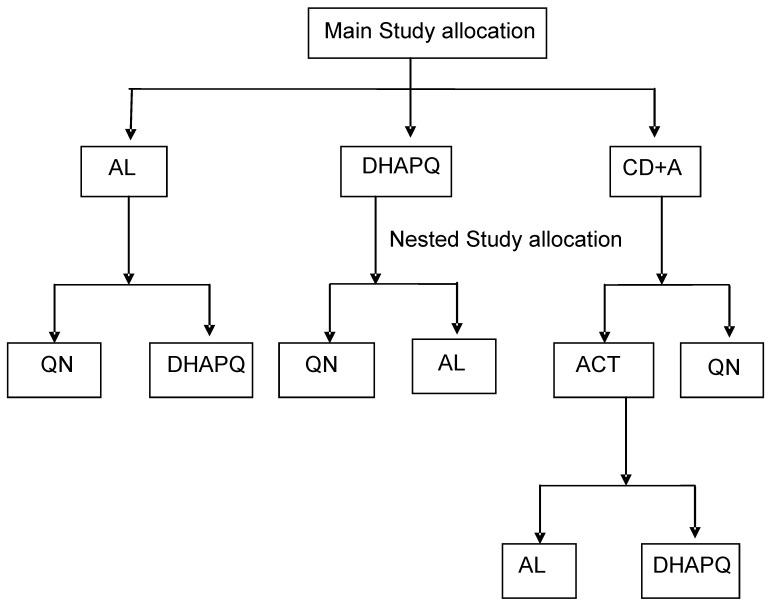
We conducted a nested, randomized, open label, three-arm clinical trial of rescue therapy in children 6-59 months old with recurrent malaria infection during 28 days post treatment with artemisinin combination treatment (ACT). Patients were randomly assigned to receive either quinine, artemether-lumefantrine (AL) or dihydroartemisinin-piperaquine (DHAPQ), and actively followed up for 28 days.
FINDINGS
Among 220 patients enrolled, 217 (98·6%) were assigned an efficacy outcome and 218 (99·1%) were assessed for safety. The risk of recurrent infection was significantly higher in patients treated with quinine (70%, 74/110, HR = 3·9; 95% CI: 2·4-6·7, p<0·0001) and AL (60%, 21/35, HR = 3·3; 95% CI: 1·8-6·3, p<0·0002), compared to DHAPQ (25%, 18/72). Recrudescence tended to be lower in the DHAPQ (1%, 1/72) than in the quinine (7%, 8/110) or AL (6%, 2/35) group, though it was not statistically significant. No serious adverse events were reported.
CONCLUSION
Recurrent infections observed after the administration of an ACT can be successfully treated with an alternative ACT rather than with quinine.
TRIAL REGISTRATION
Current Controlled Trials ISRCTN99046537.
背景
在疟疾传播强度高的地区,治疗恶性疟原虫疟疾具有独特的挑战,因为复发性感染很常见。这些可能是新的感染、复发或两者的组合。尽管一些非洲国家继续将奎宁作为复发性感染患者的二线治疗药物,但关于其在挽救性治疗中的疗效的信息很少。此外,这种做法违反了世界卫生组织(WHO)关于使用联合疗法治疗无并发症疟疾的建议。
方法
我们在儿童中进行了一项嵌套、随机、开放标签、三臂临床试验,在接受青蒿素联合治疗(ACT)治疗后 28 天内,对有复发性疟疾感染的 6-59 个月大的儿童进行挽救性治疗。患者被随机分配接受奎宁、青蒿琥酯-咯萘啶(AL)或双氢青蒿素-哌喹(DHAPQ)治疗,并进行了 28 天的主动随访。
结果
在纳入的 220 名患者中,217 名(98.6%)被分配了疗效结局,218 名(99.1%)接受了安全性评估。接受奎宁治疗的患者复发性感染的风险显著更高(70%,74/110,HR=3.9;95%CI:2.4-6.7,p<0.0001)和 AL(60%,21/35,HR=3.3;95%CI:1.8-6.3,p<0.0002),与 DHAPQ(25%,18/72)相比。DHAPQ(1%,1/72)组的复发率低于奎宁(7%,8/110)或 AL(6%,2/35)组,但无统计学意义。未报告严重不良事件。
结论
在使用 ACT 治疗后观察到的复发性感染可以成功地用替代 ACT 而不是奎宁治疗。
试验注册
当前对照试验 ISRCTN99046537。


 Zotero 插件