
建立和验证原代人子宫平滑肌细胞培养模型以研究妊娠和分娩。
Development and validation of primary human myometrial cell culture models to study pregnancy and labour.
机构信息
Department of Physiology & Pharmacology, University of Calgary, Calgary, Alberta, Canada.
出版信息
BMC Pregnancy Childbirth. 2013;13 Suppl 1(Suppl 1):S7. doi: 10.1186/1471-2393-13-S1-S7. Epub 2013 Jan 31.
BACKGROUND
The development of the in vitro cell culture model has greatly facilitated the ability to study gene expression and regulation within human tissues. Within the human uterus, the upper (fundal) segment and the lower segment may provide distinct functions throughout pregnancy and during labour. We have established primary cultured human myometrial cells, isolated from both upper and lower segment regions of the pregnant human uterus, and validated them for the purpose of studying human pregnancy and labour. The specific objectives of this study were to monitor the viability and characterize the expression profile using selected cellular, contractile and pregnancy associated markers in the primary cultured human myometrial cells. Labour has been described as an inflammatory process; therefore, the ability of these cells to respond to an inflammatory stimulus was also investigated.
METHODS
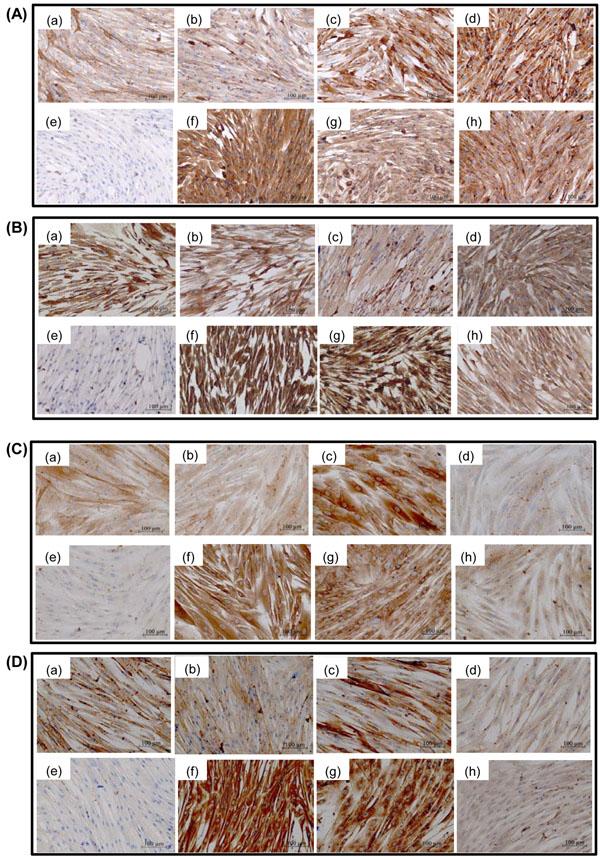
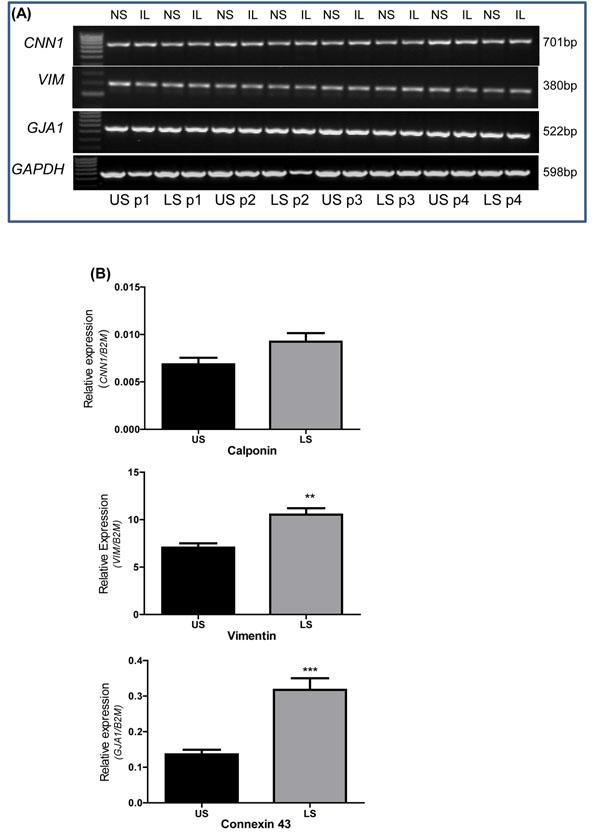
Myometrial cells isolated from paired upper segment (US) and lower segment (LS) biopsies, obtained from women undergoing Caesarean section deliveries at term prior to the onset of labour, were used to identify expression of; α smooth muscle actin, calponin, caldesmon, connexin 43, cyclo-oxygenase-2 (COX-2), oxytocin receptor, tropomyosin and vimentin, by RT-PCR and/or immunocytochemistry. Interleukin (IL)-1β was used to treat cells, subsequently expression of COX-2 mRNA and release of interleukin-8 (CXCL8), were measured. ANOVA followed by Bonferroni's multiple comparisons test was performed.
RESULTS
We demonstrate that US and LS human myometrial cells stably express all markers examined to at least passage ten (p10). Connexin 43, COX-2 and vimentin mRNA expression were significantly higher in LS cells compared to US cells. Both cell populations respond to IL-1β, demonstrated by a robust release of CXCL8 and increased expression of COX-2 mRNA from passage one (p1) through to p10.
CONCLUSIONS
Isolated primary myometrial cells maintain expression of smooth muscle and pregnancy-associated markers and retain their ability to respond to an inflammatory stimulus. These distinct myometrial cell models will provide a useful tool to investigate mechanisms underlying the process of human labour and the concept of functional regionalization of the pregnant uterus.
背景
体外细胞培养模型的发展极大地促进了人们对人类组织内基因表达和调控的研究能力。在人类子宫中,子宫上段(宫底)和下段可能在整个孕期和分娩过程中提供不同的功能。我们已经建立了从妊娠妇女的子宫上段和下段分离的原代培养的人子宫平滑肌细胞,并对其进行了验证,用于研究人类妊娠和分娩。本研究的具体目的是监测细胞活力,并使用选定的细胞、收缩和与妊娠相关的标志物来描述原代培养的人子宫平滑肌细胞的表达谱。分娩已被描述为一种炎症过程;因此,还研究了这些细胞对炎症刺激的反应能力。
方法
从因择期剖宫产分娩而在未发生分娩前接受剖宫产手术的足月妇女的子宫上段(US)和下段(LS)活检中分离的子宫平滑肌细胞,用于鉴定α平滑肌肌动蛋白、钙调蛋白、钙调蛋白、连接蛋白 43、环氧化酶-2 (COX-2)、催产素受体、原肌球蛋白和波形蛋白的表达,通过 RT-PCR 和/或免疫细胞化学。用白细胞介素 (IL)-1β 处理细胞,随后测量 COX-2 mRNA 的表达和白细胞介素-8 (CXCL8) 的释放。采用方差分析(ANOVA),然后进行 Bonferroni 多重比较检验。
结果
我们证明 US 和 LS 人子宫平滑肌细胞至少在第 10 代(p10)稳定表达所有检查的标志物。LS 细胞的连接蛋白 43、COX-2 和波形蛋白 mRNA 表达明显高于 US 细胞。两种细胞群体均对 IL-1β 有反应,表现为 CXCL8 的大量释放以及从第 1 代(p1)到第 10 代(p10)COX-2 mRNA 的表达增加。
结论
分离的原代子宫平滑肌细胞保持平滑肌和与妊娠相关标志物的表达,并保持对炎症刺激的反应能力。这些不同的子宫平滑肌细胞模型将为研究人类分娩过程的机制以及妊娠子宫功能区域化的概念提供有用的工具。



 Zotero 插件