
伊朗克尔曼省西南部一个新出现的皮肤利什曼病疫源地的现状
The present status of cutaneous leishmaniasis in a recently emerged focus in South-west of kerman province, iran.
作者信息
Khosravi Ahmad, Sharifi Iraj, Dortaj Eshagh, Aghaei Afshar Abbas, Mostafavi Mahshid
机构信息
Leishmaniasis Research Center, Kerman University of Medical Sciences, Kerman, Iran.
出版信息
Iran J Public Health. 2013;42(2):182-7. Epub 2013 Feb 1.
BACKGROUND
The objective of this study was to assess the magnitude of the cutaneous leishmaniasis (CL) disease and identification of the causative agent by nested-PCR for current control strategy.
METHODS
This study was carried out as descriptive house-to-house visits in Orzoieh district in Kerman Province, south-east Iran, during 2011-2012. A questionnaire was completed for each individual consisting of demographic and clinical data. Suspected individuals were examined by direct smear microscopy and subsequent identification by nested-PCR. X(2) -test was used for any significance (P<0.05).
RESULTS
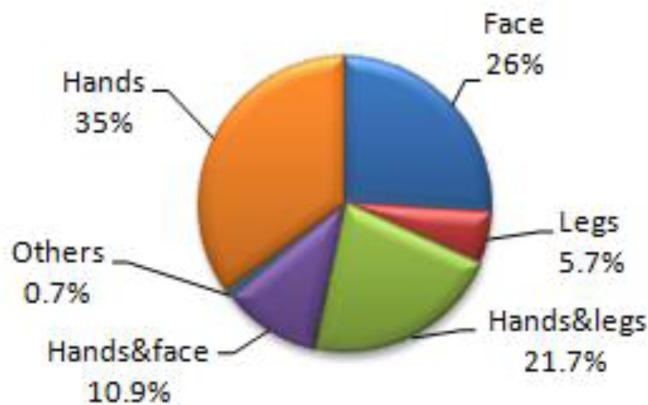
A total of 18308 inhabitants (mean age; 22.7 yr) consisting of 9011 males (49.2%) and 9297 females (50.8%) were examined for the presence of active or chronic lesions. The overall prevalence was 4.7%, including 30 cases of active and 839 cases of scar, distributed more significantly (P<0.01) in females (5.2%) than males (4.3%). Individuals <10 years of age showed the highest (6.3%) and >50 years the lowest rate of CL disease, respectively (P<0.001). The proportion of infection was the highest in Soltanabad (14.7%), followed by Vakilabad (6.8%), Dolatabad (3.2%) and Shahmaran (2.8%). The majority of cases had 2 lesions (mean; 2.1 lesions). Hand was the most common site of involvement (35%), and then face (26%), and multiple locations (39%). Nested-PCR displayed 29 isolates as Leishmania major and one isolate L. tropica. The CL disease first emerged in 1998 as epidemic in the area and appeared endemics, thereafter.
CONCLUSION
L. major was the sole species caused ZCL. These findings are necessary for future control programs and strategic planning.
背景
本研究的目的是评估皮肤利什曼病(CL)的疾病规模,并通过巢式聚合酶链反应(nested-PCR)鉴定病原体,以制定当前的控制策略。
方法
2011年至2012年期间,在伊朗东南部克尔曼省的奥尔佐伊区进行了逐户访问的描述性研究。为每个个体填写了一份包含人口统计学和临床数据的问卷。对疑似个体进行直接涂片显微镜检查,并随后通过巢式PCR进行鉴定。使用卡方检验分析差异是否具有统计学意义(P<0.05)。
结果
共检查了18308名居民(平均年龄22.7岁),其中男性9011名(49.2%),女性9297名(50.8%),以确定是否存在活动性或慢性病变。总体患病率为4.7%,包括30例活动性病例和839例瘢痕病例,女性患病率(5.2%)显著高于男性(4.3%)(P<0.01)。年龄小于10岁的个体CL疾病发病率最高(6.3%),年龄大于50岁的个体发病率最低(P<0.001)。感染率最高的是索尔塔纳巴德(14.7%),其次是瓦基拉巴德(6.8%)、多拉塔巴德(3.2%)和沙赫马兰(2.8%)。大多数病例有2处病变(平均2.1处病变)。手部是最常见的受累部位(35%),其次是面部(26%),以及多个部位受累(39%)。巢式PCR显示29株分离株为硕大利什曼原虫,1株为热带利什曼原虫。CL疾病于1998年在该地区首次以流行病形式出现,此后呈地方病态势。
结论
硕大利什曼原虫是导致ZCL的唯一物种。这些发现对于未来的控制计划和战略规划是必要的。

 Zotero 插件