
洞穴鱼小眼转录组在持续黑暗环境下的进化。
Evolution of the eye transcriptome under constant darkness in Sinocyclocheilus cavefish.
机构信息
Institute of Zoology, Chinese Academy of Sciences, Beijing, China.
出版信息
Mol Biol Evol. 2013 Jul;30(7):1527-43. doi: 10.1093/molbev/mst079. Epub 2013 Apr 23.
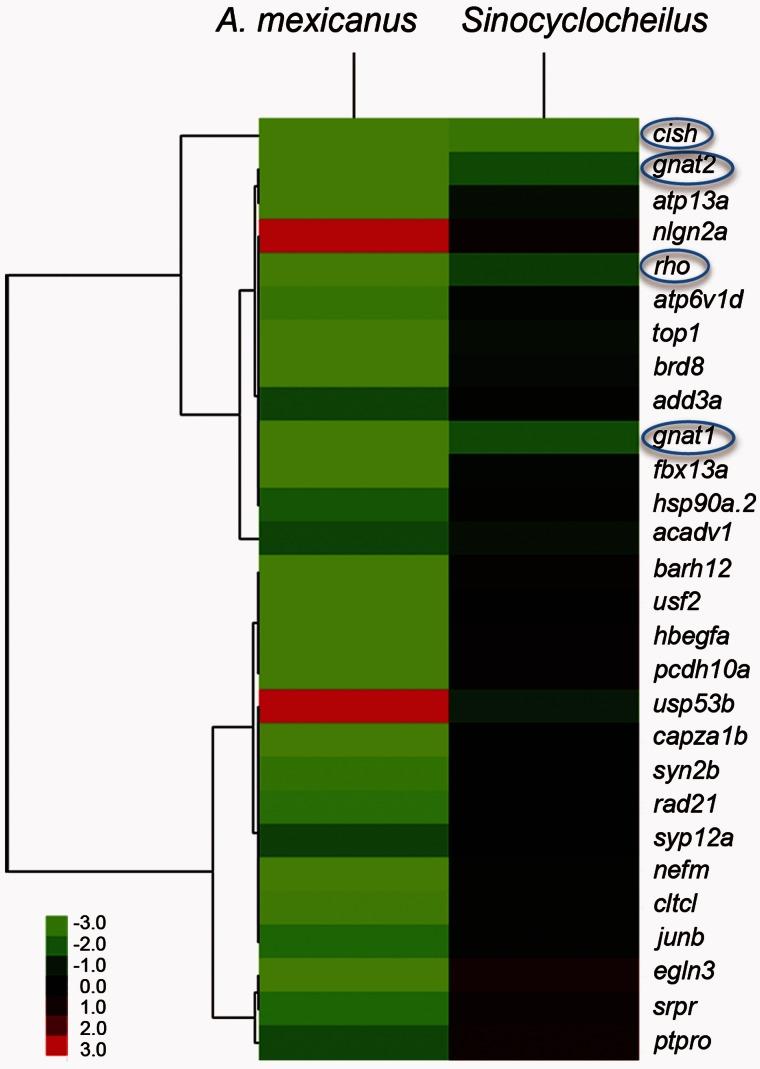
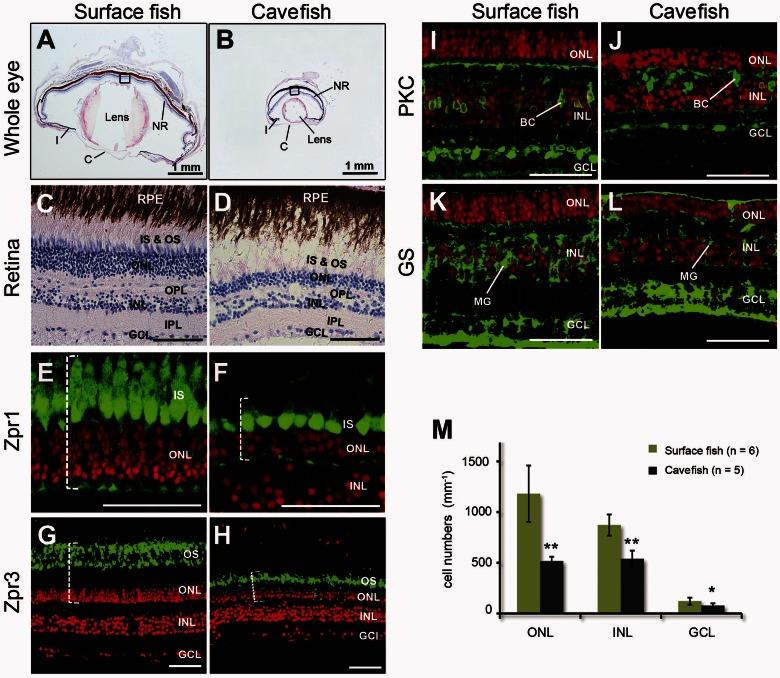
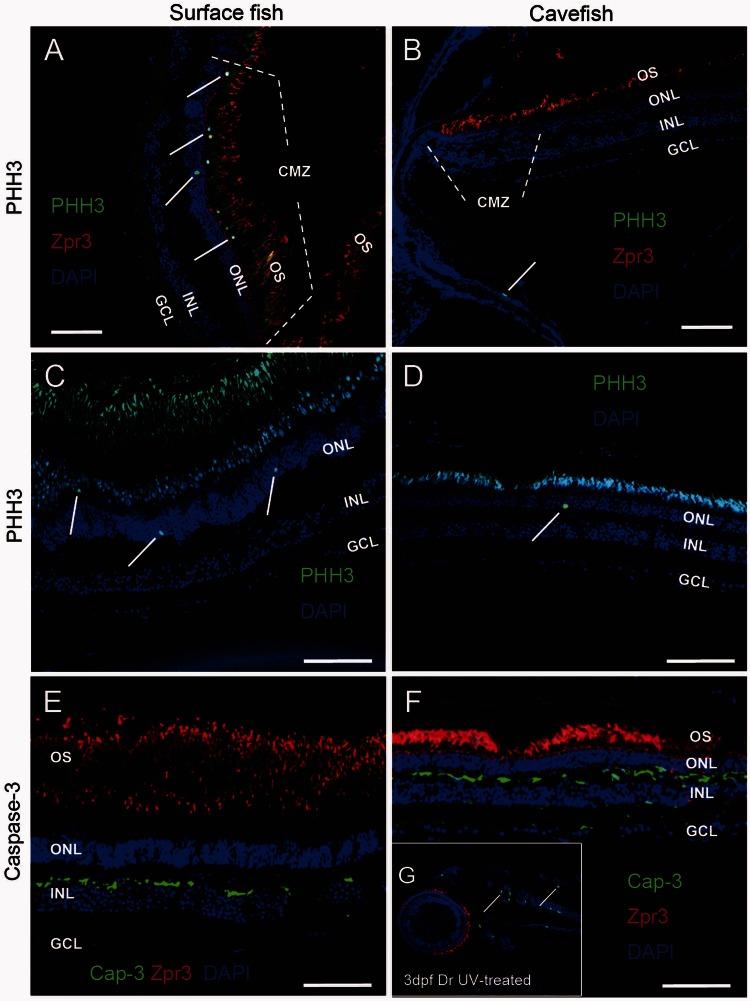
In adaptating to perpetual darkness, cave species gradually lose eyes and body pigmentation and evolve alternatives for exploring their environments. Although troglodyte features evolved independently many times in cavefish, we do not yet know whether independent evolution of these characters involves common genetic mechanisms. Surface-dwelling and many cave-dwelling species make the freshwater teleost genus Sinocyclocheilus an excellent model for studying the evolution of adaptations to life in constant darkness. We compared the mature retinal histology of surface and cave species in Sinocyclocheilus and found that adult cavefish showed a reduction in the number and length of photoreceptor cells. To identify genes and genetic pathways that evolved in constant darkness, we used RNA-seq to compare eyes of surface and cave species. De novo transcriptome assemblies were developed for both species, and contigs were annotated with gene ontology. Results from cave-dwelling Sinocyclocheilus revealed reduced transcription of phototransduction and other genes important for retinal function. In contrast to the blind Mexican tetra cavefish Astyanax mexicanus, our results on morphologies and gene expression suggest that evolved retinal reduction in cave-dwelling Sinocyclocheilus occurs in a lens-independent fashion by the reduced proliferation and downregulation of transcriptional factors shown to have direct roles in retinal development and maintenance, including cone-rod homeobox (crx) and Wnt pathway members. These results show that the independent evolution of retinal degeneration in cavefish can occur by different developmental genetic mechanisms.
在适应永久黑暗的过程中,洞穴物种逐渐失去眼睛和身体色素,并进化出替代方法来探索它们的环境。虽然洞穴鱼中的穴居特征已经独立进化了很多次,但我们还不知道这些特征的独立进化是否涉及共同的遗传机制。在地表和许多洞穴物种中都存在的淡水硬骨鱼属 Sinocyclocheilus 是研究适应持续黑暗生活的进化的绝佳模型。我们比较了 Sinocyclocheilus 中地表和洞穴物种的成熟视网膜组织学,发现成年洞穴鱼的感光细胞数量和长度减少。为了确定在持续黑暗中进化的基因和遗传途径,我们使用 RNA-seq 比较了地表和洞穴物种的眼睛。为这两个物种都开发了从头转录组组装,并使用基因本体论对 contigs 进行了注释。洞穴栖居的 Sinocyclocheilus 的结果显示,光转导和其他对视网膜功能很重要的基因转录减少。与盲眼的墨西哥脂鲤洞穴亚种 Astyanax mexicanus 不同,我们对形态和基因表达的研究结果表明,在洞穴栖居的 Sinocyclocheilus 中,进化导致的视网膜减少是通过减少增殖和下调转录因子来实现的,这些转录因子被证明在视网膜发育和维持中具有直接作用,包括视锥-视杆同源盒 (crx) 和 Wnt 途径成员。这些结果表明,洞穴鱼中视网膜退化的独立进化可以通过不同的发育遗传机制发生。


 Zotero 插件