
转移性肾细胞癌的过继细胞免疫治疗:系统评价和荟萃分析。
Adoptive cellular immunotherapy in metastatic renal cell carcinoma: a systematic review and meta-analysis.
机构信息
Department of Hematopoietic Stem Cell Transplantation, Affiliated Hospital of Academy of Military Medical Sciences, Beijing, China.
出版信息
PLoS One. 2013 May 7;8(5):e62847. doi: 10.1371/journal.pone.0062847. Print 2013.
PURPOSE
Metastatic renal cell carcinoma (mRCC), as one of the most immunogenic tumors has been the focus of adoptive cellular immunotherapy (ACI), but the effects of ACI on objective response and survival in patients with mRCC are still controversial. Therefore, a systematic review and meta-analysis was performed to address this issue.
METHODS
A search was conducted in the PubMed database for randomized clinical trials (RCTs) with ACI in mRCC. All included articles in this study were assessed according to the selection criteria and were divided into two groups: ACI versus no ACI. Outcomes were toxicity, objective response, 1-, 3- and 5-year survival. Risk ratio (RR) and 95% confidence intervals (CI) were calculated using a fixed-effects meta-analysis. Heterogeneity was measured by value of I(2) or P.
RESULTS
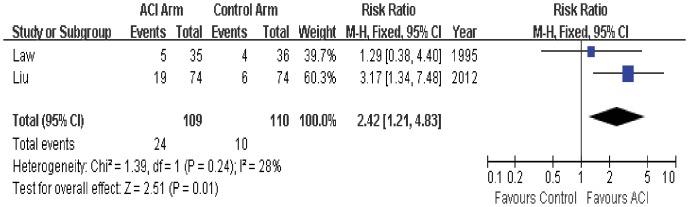
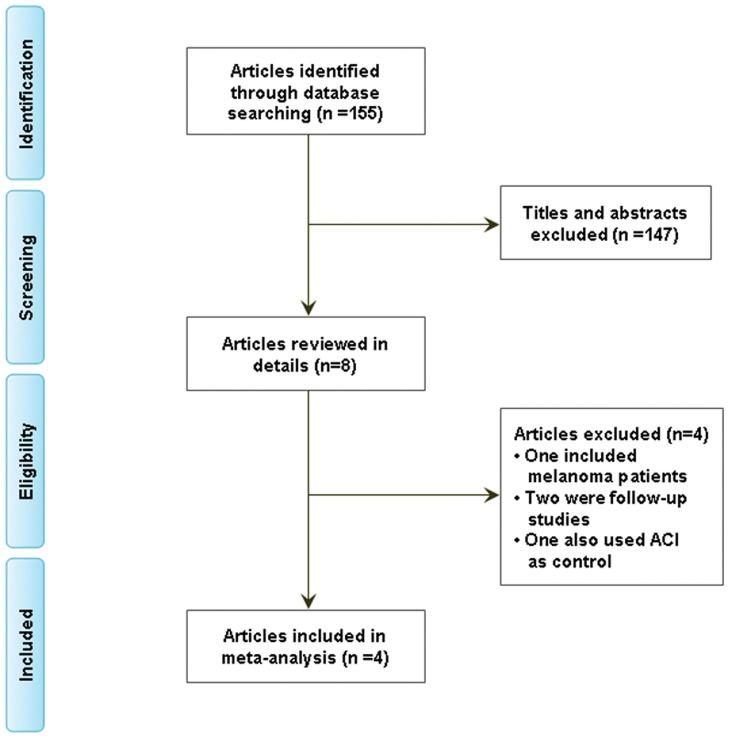
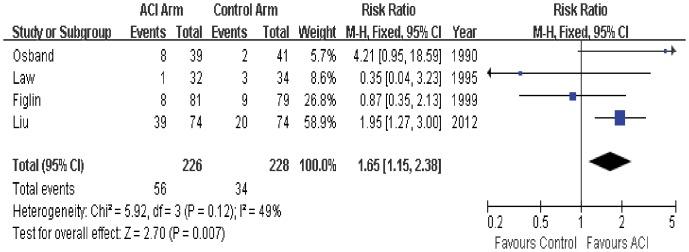
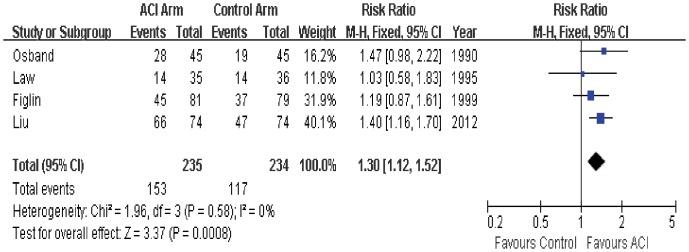
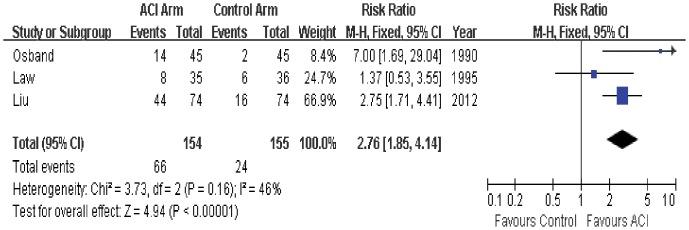
4 studies (469 patients) were included. Most of ACI-related adverse reactions were grade 1 or 2 and reversible. ACI provided significant benefit in terms of objective response (RR = 1.65; 95% CI, 1.15 to 2.38; P = 0.007, I(2) = 49%), 1-year survival (RR = 1.30; 95% CI, 1.12 to 1.52; P = 0.0008, I(2) = 0%), 3-year survival (RR = 2.76; 95% CI, 1.85 to 4.14; P<0.00001, I(2) = 46%) and 5-year survival (RR = 2.42; 95% CI, 1.21 to 4.83; P = 0.01, I(2) = 28%).
CONCLUSIONS
ACI may be a safe and effective treatment for improving objective response, 1-, 3- and 5-year survival in patients with mRCC. Besides, five obstacles for ACI, including high degree of personalization, unsuitable WHO/RECIST response criteria, inadequate identification of tumor-associated antigens (TAAs), lack of effective combination treatments and less attention paid to the quality of ACI products, should be overcome during the successful development of more potent ACI for cancer in the future.
目的
转移性肾细胞癌(mRCC)是最具免疫原性的肿瘤之一,一直是过继性细胞免疫治疗(ACI)的重点,但 ACI 对 mRCC 患者的客观反应和生存的影响仍存在争议。因此,进行了系统评价和荟萃分析以解决这个问题。
方法
在 PubMed 数据库中对 mRCC 中采用 ACI 的随机临床试验(RCT)进行了搜索。根据选择标准对本研究中包含的所有文章进行了评估,并分为两组:ACI 与无 ACI。结果为毒性、客观反应、1、3 和 5 年生存率。使用固定效应荟萃分析计算风险比(RR)和 95%置信区间(CI)。使用 I(2)值或 P 值测量异质性。
结果
纳入了 4 项研究(469 例患者)。大多数与 ACI 相关的不良反应为 1 级或 2 级,且是可逆的。ACI 在客观反应(RR=1.65;95%CI,1.15 至 2.38;P=0.007,I(2)=49%)、1 年生存率(RR=1.30;95%CI,1.12 至 1.52;P=0.0008,I(2)=0%)、3 年生存率(RR=2.76;95%CI,1.85 至 4.14;P<0.00001,I(2)=46%)和 5 年生存率(RR=2.42;95%CI,1.21 至 4.83;P=0.01,I(2)=28%)方面提供了显著益处。
结论
ACI 可能是一种安全有效的治疗方法,可提高 mRCC 患者的客观反应、1、3 和 5 年生存率。此外,在未来成功开发更有效的癌症 ACI 时,应克服 ACI 的五个障碍,包括高度个性化、不适合 WHO/RECIST 反应标准、肿瘤相关抗原(TAA)鉴定不足、缺乏有效的联合治疗以及对 ACI 产品质量的关注较少。
 Zotero 插件