
微小隐孢子虫:实验性感染犊牛的 ID₅₀ 和剂量反应关系的测定。
Cryptosporidium parvum: determination of ID₅₀ and the dose-response relationship in experimentally challenged dairy calves.
机构信息
Department of Animal Science, College of Animal Science, Cornell University, Ithaca, NY 14853, USA.
出版信息
Vet Parasitol. 2013 Oct 18;197(1-2):104-12. doi: 10.1016/j.vetpar.2013.04.022. Epub 2013 Apr 20.
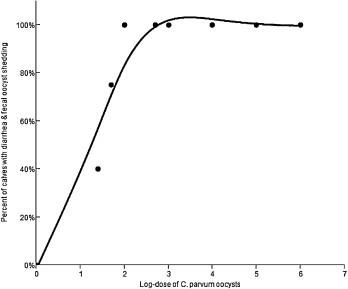
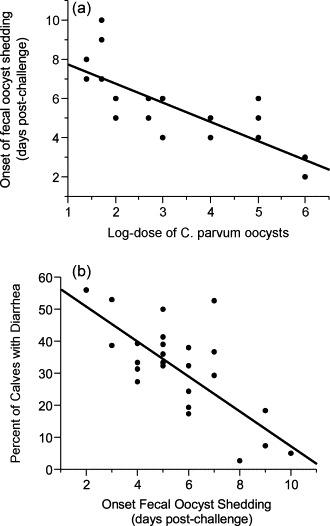
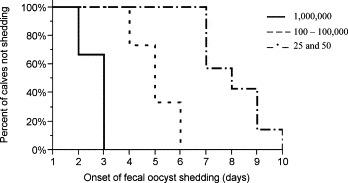
The objectives were to determine the median infective dose (ID₅₀) of Cryptosporidium parvum and to describe the dose-response relationship including associated clinical illness in experimentally challenged dairy calves. Within the first 24h of life, 27 test calves were experimentally challenged with C. parvum oocysts and 3 control calves were sham dosed. Test calves received 1 of 8 possible doses (25, 50, 100, 500, 1 × 10(3), 1 × 10(4), 1 × 10(5), and 1 × 10(6) oocysts). All 27 test calves developed diarrhea. Fecal oocyst shedding occurred in 25 (92.6%) test calves and in 0 control calves. The 2 non-shedding test calves both received 25 oocysts. There was an inverse relationship between dose and time to onset of fecal oocyst shedding (P=0.005). There was no relationship found between dose and duration (P=0.2) or cessation (P=0.3) of fecal oocyst shedding. In addition, there was not a significant relationship between log-dose and the log-peak oocysts (P=0.2) or log-total oocysts (P=0.5) counted/g of feces across the dose groups. There was a positive dose-response relationship between log-dose and diarrhea (P=0.01). However, when controlling for other factors, such as onset and cessation of fecal oocyst shedding, dose was not a significant predictor of diarrhea (P=0.5). Onset and cessation of fecal oocyst shedding were found to be the best predictors of diarrhea (P=0.0006 and P=0.04, respectively). The ID₅₀ for fecal oocyst shedding was 5.8 oocysts, for diarrhea was 9.7 oocysts, and for fecal oocyst shedding with diarrhea was 16.6 oocysts. Given that the ID₅₀ of C. parvum is far less than would be excreted into the environment by a naturally infected calf, prevention and control of cryptosporidiosis is a formidable challenge.
目的是确定微小隐孢子虫(Cryptosporidium parvum)的半数感染剂量(ID₅₀),并描述剂量反应关系,包括实验性挑战的奶牛犊牛的相关临床疾病。在生命的头 24 小时内,27 头试验犊牛用微小隐孢子虫卵囊进行了实验性挑战,3 头对照犊牛进行了假处理。试验犊牛接受了 8 种可能剂量(25、50、100、500、1×10(3)、1×10(4)、1×10(5)和 1×10(6)卵囊)中的 1 种。所有 27 头试验犊牛均出现腹泻。27 头试验犊牛中有 25 头(92.6%)出现粪便卵囊脱落,而对照犊牛中无卵囊脱落。2 头未脱落的试验犊牛均接受了 25 个卵囊。粪便卵囊脱落的时间与剂量呈反比关系(P=0.005)。但剂量与粪便卵囊脱落的持续时间(P=0.2)或停止时间(P=0.3)之间没有关系。此外,粪便卵囊计数/克粪便的对数剂量与对数峰值卵囊(P=0.2)或对数总卵囊(P=0.5)之间也没有显著关系。在对数剂量和腹泻之间存在正的剂量反应关系(P=0.01)。然而,当控制粪便卵囊脱落的开始和停止等其他因素时,剂量不是腹泻的显著预测因素(P=0.5)。粪便卵囊脱落的开始和停止是腹泻的最佳预测因素(P=0.0006 和 P=0.04)。粪便卵囊脱落的 ID₅₀ 为 5.8 个卵囊,腹泻的 ID₅₀ 为 9.7 个卵囊,粪便卵囊脱落伴腹泻的 ID₅₀ 为 16.6 个卵囊。鉴于微小隐孢子虫的 ID₅₀ 远低于自然感染的犊牛排泄到环境中的数量,因此,隐孢子虫病的预防和控制是一个巨大的挑战。
 Zotero 插件