
CNF1 可提高大脑能量水平,对抗神经炎症标志物,并可挽救阿尔茨海默病小鼠模型的认知缺陷。
CNF1 increases brain energy level, counteracts neuroinflammatory markers and rescues cognitive deficits in a murine model of Alzheimer's disease.
机构信息
Department of Therapeutic Research and Medicines Evaluation, Istituto Superiore di Sanità, Rome, Italy.
出版信息
PLoS One. 2013 May 30;8(5):e65898. doi: 10.1371/journal.pone.0065898. Print 2013.
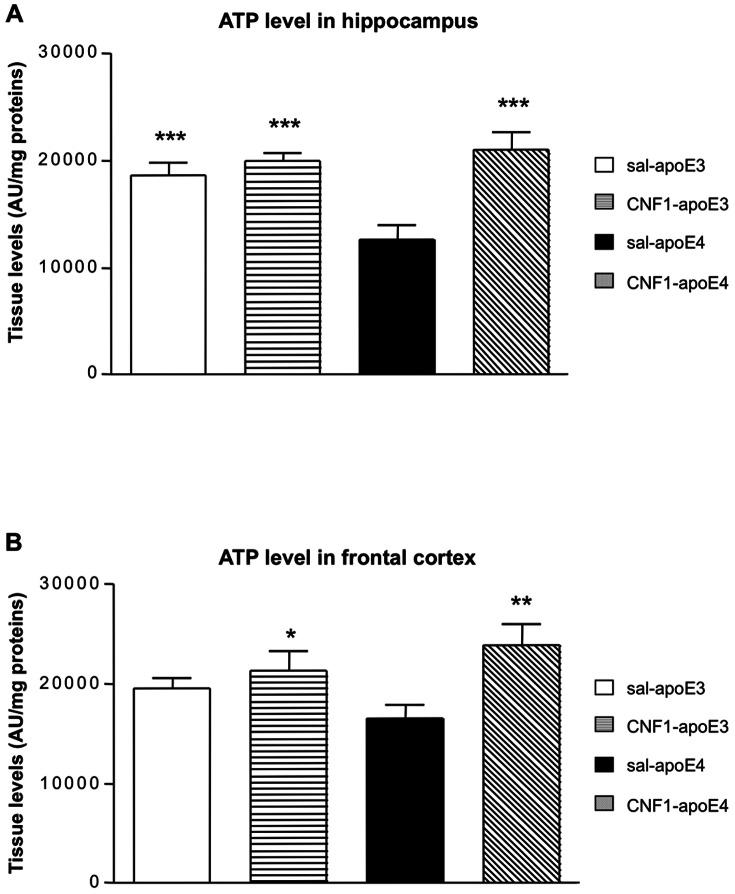
Overexpression of pro-inflammatory cytokines and cellular energy failure are associated with neuroinflammatory disorders, such as Alzheimer's disease. Transgenic mice homozygous for human ApoE4 gene, a well known AD and atherosclerosis animal model, show decreased levels of ATP, increased inflammatory cytokines level and accumulation of beta amyloid in the brain. All these findings are considered responsible for triggering cognitive decline. We have demonstrated that a single administration of the bacterial E. coli protein toxin CNF1 to aged apoE4 mice, beside inducing a strong amelioration of both spatial and emotional memory deficits, favored the cell energy restore through an increment of ATP content. This was accompanied by a modulation of cerebral Rho and Rac1 activity. Furthermore, CNF1 decreased the levels of beta amyloid accumulation and interleukin-1β expression in the hippocampus. Altogether, these data suggest that the pharmacological modulation of Rho GTPases by CNF1 can improve memory performances in an animal model of Alzheimer's disease via a control of neuroinflammation and a rescue of systemic energy homeostasis.
促炎细胞因子和细胞能量衰竭的过度表达与神经炎症性疾病有关,如阿尔茨海默病。载脂蛋白 E4 基因纯合的转基因小鼠是一种众所周知的 AD 和动脉粥样硬化动物模型,其大脑中的 ATP 水平降低,促炎细胞因子水平升高,β淀粉样蛋白积累增加。所有这些发现都被认为是导致认知能力下降的原因。我们已经证明,向载脂蛋白 E4 小鼠单次给予细菌大肠杆菌蛋白毒素 CNF1,除了强烈改善空间和情绪记忆缺陷外,还通过增加 ATP 含量促进细胞能量恢复。这伴随着大脑 Rho 和 Rac1 活性的调节。此外,CNF1 降低了海马体中β淀粉样蛋白积累和白细胞介素-1β表达的水平。总的来说,这些数据表明,CNF1 通过 Rho GTPases 的药理学调节可以通过控制神经炎症和挽救全身能量平衡来改善阿尔茨海默病动物模型的记忆表现。



 Zotero 插件