
人嘌呤/嘧啶内切核酸酶 siRNA 抑制 X 射线照射诱导的肺癌细胞血管生成。
Human apurinic/apyrimidinic endonuclease siRNA inhibits the angiogenesis induced by X-ray irradiation in lung cancer cells.
机构信息
Cancer Center, Daping Hospital and Research Institute of Surgery, Third Military Medical University, Chongqing 400042, China.
出版信息
Int J Med Sci. 2013 May 20;10(7):870-82. doi: 10.7150/ijms.5727. Print 2013.
OBJECTIVE
Radiotherapy is an important and effective treatment method for non-small cell lung cancer (NSCLC). Nonetheless, radiotherapy can alter the expression of proangiogenic molecules and induce angiogenesis. Human apurinic/apyrimidinic endonuclease (APE1) is a multifunctional protein, which has DNA repair and redox function. Our previous studies indicated APE1 is also a crucial angiogenic regulator. Thus, we investigated the effect of APE1 on radiation-induced angiogenesis in lung cancer and its underlying mechanism.
METHODS
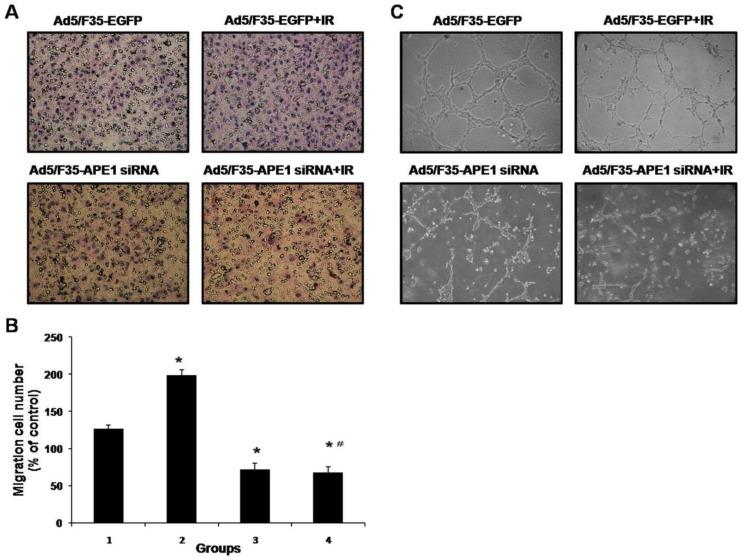
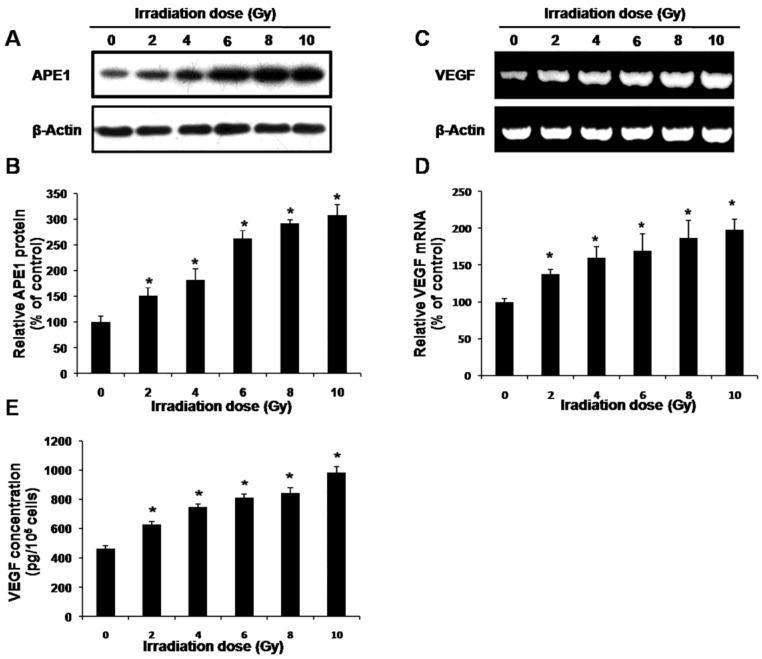
Tumor specimens of 136 patients with NSCLC were obtained from 2003 to 2008. The APE1 and vascular endothelial growth factor (VEGF) expression, as well as microvessel density (MVD) were observed with immunohistochemistry in tumor samples. Human lung adenocarcinoma A549 cells were treated with Ad5/F35-APE1 siRNA and/or irradiation, and then the cells were used for APE1 analysis by Western blot and VEGF analysis by RT-PCR and ELISA. To elucidate the underline mechanism of APE1 on VEGF expression, HIF-1α protein level was determined by Western blot, and the DNA binding activity of HIF-1α was detected by EMSA. Transwell migration assay and capillary-like structure assay were used to observe the migration and capillary-like structure formation ability of human umbilical veins endothelial cells (HUVECs) that were co-cultured with Ad5/F35-APE1 siRNA and (or) irradiation treated A549 cells culture medium.
RESULTS
The high expression rates of APE1 and VEGF in NSCLC were 77.94% and 66.18%, respectively. The expressions of APE1 was significantly correlated with VEGF and MVD (r=0.369, r=0.387). APE1 and VEGF high expression were significantly associated with reduced disease free survival (DFS) time. The high expressions of APE1 and VEGF on A549 cells were concurrently induced by X-ray irradiation in a dose-dependent manner. Silencing of APE1 by Ad5/F35-APE1 siRNA significantly decreased DNA binding activity of HIF-1α and suppressed the expression of VEGF in A549 cells, moreover, significantly inhibited the endothelial cells immigration and capillary-like structure formation induced by irradiated A549 cells.
CONCLUSION
Our results indicate that APE1 may play a crucial role in angiogenesis induced by irradiation. Administration of Ad5/F35-APE1 siRNA during radiotherapy could be a potent adjuvant therapeutic approach to enhance the radiotherapy response, effectively eliminate metastasis and improve the efficacy of radiotherapy for NSCLC.
目的
放射治疗是非小细胞肺癌(NSCLC)的一种重要且有效的治疗方法。然而,放射治疗会改变促血管生成分子的表达并诱导血管生成。人脱嘌呤/脱嘧啶核酸内切酶(APE1)是一种多功能蛋白,具有 DNA 修复和氧化还原功能。我们之前的研究表明,APE1 也是一种重要的血管生成调节因子。因此,我们研究了 APE1 对肺癌放射诱导血管生成的影响及其潜在机制。
方法
从 2003 年至 2008 年,收集了 136 例 NSCLC 患者的肿瘤标本。采用免疫组织化学方法观察肿瘤标本中 APE1 和血管内皮生长因子(VEGF)的表达以及微血管密度(MVD)。用 Ad5/F35-APE1 siRNA 和/或辐照处理人肺腺癌细胞 A549,用 Western blot 分析 APE1,用 RT-PCR 和 ELISA 分析 VEGF。为了阐明 APE1 对 VEGF 表达的潜在机制,通过 Western blot 测定 HIF-1α 蛋白水平,通过 EMSA 检测 HIF-1α 的 DNA 结合活性。用 Transwell 迁移实验和毛细血管样结构实验观察共培养 Ad5/F35-APE1 siRNA 和(或)辐照处理的 A549 细胞培养上清液的人脐静脉内皮细胞(HUVEC)的迁移和毛细血管样结构形成能力。
结果
在 NSCLC 中,APE1 和 VEGF 的高表达率分别为 77.94%和 66.18%。APE1 的表达与 VEGF 和 MVD 显著相关(r=0.369,r=0.387)。APE1 和 VEGF 的高表达与无病生存时间(DFS)的缩短显著相关。X 射线照射以剂量依赖性方式同时诱导 A549 细胞中 APE1 和 VEGF 的高表达。用 Ad5/F35-APE1 siRNA 沉默 APE1 可显著降低 HIF-1α 的 DNA 结合活性,抑制 A549 细胞中 VEGF 的表达,并显著抑制辐照 A549 细胞诱导的内皮细胞迁移和毛细血管样结构形成。
结论
我们的结果表明,APE1 可能在放射诱导的血管生成中起关键作用。在放射治疗期间给予 Ad5/F35-APE1 siRNA 可能是一种有效的辅助治疗方法,可增强放射治疗反应,有效消除转移并提高 NSCLC 的放射治疗效果。




 Zotero 插件