
中国上海一家中心教学医院的金黄色葡萄球菌感染现状。
Current status of Staphylococcus aureus infection in a central teaching hospital in Shanghai, China.
机构信息
Department of Laboratory Medicine, Huashan Hospital, Shanghai Medical College, Fudan University, 12 Central Urumqi Road, Shanghai, China.
出版信息
BMC Microbiol. 2013 Jul 8;13:153. doi: 10.1186/1471-2180-13-153.
BACKGROUND
To control the spread of methicillin-resistant Staphylococcus aureus (MRSA) in hospitals, infection control measures such as hand hygiene practices were introduced into the teaching hospitals in Shanghai, China, in 2008. Currently, there is limited information characterizing the latest hospital-acquired S. aureus infections in this area. Therefore, we sought to determine the prevalence, molecular characteristics, and genotype-phenotype correlation of hospital-acquired S. aureus infections in Huashan Hospital, one of the largest teaching hospitals in Shanghai.
RESULTS
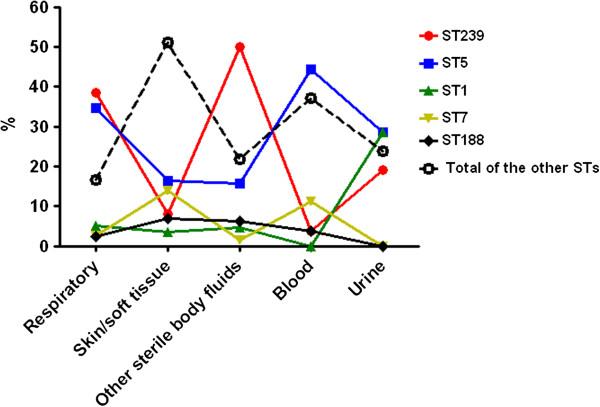
Among 608 hospital-acquired S. aureus clinical isolates obtained from January to December of 2011 in Huashan Hospital, 68.1% were MRSA. The predominant MRSA clones were ST239-SCCmecIII and ST5-SCCmecII. ST239 was mainly recovered from respiratory specimens and sterile body fluids, ST5 was associated with respiratory specimens and blood, and ST1 was most prevalent in urine samples. In this study, 31 dispersed sequence types (STs) of methicillin-susceptible S. aureus (MSSA) were identified, most of which caused skin/soft tissue infection and bacteremia. The frequencies of pvl-, muPA-, and qacA/B-positive isolates were 1.6, 9.9, and 11.8% respectively. MuPA was more frequently identified in ST1 and ST5, and qacA/B was more prevalent in ST239 and ST5. Most of the pvl-positive isolates were MSSA, whereas the majority of muPA- and qacA/B-positive isolates were MRSA. ST239 and ST5 had higher resistance rates to multiple antibiotics. In Huashan Hospital, the infection rate in the intensive care unit (ICU) was 3.9 per 1000 hospitalized days, but only 1.2 per 1000 hospitalized days in the other wards. Each ward harbored its own dominant STs. Pulsed-field gel electrophoresis showed diversity within the same epidemic S. aureus clones originating from the same wards.
CONCLUSION
There is still a high prevalence of MRSA infections in the teaching hospital in Shanghai. There were also differences in the major infection types caused by MRSA and MSSA, and hospital-acquired S. aureus infections in the ICU of Huashan Hospital pose a greater threat to patient safety than in other wards. The high proportion of multiple antibiotic and chlorhexidine-based antiseptic-resistant clones in this hospital underscores the need for more effective infection control measures to help curtail dissemination of MRSA to hospitalized patients.
背景
为了控制耐甲氧西林金黄色葡萄球菌(MRSA)在医院的传播,中国上海的教学医院于 2008 年引入了感染控制措施,如手部卫生实践。目前,该地区关于最新医院获得性金黄色葡萄球菌感染的信息有限。因此,我们试图确定华山医院(上海最大的教学医院之一)医院获得性金黄色葡萄球菌感染的流行率、分子特征和基因型-表型相关性。
结果
在华山医院 2011 年 1 月至 12 月期间获得的 608 株医院获得性金黄色葡萄球菌临床分离株中,68.1%为 MRSA。主要的 MRSA 克隆为 ST239-SCCmecIII 和 ST5-SCCmecII。ST239 主要从呼吸道标本和无菌体液中回收,ST5 与呼吸道标本和血液相关,ST1 则主要存在于尿液样本中。在本研究中,鉴定出 31 种耐甲氧西林金黄色葡萄球菌(MSSA)的离散序列类型(ST),其中大多数引起皮肤/软组织感染和菌血症。pvl-、muPA-和 qacA/B 阳性分离株的频率分别为 1.6%、9.9%和 11.8%。muPA 更常出现在 ST1 和 ST5 中,qacA/B 则更常见于 ST239 和 ST5。大多数 pvl 阳性分离株为 MSSA,而 muPA-和 qacA/B 阳性分离株则大多数为 MRSA。ST239 和 ST5 对多种抗生素的耐药率更高。在华山医院,重症监护病房(ICU)的感染率为每 1000 个住院日 3.9 例,但其他病房每 1000 个住院日仅 1.2 例。每个病房都有自己的优势 ST。脉冲场凝胶电泳显示,来自同一病房的同一流行金黄色葡萄球菌克隆存在多样性。
结论
上海教学医院的 MRSA 感染仍然高发。MRSA 和 MSSA 引起的主要感染类型也存在差异,华山医院 ICU 的医院获得性金黄色葡萄球菌感染对患者安全构成的威胁大于其他病房。该医院中多种抗生素和洗必泰类消毒剂耐药克隆的高比例表明,需要采取更有效的感染控制措施,以帮助遏制 MRSA 传播给住院患者。


 Zotero 插件