
保守的中介体亚基MDT-15是秀丽隐杆线虫氧化应激反应所必需的。
The conserved Mediator subunit MDT-15 is required for oxidative stress responses in Caenorhabditis elegans.
作者信息
Goh Grace Y S, Martelli Katherine L, Parhar Kulveer S, Kwong Ada W L, Wong Marcus A, Mah Allan, Hou Nicole S, Taubert Stefan
机构信息
Graduate Program in Cell and Developmental Biology, University of British Columbia, Vancouver, BC, Canada; Centre for Molecular Medicine and Therapeutics, Child & Family Research Institute, Vancouver, BC, Canada.
出版信息
Aging Cell. 2014 Feb;13(1):70-9. doi: 10.1111/acel.12154. Epub 2013 Sep 18.
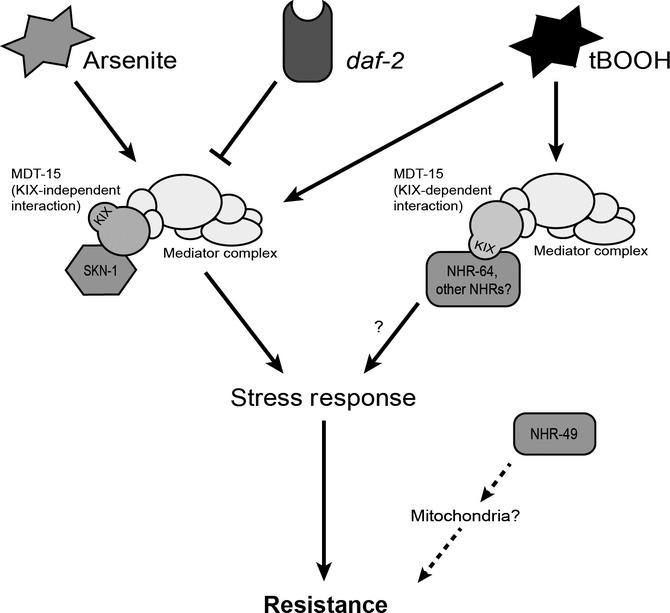
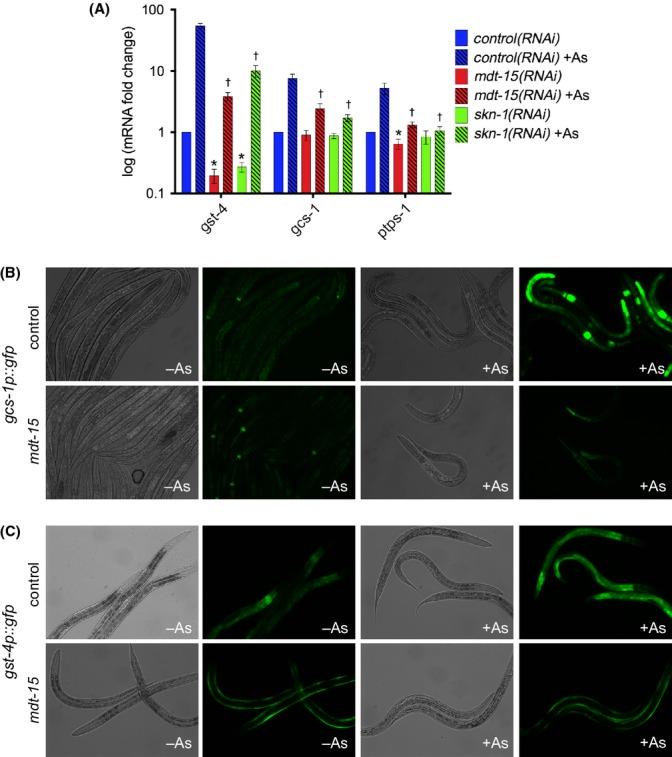
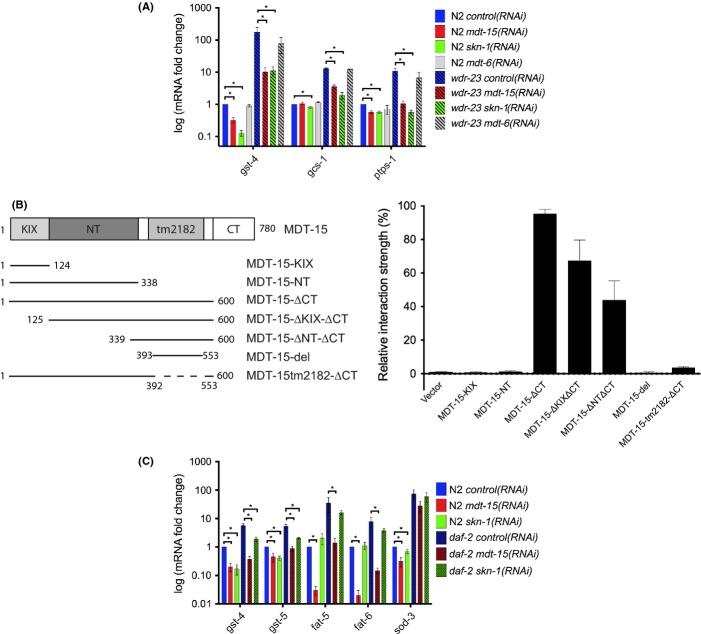
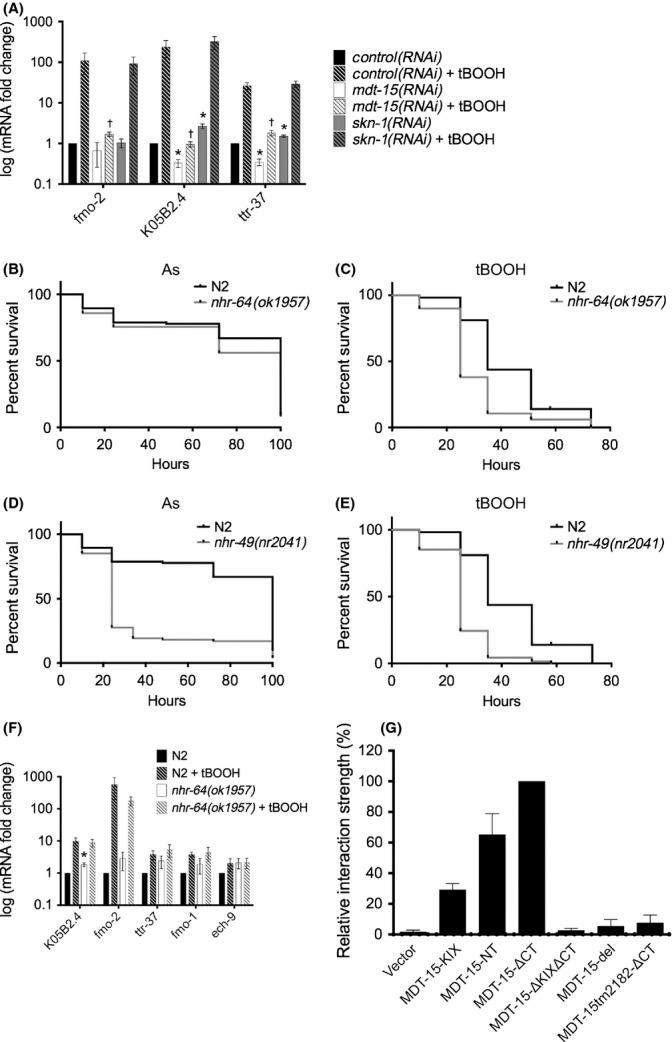
Reactive oxygen species (ROS) play important signaling roles in metazoans, but also cause significant molecular damage. Animals tightly control ROS levels using sophisticated defense mechanisms, yet the transcriptional pathways that induce ROS defense remain incompletely understood. In the nematode Caenorhabditis elegans, the transcription factor SKN-1 is considered a master regulator for detoxification and oxidative stress responses. Here, we show that MDT-15, a subunit of the conserved Mediator complex, is also required for oxidative stress responses in nematodes. Specifically, mdt-15 is required to express SKN-1 targets upon chemical and genetic increase in SKN-1 activity. mdt-15 is also required to express genes in SKN-1-dependent and SKN-1-independent fashions downstream of insulin/IGF-1 signaling and for the longevity of daf-2/insulin receptor mutants. At the molecular level, MDT-15 binds SKN-1 through a region distinct from the classical transcription-factor-binding KIX-domain. Moreover, mdt-15 is essential for the transcriptional response to and survival on the organic peroxide tert-butyl-hydroperoxide (tBOOH), a largely SKN-1-independent response. The MDT-15 interacting nuclear hormone receptor, NHR-64, is specifically required for tBOOH but not arsenite resistance, but NHR-64 is dispensable for the transcriptional response to tBOOH. Hence, NHR-64 and MDT-15's mode of action remain elusive. Lastly, the role of MDT-15 in oxidative stress defense is functionally separable from its function in fatty acid metabolism, as exogenous polyunsaturated fatty acid complementation rescues developmental, but not stress sensitivity phenotypes of mdt-15 worms. Our findings reveal novel conserved players in the oxidative stress response and suggest a broad cytoprotective role for MDT-15.
活性氧(ROS)在多细胞动物中发挥着重要的信号传导作用,但也会造成显著的分子损伤。动物利用复杂的防御机制严格控制ROS水平,然而诱导ROS防御的转录途径仍未完全明确。在线虫秀丽隐杆线虫中,转录因子SKN-1被认为是解毒和氧化应激反应的主要调节因子。在此,我们表明,保守的中介体复合物的一个亚基MDT-15对线虫的氧化应激反应也是必需的。具体而言,当通过化学和基因手段提高SKN-1活性时,需要mdt-15来表达SKN-1的靶标。在胰岛素/IGF-1信号下游,还需要mdt-15以SKN-1依赖和非依赖的方式表达基因,以及维持daf-2/胰岛素受体突变体的寿命。在分子水平上,MDT-15通过一个不同于经典转录因子结合KIX结构域的区域与SKN-1结合。此外,mdt-15对于对有机过氧化物叔丁基过氧化氢(tBOOH)的转录反应和在其作用下的存活至关重要,这是一个很大程度上不依赖于SKN-1的反应。与MDT-15相互作用的核激素受体NHR-64,对tBOOH抗性是特异性必需的,但对亚砷酸盐抗性则不是必需的,不过NHR-64对于对tBOOH的转录反应是可有可无的。因此,NHR-64和MDT-15的作用方式仍然难以捉摸。最后,MDT-15在氧化应激防御中的作用在功能上与其在脂肪酸代谢中的作用是可分离的,因为外源性多不饱和脂肪酸补充可挽救mdt-15蠕虫的发育缺陷,但不能挽救其应激敏感性表型。我们的研究结果揭示了氧化应激反应中新的保守参与者,并表明MDT-15具有广泛的细胞保护作用。


 Zotero 插件