
量表的心理计量学评估——目标导向型蔬菜养育实践模型(MGDVPP)
Psychometric assessment of scales for a Model of Goal Directed Vegetable Parenting Practices (MGDVPP).
机构信息
USDA/ARS Children's Nutrition Research Center, Baylor College of Medicine, Department of Pediatrics, 1100 Bates Street, Houston 77030-2600 TX, USA.
出版信息
Int J Behav Nutr Phys Act. 2013 Sep 22;10:110. doi: 10.1186/1479-5868-10-110.
BACKGROUND
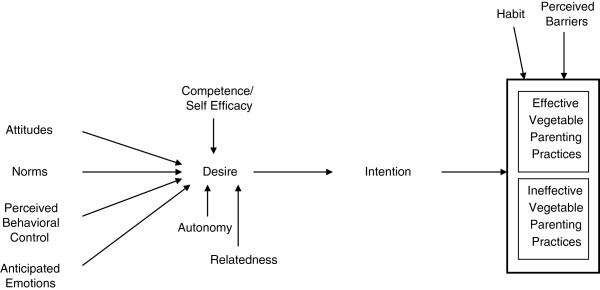
Vegetable intake has been related to lower risk of chronic illnesses in the adult years. The habit of vegetable intake should be established early in life, but many parents of preschoolers report not being able to get their child to eat vegetables. The Model of Goal Directed Behavior (MGDB) has been employed to understand vegetable parenting practices (VPP) to encourage a preschool child's vegetable intake. The Model of Goal Directed Vegetable Parenting Practices (MGDVPP) provides possible determinants and may help explain why parents use effective or ineffective VPP. Scales to measure effective and ineffective vegetable parenting practices have previously been validated. This manuscript presents the psychometric characteristics and factor structures of new scales to measure the constructs in MGDVPP.
METHODS
Participants were 307 parents of preschool (i.e. 3 to 5 year old) children, used for both exploratory (EFA) and confirmatory factor analyses (CFA). Data were collected via an internet survey. First, EFA were conducted using the scree plot criterion for factor extraction. Next, CFA assessed the fit of the exploratory derived factors. Then, classical test theory procedures were employed with all scales. Finally, Pearson correlations were calculated between each scale and composite effective and ineffective VPP as a test of scale predictive validity.
RESULTS
Twenty-nine subscales (164 items) within 11 scales were extracted. The number of items per subscale ranged from 2 to 13, with three subscales having 10 or more items and 12 subscales having 4 items or less. Cronbach's alphas varied from 0.13 to 0.92, with 17 being 0.70 or higher. Most alphas <0.70 had only three or four items. Twenty-five of the 29 subscales significantly bivariately correlated with the composite effective or ineffective VPP scales.
DISCUSSION
This was the initial examination of the factor structure and psychometric assessment of MGDVPP scales. Most of the scales displayed acceptable to desirable psychometric characteristics. Research is warranted to add items to those subscales with small numbers of items, test their validity and reliability, and characterize the model's influence on child vegetable consumption.
背景
蔬菜摄入与成年后患慢性病的风险较低有关。蔬菜摄入的习惯应该在幼儿期尽早养成,但许多学龄前儿童的父母报告说,他们无法让孩子吃蔬菜。目标导向行为模型(MGDB)已被用于了解鼓励学龄前儿童蔬菜摄入量的蔬菜养育实践(VPP)。目标导向蔬菜养育实践模型(MGDVPP)提供了可能的决定因素,并可能有助于解释为什么父母使用有效或无效的 VPP。以前已经验证了衡量有效和无效蔬菜养育实践的量表。本文介绍了新量表的心理计量学特征和因素结构,以衡量 MGDVPP 中的结构。
方法
参与者为 307 名学龄前(即 3 至 5 岁)儿童的父母,用于进行探索性(EFA)和验证性因素分析(CFA)。数据通过互联网调查收集。首先,使用 scree 图准则进行 EFA 以提取因子。接下来,CFA 评估了探索性衍生因子的拟合度。然后,采用经典测试理论程序对所有量表进行处理。最后,计算了每个量表与有效和无效 VPP 综合之间的 Pearson 相关系数,以检验量表的预测有效性。
结果
从 11 个量表中提取了 29 个子量表(164 个项目)。每个子量表的项目数从 2 到 13 不等,其中 3 个子量表有 10 个或更多项目,12 个子量表有 4 个或更少项目。克朗巴赫的阿尔法值从 0.13 到 0.92 不等,其中 17 个值为 0.70 或更高。大多数阿尔法值<0.70 的量表只有 3 或 4 个项目。29 个子量表中有 25 个与有效或无效 VPP 综合量表显著双向相关。
讨论
这是对 MGDVPP 量表的因素结构和心理计量评估的初步检验。大多数量表表现出可接受或理想的心理计量学特征。需要进行研究,以向那些项目数量较少的子量表添加项目,测试其有效性和可靠性,并描述模型对儿童蔬菜消费的影响。
 Zotero 插件