
衰老和热量限制通过 TFAM 在大鼠肝脏线粒体 DNA 复制起点处的结合,对线粒体生物发生产生相反的影响。
Aging and calorie restriction oppositely affect mitochondrial biogenesis through TFAM binding at both origins of mitochondrial DNA replication in rat liver.
机构信息
Department of Aging and Geriatric Research, Institute on Aging, Division of Biology of Aging, University of Florida, Gainesville, United States of America.
出版信息
PLoS One. 2013 Sep 13;8(9):e74644. doi: 10.1371/journal.pone.0074644. eCollection 2013.
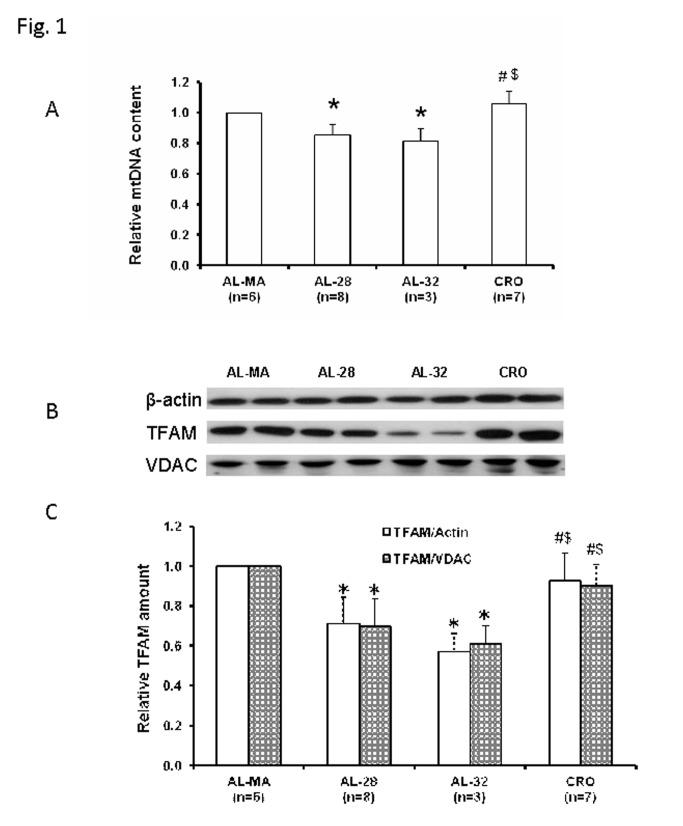
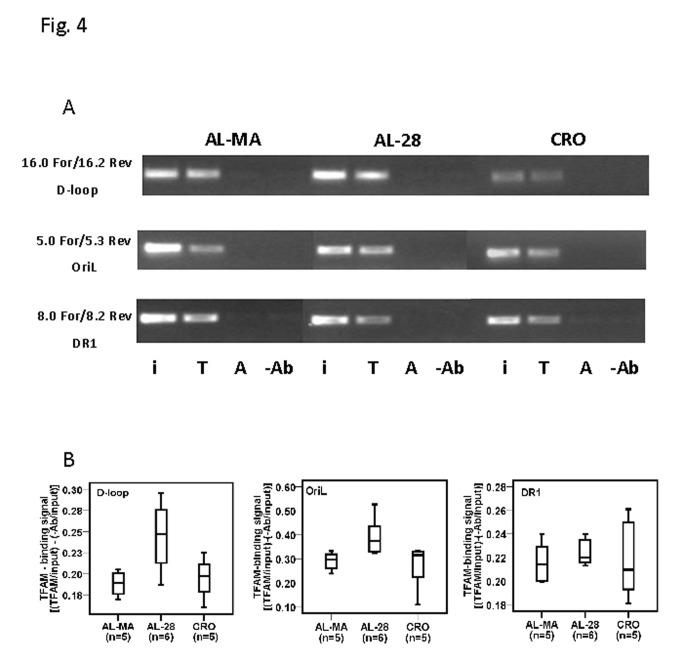
Aging affects mitochondria in a tissue-specific manner. Calorie restriction (CR) is, so far, the only intervention able to delay or prevent the onset of several age-related changes also in mitochondria. Using livers from middle age (18-month-old), 28-month-old and 32-month-old ad libitum-fed and 28-month-old calorie-restricted rats we found an age-related decrease in mitochondrial DNA (mtDNA) content and mitochondrial transcription factor A (TFAM) amount, fully prevented by CR. We revealed also an age-related decrease, completely prevented by CR, for the proteins PGC-1α NRF-1 and cytochrome c oxidase subunit IV, supporting the efficiency of CR to forestall the age-related decrease in mitochondrial biogenesis. Furthermore, CR counteracted the age-related increase in oxidative damage to proteins, represented by the increased amount of oxidized peroxiredoxins (PRX-SO3) in the ad libitum-fed animals. An unexpected age-related decrease in the mitochondrial proteins peroxiredoxin III (Prx III) and superoxide dismutase 2 (SOD2), usually induced by increased ROS and involved in mitochondrial biogenesis, suggested a prevailing relevance of the age-reduced mitochondrial biogenesis above the induction by ROS in the regulation of expression of these genes with aging. The partial prevention of the decrease in Prx III and SOD2 proteins by CR also supported the preservation of mitochondrial biogenesis in the anti-aging action of CR. To investigate further the age- and CR-related effects on mitochondrial biogenesis we analyzed the in vivo binding of TFAM to specific mtDNA regions and demonstrated a marked increase in the TFAM-bound amounts of mtDNA at both origins of replication with aging, fully prevented by CR. A novel, positive correlation between the paired amounts of TFAM-bound mtDNA at these sub-regions was found in the joined middle age ad libitum-fed and 28-month-old calorie-restricted groups, but not in the 28-month-old ad libitum-fed counterpart suggesting a quite different modulation of TFAM binding at both origins of replication in aging and CR.
衰老是一种组织特异性的影响线粒体的过程。到目前为止,热量限制(CR)是唯一能够延缓或预防多种与年龄相关的变化的干预措施,这些变化也发生在线粒体中。我们使用来自自由进食的中年(18 个月)、28 个月和 32 个月龄大鼠以及 28 个月龄热量限制大鼠的肝脏,发现线粒体 DNA(mtDNA)含量和线粒体转录因子 A(TFAM)数量随年龄增长而减少,这一减少完全可以通过 CR 来预防。我们还发现,PGC-1α、NRF-1 和细胞色素 c 氧化酶亚基 IV 的蛋白质含量随年龄增长而减少,这一减少也完全可以通过 CR 来预防,这支持了 CR 能够预防线粒体生物发生随年龄增长而减少的效率。此外,CR 还可以对抗蛋白质的氧化损伤随年龄增长而增加,这表现为自由进食的动物中氧化型过氧化物酶(PRX-SO3)的数量增加。出乎意料的是,线粒体蛋白过氧化物酶 III(Prx III)和超氧化物歧化酶 2(SOD2)的含量随年龄增长而减少,这通常是由 ROS 增加引起的,并且与线粒体生物发生有关,这表明在衰老过程中,ROS 诱导的线粒体生物发生的减少对这些基因表达的调控具有更重要的意义。CR 对 Prx III 和 SOD2 蛋白减少的部分预防也支持了 CR 在抗衰老作用中对线粒体生物发生的保护。为了进一步研究线粒体生物发生的年龄和 CR 相关效应,我们分析了 TFAM 与特定 mtDNA 区域的体内结合情况,并证明随着年龄的增长,TFAM 与 mtDNA 的结合量在两个复制起点都显著增加,这一增加完全可以通过 CR 来预防。在联合的中年自由进食和 28 个月龄热量限制组中,我们发现了这两个亚区的 TFAM 结合 mtDNA 配对量之间存在新的正相关关系,但在 28 个月龄自由进食的对照组中没有发现这一关系,这表明在衰老和 CR 中,TFAM 在两个复制起点的结合受到了非常不同的调节。




 Zotero 插件