
德国预防带状疱疹和疱疹后神经痛的疫苗接种策略的健康经济评价。
Health economic evaluation of vaccination strategies for the prevention of herpes zoster and postherpetic neuralgia in Germany.
机构信息
Immunisation Unit, Robert Koch Institute, Berlin, Germany.
出版信息
BMC Health Serv Res. 2013 Sep 26;13:359. doi: 10.1186/1472-6963-13-359.
BACKGROUND
Herpes zoster (HZ) is a self-limiting painful skin rash affecting mostly individuals from 50 years of age. The main complication is postherpetic neuralgia (PHN), a long-lasting pain after rash has resolved. A HZ-vaccine has recently been licensed in Europe for individuals older than 50 years. To support an informed decision-making for a potential vaccination recommendation, we conducted a health economic evaluation to identify the most cost-effective vaccination strategy.
METHODS
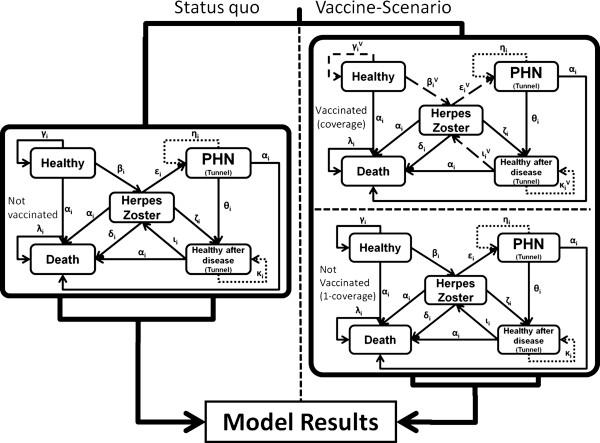
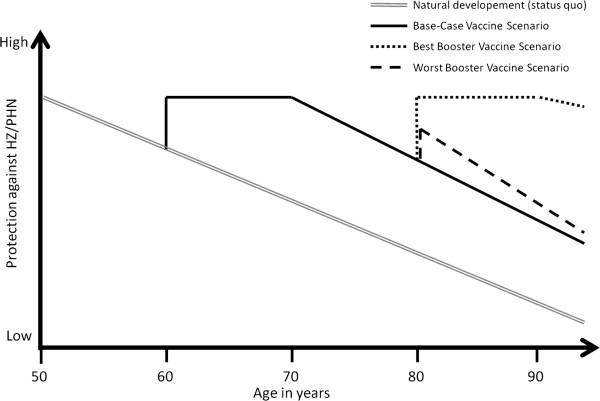
We developed a static Markov-cohort model, which compared a vaccine-scenario with no vaccination. The cohort entering the model was 50 years of age, vaccinated at age 60, and stayed over life-time in the model. Transition probabilities were based on HZ/PHN-epidemiology and demographic data from Germany, as well as vaccine efficacy (VE) data from clinical trials. Costs for vaccination and HZ/PHN-treatment (in Euros; 2010), as well as outcomes were discounted equally with 3% p.a. We accounted results from both, payer and societal perspective. We calculated benefit-cost-ratio (BCR), number-needed-to-vaccinate (NNV), and incremental cost-effectiveness ratios (ICERs) for costs per HZ-case avoided, per PHN-case avoided, and per quality-adjusted life-year (QALY) gained. Different target age-groups were compared to identify the most cost-effective vaccination strategy. Base-case-analysis as well as structural, descriptive-, and probabilistic-sensitivity-analyses (DSA, PSA) were performed.
RESULTS
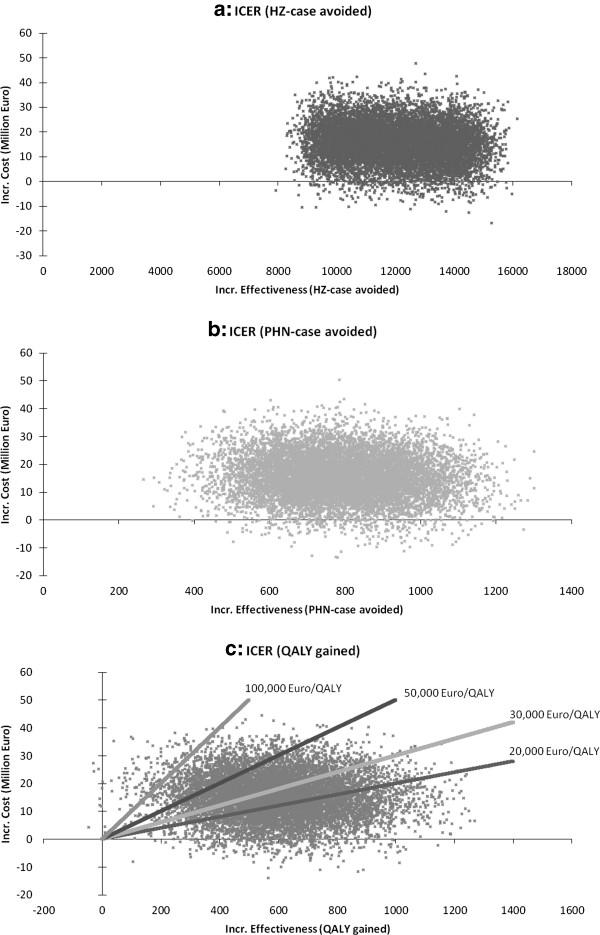
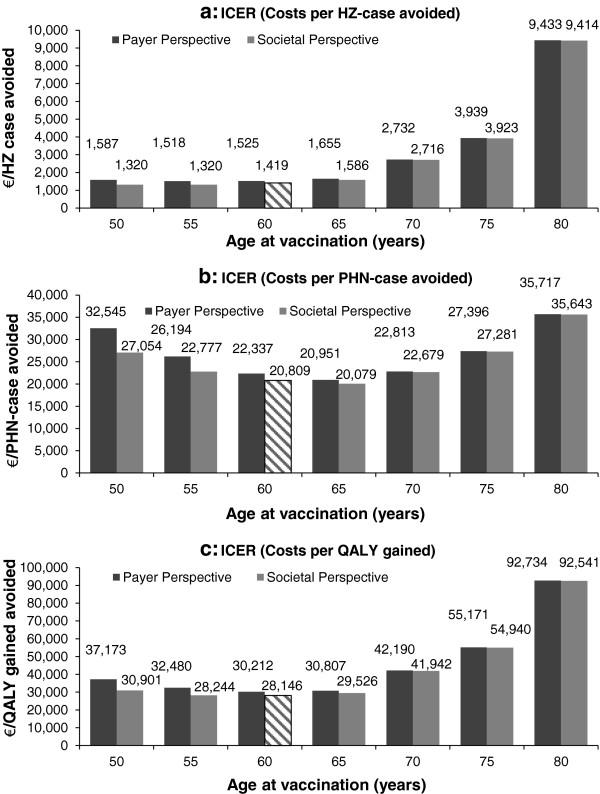
When vaccinating 20% of a cohort of 1 million 50 year old individuals at the age of 60 years, approximately 20,000 HZ-cases will be avoided over life-time. The NNV to avoid one HZ (PHN)-case was 10 (144). However, with a BCR of 0.34 this vaccination-strategy did not save costs. The base-case-analysis yielded an ICER of 1,419 (20,809) Euros per avoided HZ (PHN)-case and 28,146 Euros per QALY gained. Vaccination at the age of 60 was identified in most (sensitivity) analyses to be the most cost-effective vaccination strategy. In DSA, vaccine price and VE were shown to be the most critical input-data.
CONCLUSIONS
According to our evaluation, HZ-vaccination is expected to avoid HZ/PHN-cases and gain QALYs to higher costs. However, the vaccine price had the highest impact on the ICERs. Among different scenarios, targeting individuals aged 60 years seems to represent the most cost-effective vaccination-strategy.
背景
带状疱疹(HZ)是一种自限性的疼痛性皮疹,主要影响 50 岁以上的人群。主要并发症是带状疱疹后神经痛(PHN),即在皮疹消退后仍持续存在的疼痛。最近,一种 HZ 疫苗已在欧洲获得批准,适用于 50 岁以上的人群。为了支持潜在疫苗接种建议的决策,我们进行了一项卫生经济学评估,以确定最具成本效益的疫苗接种策略。
方法
我们开发了一个静态马尔可夫队列模型,比较了疫苗接种方案和不接种疫苗方案。进入模型的队列为 50 岁,60 岁时接种疫苗,并在模型中终生存在。转移概率基于德国的 HZ/PHN 流行病学和人口统计学数据,以及临床试验的疫苗效力(VE)数据。疫苗接种和 HZ/PHN 治疗的成本(以欧元计算;2010 年)以及结果均以 3%的年利率进行贴现。我们从支付者和社会两个角度计算了结果。我们计算了每例 HZ 病例避免、每例 PHN 病例避免和每例质量调整生命年(QALY)获得的成本效益比(BCR)、需要接种疫苗的人数(NNV)和增量成本效益比(ICER)。比较了不同的目标年龄组,以确定最具成本效益的疫苗接种策略。进行了基础案例分析以及结构、描述性和概率敏感性分析(DSA、PSA)。
结果
在 100 万 50 岁的人群中,60 岁时接种 20%的疫苗,一生中大约可以避免 20000 例 HZ 病例。避免一例 HZ(PHN)病例的 NNV 为 10(144)。然而,由于 BCR 为 0.34,该疫苗接种策略并未节省成本。基础案例分析得出的 HZ(PHN)病例避免一例和 QALY 获得一例的 ICER 分别为 1419(20809)欧元和 28146 欧元。在大多数(敏感性)分析中,60 岁时接种疫苗被确定为最具成本效益的疫苗接种策略。在 DSA 中,疫苗价格和 VE 被证明是最关键的输入数据。
结论
根据我们的评估,HZ 疫苗接种有望避免 HZ/PHN 病例并获得更高成本的 QALYs。然而,疫苗价格对 ICERs 的影响最大。在不同的方案中,针对 60 岁人群的方案似乎代表了最具成本效益的疫苗接种策略。


 Zotero 插件