
在脱水和复水条件下两个大豆基因型的全基因组转录分析。
Genome-wide transcriptional analysis of two soybean genotypes under dehydration and rehydration conditions.
机构信息
Oil Crops Research Institute of Chinese Academy of Agriculture Sciences, Wuhan 430062, China.
出版信息
BMC Genomics. 2013 Oct 6;14:687. doi: 10.1186/1471-2164-14-687.
BACKGROUND
Soybean is an important crop that provides valuable proteins and oils for human use. Because soybean growth and development is extremely sensitive to water deficit, quality and crop yields are severely impacted by drought stress. In the face of limited water resources, drought-responsive genes are therefore of interest. Identification and analysis of dehydration- and rehydration-inducible differentially expressed genes (DEGs) would not only aid elucidation of molecular mechanisms of stress response, but also enable improvement of crop stress tolerance via gene transfer. Using Digital Gene Expression Tag profiling (DGE), a new technique based on Illumina sequencing, we analyzed expression profiles between two soybean genotypes to identify drought-responsive genes.
RESULTS
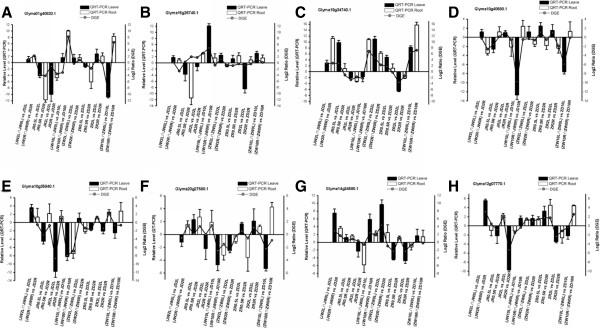
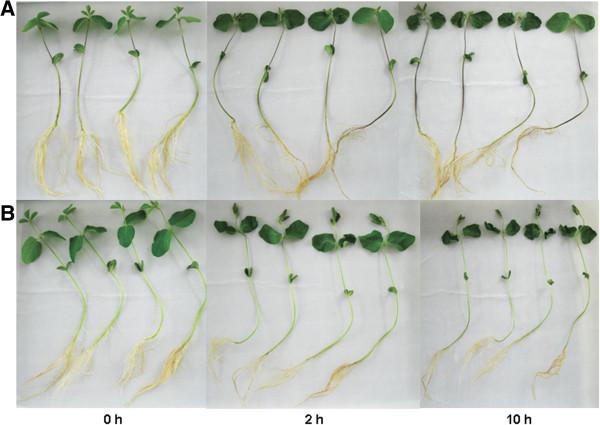
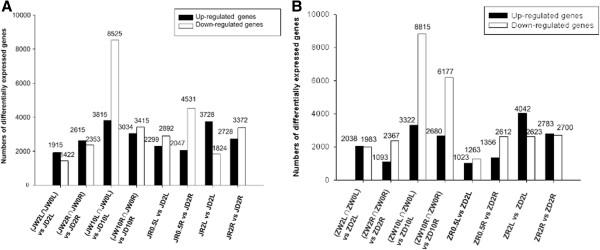
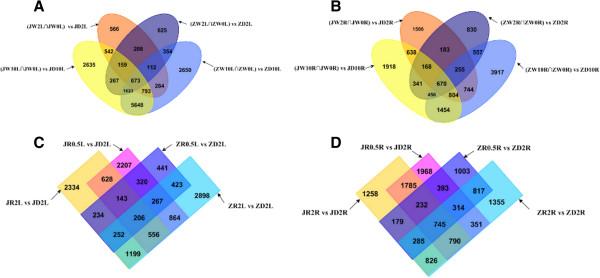
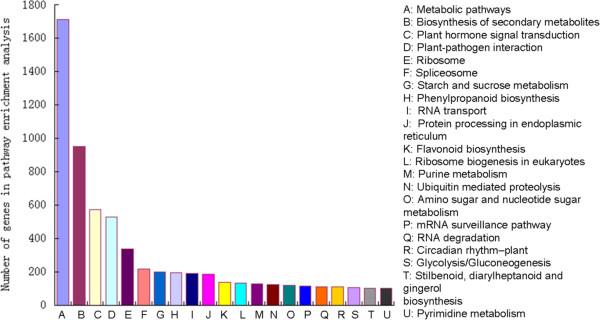
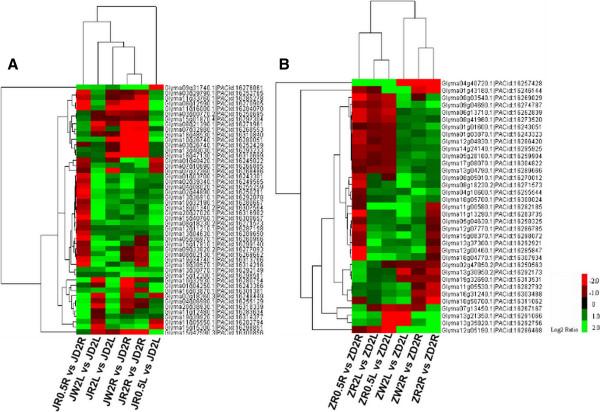
Two soybean genotypes - drought-tolerant Jindou21 and drought-sensitive Zhongdou33 - were subjected to dehydration and rehydration conditions. For analysis of DEGs under dehydration conditions, 20 cDNA libraries were generated from roots and leaves at two different time points under well-watered and dehydration conditions. We also generated eight libraries for analysis under rehydration conditions. Sequencing of the 28 libraries produced 25,000-33,000 unambiguous tags, which were mapped to reference sequences for annotation of expressed genes. Many genes exhibited significant expression differences among the libraries. DEGs in the drought-tolerant genotype were identified by comparison of DEGs among treatments and genotypes. In Jindou21, 518 and 614 genes were differentially expressed under dehydration in leaves and roots, respectively, with 24 identified both in leaves and roots. The main functional categories enriched in these DEGs were metabolic process, response to stresses, plant hormone signal transduction, protein processing, and plant-pathogen interaction pathway; the associated genes primarily encoded transcription factors, protein kinases, and other regulatory proteins. The seven most significantly expressed (|log2 ratio| ≥ 8) genes - Glyma15g03920, Glyma05g02470, Glyma15g15010, Glyma05g09070, Glyma06g35630, Glyma08g12590, and Glyma11g16000 - are more likely to determine drought stress tolerance. The expression patterns of eight randomly-selected genes were confirmed by quantitative RT-PCR; the results of QRT-PCR analysis agreed with transcriptional profile data for 96 out of 128 (75%) data points.
CONCLUSIONS
Many soybean genes were differentially expressed between drought-tolerant and drought-sensitive genotypes. Based on GO functional annotation and pathway enrichment analysis, some of these genes encoded transcription factors, protein kinases, and other regulatory proteins. The seven most significant DEGs are candidates for improving soybean drought tolerance. These findings will be helpful for analysis and elucidation of molecular mechanisms of drought tolerance; they also provide a basis for cultivating new varieties of drought-tolerant soybean.
背景
大豆是一种重要的作物,为人类提供有价值的蛋白质和油脂。由于大豆的生长和发育对水分亏缺极为敏感,干旱胁迫严重影响了大豆的品质和产量。因此,在面对有限的水资源时,干旱响应基因备受关注。鉴定和分析脱水和复水诱导的差异表达基因(DEGs)不仅有助于阐明胁迫响应的分子机制,还可以通过基因转移提高作物的抗胁迫能力。本研究采用基于 Illumina 测序的 Digital Gene Expression Tag profiling(DGE)新技术,对两个大豆基因型进行了分析,以鉴定干旱响应基因。
结果
对耐旱品种金豆 21 和敏感品种中豆 33 进行了脱水和复水处理。为了分析脱水条件下的 DEGs,我们从充分供水和脱水条件下的两个时间点的根和叶中生成了 20 个 cDNA 文库。我们还生成了 8 个复水文库进行分析。28 个文库的测序产生了 25000-33000 个明确标签,这些标签被映射到参考序列中以注释表达基因。许多基因在文库之间表现出显著的表达差异。通过比较处理和基因型之间的 DEGs,鉴定出耐旱基因型中的 DEGs。在金豆 21 中,叶片和根系的脱水分别有 518 和 614 个基因差异表达,其中 24 个基因在叶片和根系中均有表达。这些 DEGs 主要富集在代谢过程、应激反应、植物激素信号转导、蛋白质加工和植物-病原体相互作用途径等功能类别中;相关基因主要编码转录因子、蛋白激酶和其他调节蛋白。七个表达最显著(|log2 比值|≥8)的基因——Glyma15g03920、Glyma05g02470、Glyma15g15010、Glyma05g09070、Glyma06g35630、Glyma08g12590 和 Glyma11g16000——更有可能决定干旱胁迫耐受性。通过定量 RT-PCR 验证了 8 个随机选择基因的表达模式;QRT-PCR 分析的结果与 128 个数据点中的 96 个(75%)数据点的转录谱数据一致。
结论
耐旱和敏感基因型之间有许多大豆基因差异表达。基于 GO 功能注释和途径富集分析,其中一些基因编码转录因子、蛋白激酶和其他调节蛋白。这七个最显著的 DEGs 是提高大豆耐旱性的候选基因。这些发现将有助于分析和阐明耐旱性的分子机制;它们也为培育耐旱大豆新品种提供了依据。



 Zotero 插件