
长期护理中的骨折风险评估:对长期护理医生的调查。
Fracture risk assessment in long-term care: a survey of long-term care physicians.
机构信息
McGill University Health Center Research Institute, Montreal, Canada.
出版信息
BMC Geriatr. 2013 Oct 18;13:109. doi: 10.1186/1471-2318-13-109.
BACKGROUND
The majority of frail elderly who live in long-term care (LTC) are not treated for osteoporosis despite their high risk for fragility fractures. Clinical Practice Guidelines for the diagnosis and management of osteoporosis provide guidance for the management of individuals 50 years and older at risk for fractures, however, they cannot benefit LTC residents if physicians perceive barriers to their application. Our objectives are to explore current practices to fracture risk assessment by LTC physicians and describe barriers to applying the recently published Osteoporosis Canada practice guidelines for fracture assessment and prevention in LTC.
METHODS
A cross-sectional survey was conducted with the Ontario Long-Term Care Physicians Association using an online questionnaire. The survey included questions that addressed members' attitudes, knowledge, and behaviour with respect to fracture risk assessment in LTC. Closed-ended responses were analyzed using descriptive statistics and thematic framework analysis for open-ended responses.
RESULTS
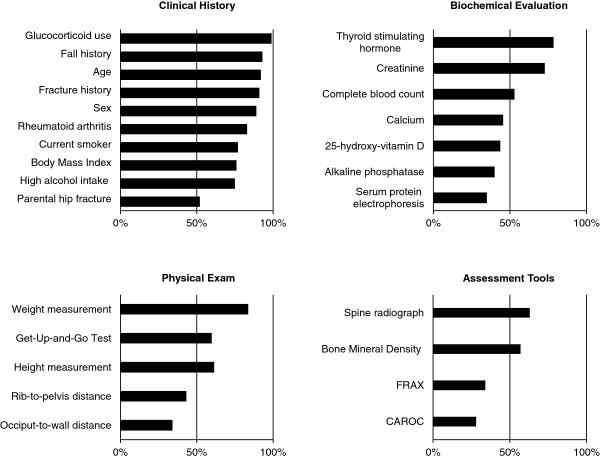
We contacted 347 LTC physicians; 25% submitted completed surveys (81% men, mean age 60 (Standard Deviation [SD] 11) years, average 32 [SD 11] years in practice). Of the surveyed physicians, 87% considered prevention of fragility fractures to be important, but a minority (34%) reported using validated fracture risk assessment tools, while 33% did not use any. Clinical risk factors recommended by the OC guidelines for assessing fracture risk considered applicable included; glucocorticoid use (99%), fall history (93%), age (92%), and fracture history (91%). Recommended clinical measurements considered applicable included: weight (84%), thyroid-stimulating hormone (78%) and creatinine (73%) measurements, height (61%), and Get-Up-and-Go test (60%). Perceived barriers to assessing fracture risk included difficulty acquiring necessary information, lack of access to tests (bone mineral density, x-rays) or obtaining medical history; resource constraints, and a sentiment that assessing fracture risk is futile in this population because of short life expectancy and polypharmacy.
CONCLUSION
Perceived barriers to fracture risk assessment and osteoporosis management in LTC have not changed recently, contributing in part to the ongoing care gap in osteoporosis management. Our findings highlight the importance to adapt guidelines to be applicable to the LTC environment, and to develop partnerships with stakeholders to facilitate their use in clinical practice.
背景
尽管患有脆性骨折的高风险,但大多数居住在长期护理(LTC)机构中的体弱老年人并未接受骨质疏松症的治疗。骨质疏松症的临床实践指南为 50 岁及以上有骨折风险的个体的管理提供了指导,但如果医生认为这些指南在应用上存在障碍,那么这些指南就无法惠及 LTC 居民。我们的目标是探讨 LTC 医生目前对骨折风险评估的做法,并描述在 LTC 中应用最近发布的加拿大骨质疏松症实践指南进行骨折评估和预防的障碍。
方法
我们使用在线问卷对安大略省长期护理医生协会进行了横断面调查。该调查包括了与 LTC 中骨折风险评估相关的成员态度、知识和行为的问题。使用描述性统计和主题框架分析对封闭式回答进行分析,对开放式回答进行描述性分析。
结果
我们联系了 347 名 LTC 医生;25%的医生提交了完整的调查问卷(81%为男性,平均年龄 60(标准差 [SD] 11)岁,平均从业年限 32(SD 11)年)。在所调查的医生中,87%认为预防脆性骨折很重要,但只有少数(34%)医生报告使用了经过验证的骨折风险评估工具,而 33%的医生则没有使用任何工具。OC 指南中用于评估骨折风险的临床推荐因素包括:使用糖皮质激素(99%)、有跌倒史(93%)、年龄(92%)和骨折史(91%)。认为适用的推荐临床测量包括:体重(84%)、促甲状腺激素(78%)和肌酐(73%)测量、身高(61%)和起床和行走测试(60%)。评估骨折风险的感知障碍包括难以获取必要信息、缺乏测试(骨密度、X 射线)或获取病史的途径;资源受限,以及认为由于预期寿命短和多种药物治疗,评估该人群的骨折风险是徒劳的。
结论
最近,LTC 中评估骨折风险和管理骨质疏松症的感知障碍并未改变,这在一定程度上导致了骨质疏松症管理方面持续存在的护理差距。我们的研究结果强调了使指南适用于 LTC 环境以及与利益相关者建立伙伴关系以促进其在临床实践中的应用的重要性。
 Zotero 插件