
人类组织和细胞类型的DNA甲基化年龄
DNA methylation age of human tissues and cell types.
作者信息
Horvath Steve
出版信息
Genome Biol. 2013;14(10):R115. doi: 10.1186/gb-2013-14-10-r115.
BACKGROUND
It is not yet known whether DNA methylation levels can be used to accurately predict age across a broad spectrum of human tissues and cell types, nor whether the resulting age prediction is a biologically meaningful measure.
RESULTS
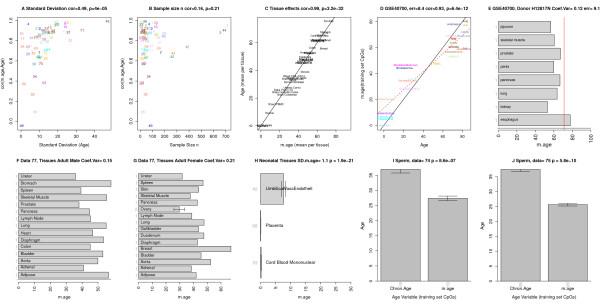
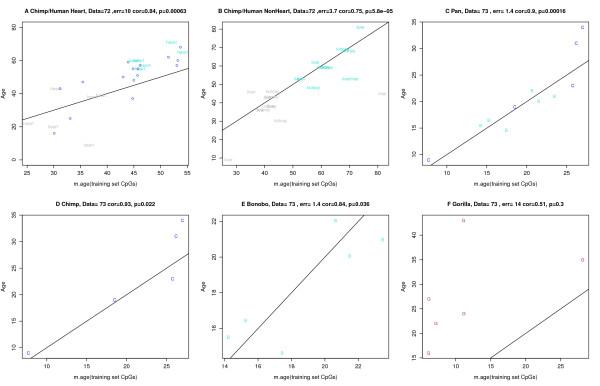
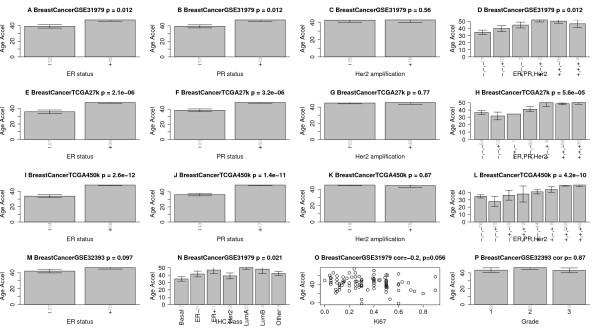
I developed a multi-tissue predictor of age that allows one to estimate the DNA methylation age of most tissues and cell types. The predictor, which is freely available, was developed using 8,000 samples from 82 Illumina DNA methylation array datasets, encompassing 51 healthy tissues and cell types. I found that DNA methylation age has the following properties: first, it is close to zero for embryonic and induced pluripotent stem cells; second, it correlates with cell passage number; third, it gives rise to a highly heritable measure of age acceleration; and, fourth, it is applicable to chimpanzee tissues. Analysis of 6,000 cancer samples from 32 datasets showed that all of the considered 20 cancer types exhibit significant age acceleration, with an average of 36 years. Low age-acceleration of cancer tissue is associated with a high number of somatic mutations and TP53 mutations, while mutations in steroid receptors greatly accelerate DNA methylation age in breast cancer. Finally, I characterize the 353 CpG sites that together form an aging clock in terms of chromatin states and tissue variance.
CONCLUSIONS
I propose that DNA methylation age measures the cumulative effect of an epigenetic maintenance system. This novel epigenetic clock can be used to address a host of questions in developmental biology, cancer and aging research.
背景
目前尚不清楚DNA甲基化水平是否可用于在广泛的人类组织和细胞类型中准确预测年龄,也不清楚由此产生的年龄预测是否是一种具有生物学意义的指标。
结果
我开发了一种多组织年龄预测器,可用于估计大多数组织和细胞类型的DNA甲基化年龄。该预测器可免费获取,它是使用来自82个Illumina DNA甲基化阵列数据集的8000个样本开发的,涵盖51种健康组织和细胞类型。我发现DNA甲基化年龄具有以下特性:第一,对于胚胎和诱导多能干细胞,其接近零;第二,它与细胞传代次数相关;第三,它产生了一种高度可遗传的年龄加速指标;第四,它适用于黑猩猩组织。对来自32个数据集的6000个癌症样本的分析表明,所有20种被考虑的癌症类型均表现出显著的年龄加速,平均为36岁。癌症组织的低年龄加速与大量体细胞突变和TP53突变相关,而类固醇受体突变在乳腺癌中极大地加速了DNA甲基化年龄。最后,我根据染色质状态和组织差异对共同构成衰老时钟的353个CpG位点进行了表征。
结论
我提出DNA甲基化年龄衡量的是一种表观遗传维持系统的累积效应。这种新型表观遗传时钟可用于解决发育生物学、癌症和衰老研究中的一系列问题。




 Zotero 插件