
网络组件分析为拟南芥转录因子-基因调控网络提供了定量见解。
Network component analysis provides quantitative insights on an Arabidopsis transcription factor-gene regulatory network.
作者信息
Misra Ashish, Sriram Ganesh
机构信息
Department of Chemical and Biomolecular Engineering, University of Maryland, College Park, MD 20742, USA.
出版信息
BMC Syst Biol. 2013 Nov 14;7:126. doi: 10.1186/1752-0509-7-126.
BACKGROUND
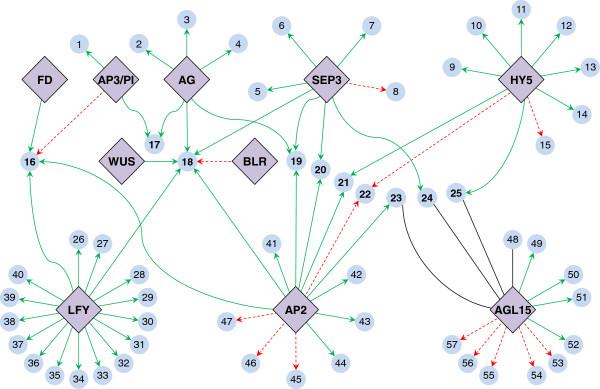
Gene regulatory networks (GRNs) are models of molecule-gene interactions instrumental in the coordination of gene expression. Transcription factor (TF)-GRNs are an important subset of GRNs that characterize gene expression as the effect of TFs acting on their target genes. Although such networks can qualitatively summarize TF-gene interactions, it is highly desirable to quantitatively determine the strengths of the interactions in a TF-GRN as well as the magnitudes of TF activities. To our knowledge, such analysis is rare in plant biology. A computational methodology developed for this purpose is network component analysis (NCA), which has been used for studying large-scale microbial TF-GRNs to obtain nontrivial, mechanistic insights. In this work, we employed NCA to quantitatively analyze a plant TF-GRN important in floral development using available regulatory information from AGRIS, by processing previously reported gene expression data from four shoot apical meristem cell types.
RESULTS
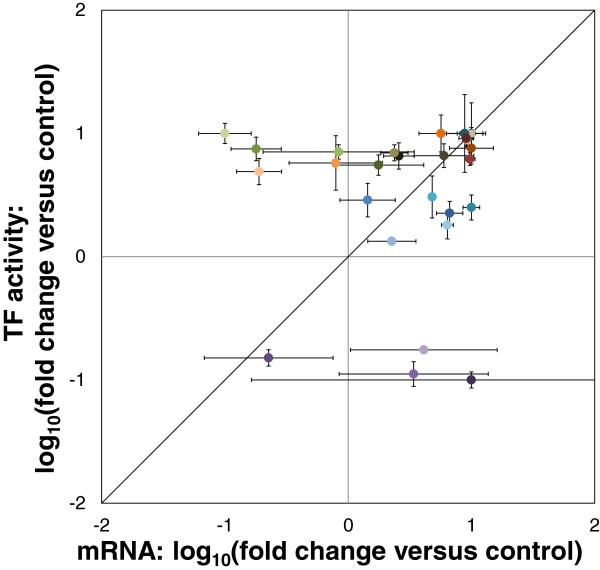
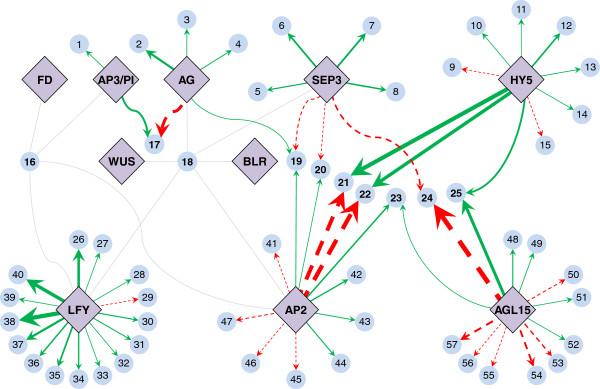
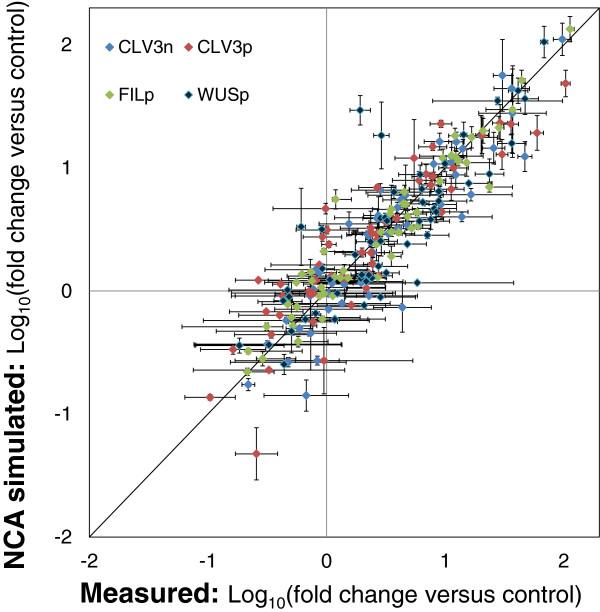
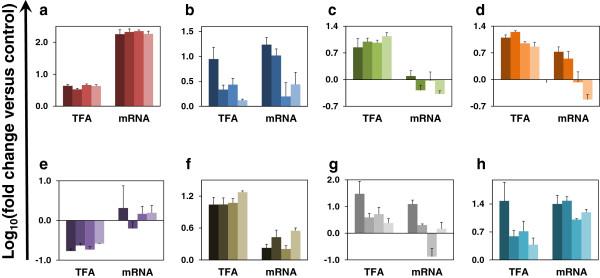
The NCA model satisfactorily accounted for gene expression measurements in a TF-GRN of seven TFs (LFY, AG, SEPALLATA3 [SEP3], AP2, AGL15, HY5 and AP3/PI) and 55 genes. NCA found strong interactions between certain TF-gene pairs including LFY → MYB17, AG → CRC, AP2 → RD20, AGL15 → RAV2 and HY5 → HLH1, and the direction of the interaction (activation or repression) for some AGL15 targets for which this information was not previously available. The activity trends of four TFs - LFY, AG, HY5 and AP3/PI as deduced by NCA correlated well with the changes in expression levels of the genes encoding these TFs across all four cell types; such a correlation was not observed for SEP3, AP2 and AGL15.
CONCLUSIONS
For the first time, we have reported the use of NCA to quantitatively analyze a plant TF-GRN important in floral development for obtaining nontrivial information about connectivity strengths between TFs and their target genes as well as TF activity. However, since NCA relies on documented connectivity information about the underlying TF-GRN, it is currently limited in its application to larger plant networks because of the lack of documented connectivities. In the future, the identification of interactions between plant TFs and their target genes on a genome scale would allow the use of NCA to provide quantitative regulatory information about plant TF-GRNs, leading to improved insights on cellular regulatory programs.
背景
基因调控网络(GRNs)是分子与基因相互作用的模型,有助于协调基因表达。转录因子(TF)-GRNs是GRNs的一个重要子集,它将基因表达描述为TF作用于其靶基因的结果。尽管此类网络可以定性地总结TF与基因的相互作用,但非常需要定量确定TF-GRN中相互作用的强度以及TF活性的大小。据我们所知,这种分析在植物生物学中很少见。为此开发的一种计算方法是网络组件分析(NCA),它已被用于研究大规模微生物TF-GRN,以获得重要的、机制性的见解。在这项工作中,我们利用NCA,通过处理先前报道的来自四种茎尖分生组织细胞类型的基因表达数据,使用来自AGRIS的可用调控信息,对在花发育中重要的植物TF-GRN进行定量分析。
结果
NCA模型令人满意地解释了由七个TF(LFY、AG、SEPALLATA3 [SEP3]、AP2、AGL15、HY5和AP3/PI)和55个基因组成的TF-GRN中的基因表达测量结果。NCA发现某些TF-基因对之间存在强相互作用,包括LFY→MYB17、AG→CRC、AP2→RD20、AGL15→RAV2和HY5→HLH1,以及一些AGL15靶标的相互作用方向(激活或抑制),而此前这些信息并不存在。NCA推断的四个TF(LFY、AG、HY5和AP3/PI)的活性趋势与编码这些TF的基因在所有四种细胞类型中的表达水平变化密切相关;而SEP3、AP2和AGL15则未观察到这种相关性。
结论
我们首次报道使用NCA对在花发育中重要的植物TF-GRN进行定量分析,以获得关于TF与其靶基因之间连接强度以及TF活性的重要信息。然而,由于NCA依赖于关于基础TF-GRN的记录连接信息,由于缺乏记录的连接性,它目前在应用于更大的植物网络时受到限制。未来,在基因组规模上鉴定植物TF与其靶基因之间的相互作用,将允许使用NCA提供关于植物TF-GRN的定量调控信息,从而更深入地了解细胞调控程序。
 Zotero 插件