
全基因组鉴定参与调控酿酒酵母中乙酸诱导程序性细胞死亡的正负调控的基因。
Genome-wide identification of genes involved in the positive and negative regulation of acetic acid-induced programmed cell death in Saccharomyces cerevisiae.
机构信息
Centre of Molecular and Environmental Biology (CBMA), Department of Biology, Universidade do Minho, Campus de Gualtar, 4710-057 Braga, Portugal.
出版信息
BMC Genomics. 2013 Nov 28;14(1):838. doi: 10.1186/1471-2164-14-838.
BACKGROUND
Acetic acid is mostly known as a toxic by-product of alcoholic fermentation carried out by Saccharomyces cerevisiae, which it frequently impairs. The more recent finding that acetic acid triggers apoptotic programmed cell death (PCD) in yeast sparked an interest to develop strategies to modulate this process, to improve several biotechnological applications, but also for biomedical research. Indeed, acetate can trigger apoptosis in cancer cells, suggesting its exploitation as an anticancer compound. Therefore, we aimed to identify genes involved in the positive and negative regulation of acetic acid-induced PCD by optimizing a functional analysis of a yeast Euroscarf knock-out mutant collection.
RESULTS
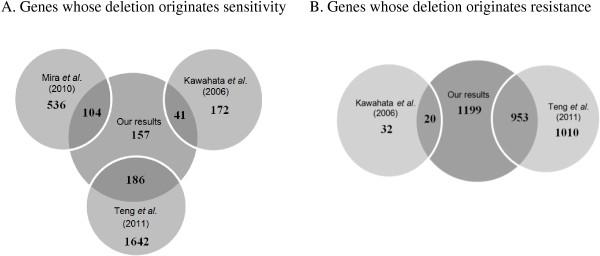
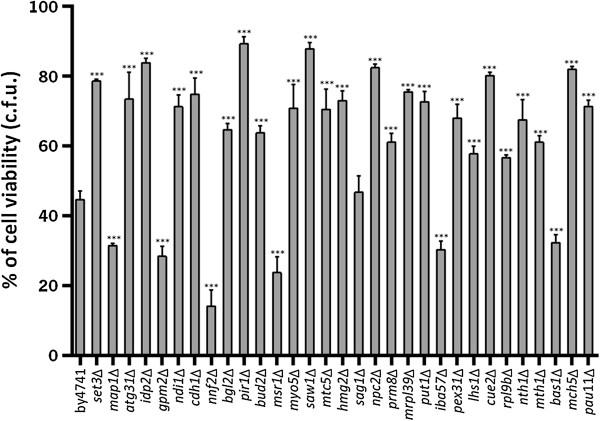
The screen consisted of exposing the mutant strains to acetic acid in YPD medium, pH 3.0, in 96-well plates, and subsequently evaluating the presence of culturable cells at different time points. Several functional categories emerged as greatly relevant for modulation of acetic acid-induced PCD (e.g.: mitochondrial function, transcription of glucose-repressed genes, protein synthesis and modifications, and vesicular traffic for protection, or amino acid transport and biosynthesis, oxidative stress response, cell growth and differentiation, protein phosphorylation and histone deacetylation for its execution). Known pro-apoptotic and anti-apoptotic genes were found, validating the approach developed. Metabolism stood out as a main regulator of this process, since impairment of major carbohydrate metabolic pathways conferred resistance to acetic acid-induced PCD. Among these, lipid catabolism arose as one of the most significant new functions identified. The results also showed that many of the cellular and metabolic features that constitute hallmarks of tumour cells (such as higher glycolytic energetic dependence, lower mitochondrial functionality, increased cell division and metabolite synthesis) confer sensitivity to acetic acid-induced PCD, potentially explaining why tumour cells are more susceptible to acetate than untransformed cells and reinforcing the interest in exploiting this acid in cancer therapy. Furthermore, our results clearly establish a connection between cell proliferation and cell death regulation, evidencing a conserved developmental role of programmed cell death in unicellular eukaryotes.
CONCLUSIONS
This work advanced the characterization of acetic acid-induced PCD, providing a wealth of new information on putative molecular targets for its control with impact both in biotechnology and biomedicine.
背景
乙酸通常被认为是酿酒酵母进行酒精发酵时产生的一种有毒副产品,它经常会损害酵母。最近的发现表明,乙酸会引发酵母中的凋亡程序性细胞死亡(PCD),这激发了人们开发调节这一过程的策略的兴趣,以改善几种生物技术应用,但也用于生物医药研究。事实上,醋酸盐可以在癌细胞中引发细胞凋亡,这表明它可以被开发为一种抗癌化合物。因此,我们旨在通过优化酵母 Euroscarf 敲除突变体文库的功能分析来鉴定参与乙酸诱导的 PCD 的正调控和负调控的基因。
结果
该筛选包括在 pH 值为 3.0 的 YPD 培养基中,将突变株暴露于乙酸中,在 96 孔板中进行,并随后在不同时间点评估可培养细胞的存在。几个功能类别被认为与调节乙酸诱导的 PCD 非常相关(例如:线粒体功能、葡萄糖抑制基因的转录、蛋白质合成和修饰以及囊泡运输以保护、或氨基酸运输和生物合成、氧化应激反应、细胞生长和分化、蛋白质磷酸化和组蛋白去乙酰化以执行)。发现了已知的促凋亡和抗凋亡基因,验证了所开发的方法。代谢作为该过程的主要调节剂脱颖而出,因为主要碳水化合物代谢途径的损伤赋予了对乙酸诱导的 PCD 的抗性。在这些途径中,脂质分解代谢被认为是鉴定出的最重要的新功能之一。结果还表明,构成肿瘤细胞特征的许多细胞和代谢特征(例如,更高的糖酵解能量依赖性、更低的线粒体功能、增加的细胞分裂和代谢物合成)使细胞对乙酸诱导的 PCD 敏感,这可能解释了为什么肿瘤细胞比未转化的细胞更容易受到乙酸的影响,并加强了在癌症治疗中利用这种酸的兴趣。此外,我们的结果清楚地建立了细胞增殖和细胞死亡调节之间的联系,证明了程序性细胞死亡在单细胞真核生物中的保守发育作用。
结论
这项工作推进了对乙酸诱导的 PCD 的表征,提供了大量关于其控制的潜在分子靶标的新信息,对生物技术和生物医学都有影响。

 Zotero 插件