
由大肠杆菌 MnmEG 和 MnmC 酶控制的 tRNA 修饰途径的输出取决于生长条件和 tRNA 种类。
The output of the tRNA modification pathways controlled by the Escherichia coli MnmEG and MnmC enzymes depends on the growth conditions and the tRNA species.
机构信息
Laboratory of RNA Modification and Mitochondrial Diseases, Príncipe Felipe Research Center, 46012-Valencia, Spain, Department of Molecular Biology, Umeå University, S90187, Sweden and Biomedical Research Networking Centre for Rare Diseases (CIBERER) (node U721), Spain.
出版信息
Nucleic Acids Res. 2014 Feb;42(4):2602-23. doi: 10.1093/nar/gkt1228. Epub 2013 Nov 30.
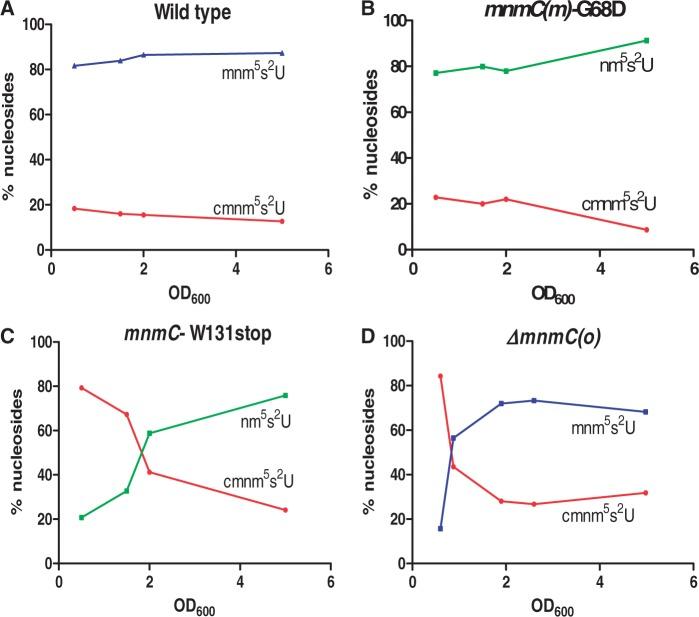
In Escherichia coli, the MnmEG complex modifies transfer RNAs (tRNAs) decoding NNA/NNG codons. MnmEG catalyzes two different modification reactions, which add an aminomethyl (nm) or carboxymethylaminomethyl (cmnm) group to position 5 of the anticodon wobble uridine using ammonium or glycine, respectively. In tRNA(cmnm5s2UUG)(Gln) and tRNA(cmnm5UmAA)(Leu), however, cmnm(5) appears as the final modification, whereas in the remaining tRNAs, the MnmEG products are converted into 5-methylaminomethyl (mnm(5)) through the two-domain, bi-functional enzyme MnmC. MnmC(o) transforms cmnm(5) into nm(5), whereas MnmC(m) converts nm(5) into mnm(5), thus producing an atypical network of modification pathways. We investigate the activities and tRNA specificity of MnmEG and the MnmC domains, the ability of tRNAs to follow the ammonium or glycine pathway and the effect of mnmC mutations on growth. We demonstrate that the two MnmC domains function independently of each other and that tRNA(cmnm5s2UUG)(Gln) and tRNA(cmnm5UmAA)(Leu), are substrates for MnmC(m), but not MnmC(o). Synthesis of mnm(5)s(2)U by MnmEG-MnmC in vivo avoids build-up of intermediates in tRNA(mnm5s2UUU)(Lys). We also show that MnmEG can modify all the tRNAs via the ammonium pathway. Strikingly, the net output of the MnmEG pathways in vivo depends on growth conditions and tRNA species. Loss of any MnmC activity has a biological cost under specific conditions.
在大肠杆菌中,MnmEG 复合物修饰翻译 RNA(tRNA)解码 NNA/NNG 密码子。MnmEG 催化两种不同的修饰反应,分别使用铵或甘氨酸将氨甲基(nm)或羧甲基氨甲基(cmnm)基团添加到反密码子摆动尿嘧啶的 5 位。然而,在 tRNA(cmnm5s2UUG)(Gln)和 tRNA(cmnm5UmAA)(Leu)中,cmnm(5)是最后的修饰产物,而在其余的 tRNA 中,MnmEG 产物通过双结构域、双功能酶 MnmC 转化为 5-甲氨基甲基(mnm(5))。MnmC(o)将 cmnm(5)转化为 nm(5),而 MnmC(m)将 nm(5)转化为 mnm(5),从而产生了一种非典型的修饰途径网络。我们研究了 MnmEG 和 MnmC 结构域的活性和 tRNA 特异性、tRNA 遵循铵或甘氨酸途径的能力以及 mnmC 突变对生长的影响。我们证明了两个 MnmC 结构域彼此独立地发挥作用,并且 tRNA(cmnm5s2UUG)(Gln)和 tRNA(cmnm5UmAA)(Leu)是 MnmC(m)的底物,但不是 MnmC(o)的底物。MnmEG-MnmC 在体内合成 mnm(5)s(2)U 可避免 tRNA(mnm5s2UUU)(Lys)中中间体的积累。我们还表明,MnmEG 可以通过铵途径修饰所有 tRNA。引人注目的是,体内 MnmEG 途径的净输出取决于生长条件和 tRNA 种类。在特定条件下,任何 MnmC 活性的丧失都会产生生物学成本。



 Zotero 插件