
右美托咪定对小儿日间手术患者七氟醚需求和苏醒期躁动的影响。
Effect of dexmedetomidine on sevoflurane requirements and emergence agitation in children undergoing ambulatory surgery.
机构信息
Department of Anesthesiology and Pain Medicine, Anesthesia and Pain Research Institute, Yonsei University College of Medicine, 50 Yonsei-ro, Seodaemun-gu, Seoul 120-752, Korea.
出版信息
Yonsei Med J. 2014 Jan;55(1):209-15. doi: 10.3349/ymj.2014.55.1.209.
PURPOSE
Dexmedetomidine, a potent selective α2-adrenergic agonist, produces sedation and analgesia. This study was conducted to assess the effect of dexmedetomidine infusion on sevoflurane requirements, recovery profiles, and emergence agitation in children undergoing ambulatory surgery.
MATERIALS AND METHODS
Forty children undergoing ambulatory hernioplasty or orchiopexy were randomized into two groups. The dexmedetomidine group (Group D, n=20) received dexmedetomidine 1 μg/kg, followed by 0.1 μg/kg/h until the end of surgery, whereas the saline group (Group S, n=20) received volume-matched normal saline. Sevoflurane was used for induction and maintenance of anesthesia and caudal block was performed in all children. End-tidal sevoflurane concentration (ET-sevo), the incidence of emergence agitation, pain scores, and sedation scores were recorded. Hemodynamic changes and other adverse effects were assessed in the perioperative period.
RESULTS
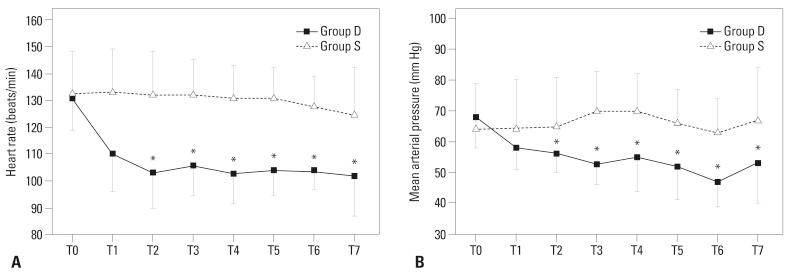
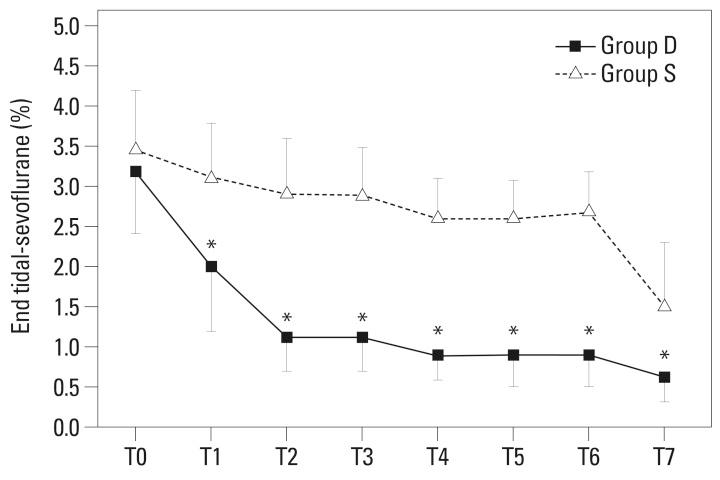
ET-sevo of Group D was significantly reduced in 23.8-67% compared to Group S during surgery. The incidence of emergence agitation was lower in Group D than in Group S (5% vs. 55%, p=0.001). Postoperative pain was comparable, and discharge time was not different between the groups. Mean arterial pressure and heart rate were significantly lower in Group D during surgery.
CONCLUSION
Intraoperative infusion of dexmedetomidine reduced sevoflurane requirements and decreased emergence agitation without delaying discharge in children undergoing ambulatory surgery. However, caution should be taken in regard to bradycardia and hypotension.
目的
右美托咪定是一种强效的选择性 α2-肾上腺素能激动剂,具有镇静和镇痛作用。本研究旨在评估右美托咪定输注对小儿日间手术中七氟醚需求、恢复特征和苏醒期躁动的影响。
材料和方法
40 名接受日间疝修补术或睾丸固定术的儿童被随机分为两组。右美托咪定组(D 组,n=20)给予右美托咪定 1μg/kg,然后以 0.1μg/kg/h 的速度输注至手术结束,而生理盐水组(S 组,n=20)给予等容量生理盐水。所有儿童均接受七氟醚诱导和维持麻醉,并进行骶管阻滞。记录呼气末七氟醚浓度(ET-sevo)、苏醒期躁动发生率、疼痛评分和镇静评分。评估围手术期的血流动力学变化和其他不良反应。
结果
与 S 组相比,D 组术中 ET-sevo 在 23.8-67%的范围内显著降低。D 组苏醒期躁动的发生率低于 S 组(5%比 55%,p=0.001)。术后疼痛评分相似,两组出院时间无差异。D 组术中平均动脉压和心率明显低于 S 组。
结论
小儿日间手术中输注右美托咪定可降低七氟醚需求,减少苏醒期躁动,而不延迟出院。然而,应注意心动过缓和低血压。

 Zotero 插件