
全基因组亚硫酸氢盐测序映射算法的比较与定量验证
Comparison and quantitative verification of mapping algorithms for whole-genome bisulfite sequencing.
作者信息
Kunde-Ramamoorthy Govindarajan, Coarfa Cristian, Laritsky Eleonora, Kessler Noah J, Harris R Alan, Xu Mingchu, Chen Rui, Shen Lanlan, Milosavljevic Aleksandar, Waterland Robert A
机构信息
Department of Pediatrics, Baylor College of Medicine, USDA/ARS Children's Nutrition Research Center, Houston, TX 77030, USA, Department of Molecular & Cell Biology, Baylor College of Medicine, Houston, TX 77030, USA, Department of Biology and Biochemistry, University of Houston, Houston, TX 77204, USA and Department of Molecular & Human Genetics, Baylor College of Medicine, Houston, TX 77030, USA.
出版信息
Nucleic Acids Res. 2014 Apr;42(6):e43. doi: 10.1093/nar/gkt1325. Epub 2014 Jan 3.
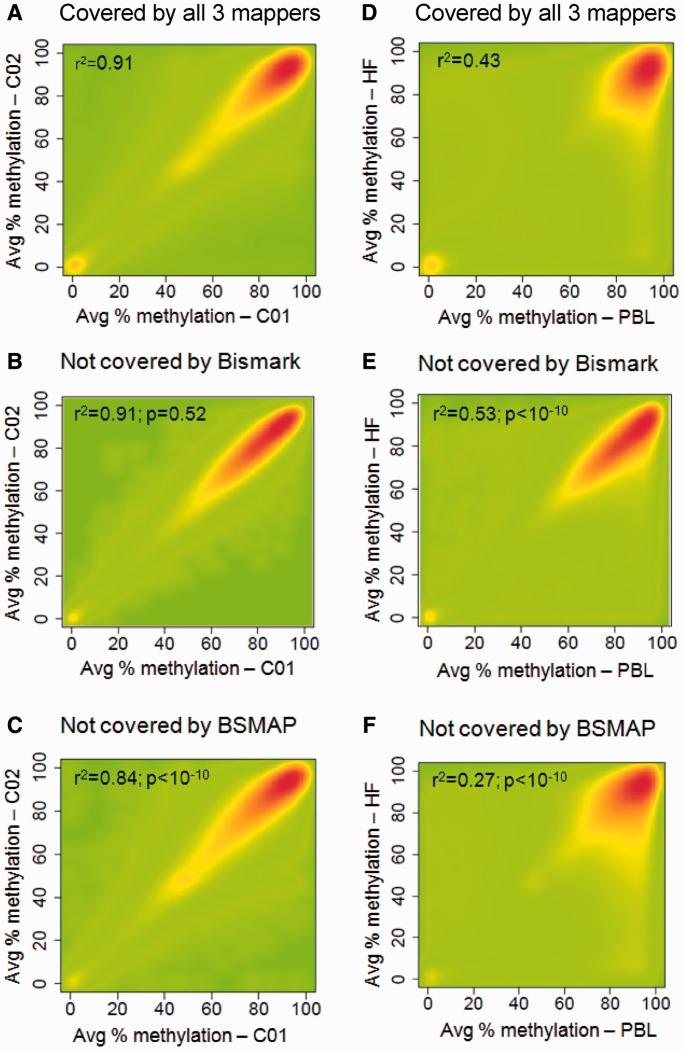
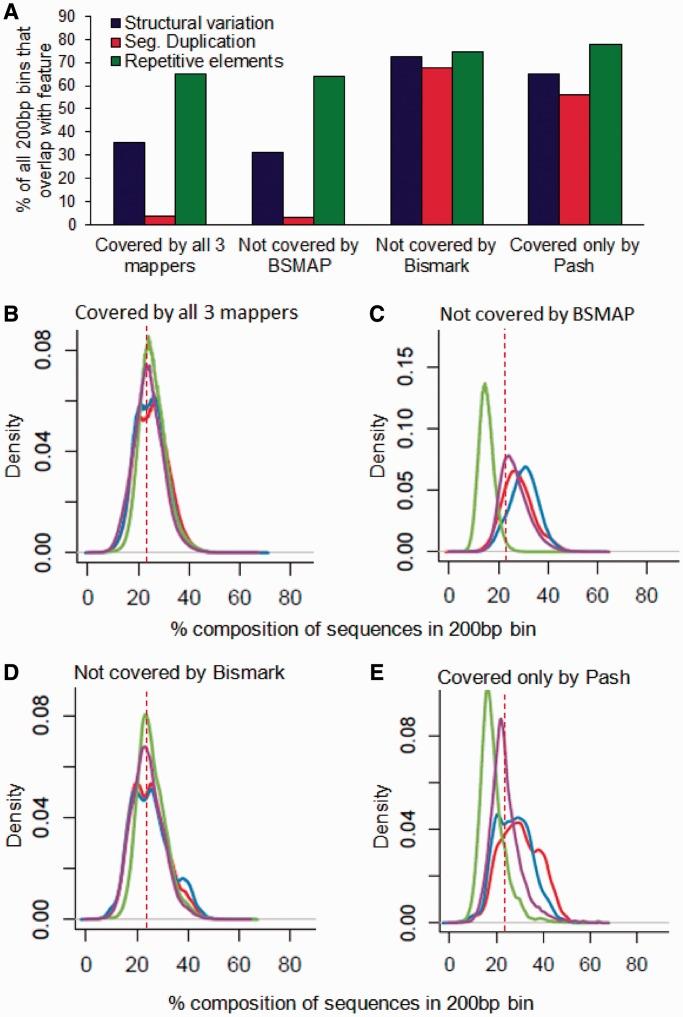
Coupling bisulfite conversion with next-generation sequencing (Bisulfite-seq) enables genome-wide measurement of DNA methylation, but poses unique challenges for mapping. However, despite a proliferation of Bisulfite-seq mapping tools, no systematic comparison of their genomic coverage and quantitative accuracy has been reported. We sequenced bisulfite-converted DNA from two tissues from each of two healthy human adults and systematically compared five widely used Bisulfite-seq mapping algorithms: Bismark, BSMAP, Pash, BatMeth and BS Seeker. We evaluated their computational speed and genomic coverage and verified their percentage methylation estimates. With the exception of BatMeth, all mappers covered >70% of CpG sites genome-wide and yielded highly concordant estimates of percentage methylation (r(2) ≥ 0.95). Fourfold variation in mapping time was found between BSMAP (fastest) and Pash (slowest). In each library, 8-12% of genomic regions covered by Bismark and Pash were not covered by BSMAP. An experiment using simulated reads confirmed that Pash has an exceptional ability to uniquely map reads in genomic regions of structural variation. Independent verification by bisulfite pyrosequencing generally confirmed the percentage methylation estimates by the mappers. Of these algorithms, Bismark provides an attractive combination of processing speed, genomic coverage and quantitative accuracy, whereas Pash offers considerably higher genomic coverage.
将亚硫酸氢盐转化与新一代测序技术(亚硫酸氢盐测序,Bisulfite-seq)相结合,能够在全基因组范围内测量DNA甲基化,但在图谱绘制方面带来了独特的挑战。然而,尽管亚硫酸氢盐测序图谱绘制工具不断涌现,但尚未有关于它们基因组覆盖范围和定量准确性的系统比较报道。我们对两名健康成年人的两种组织的亚硫酸氢盐转化后的DNA进行了测序,并系统地比较了五种广泛使用的亚硫酸氢盐测序图谱绘制算法:Bismark、BSMAP、Pash、BatMeth和BS Seeker。我们评估了它们的计算速度和基因组覆盖范围,并验证了它们对甲基化百分比的估计。除了BatMeth之外,所有映射器在全基因组范围内覆盖了>70%的CpG位点,并产生了高度一致的甲基化百分比估计值(r(2)≥0.95)。发现BSMAP(最快)和Pash(最慢)之间的映射时间有四倍的差异。在每个文库中,Bismark和Pash覆盖的基因组区域中有8-12%未被BSMAP覆盖。一项使用模拟读数的实验证实,Pash在结构变异的基因组区域中具有独特映射读数的特殊能力。通过亚硫酸氢盐焦磷酸测序进行的独立验证通常证实了映射器对甲基化百分比的估计。在这些算法中,Bismark在处理速度、基因组覆盖范围和定量准确性方面提供了有吸引力的组合,而Pash提供了更高的基因组覆盖范围。

 Zotero 插件