
系统评价不良事件的报告质量:系统评价。
Quality of reporting in systematic reviews of adverse events: systematic review.
机构信息
Department of Pediatrics, 4-548 Edmonton Clinic Health Academy, University of Alberta, Edmonton, Canada.
出版信息
BMJ. 2014 Jan 8;348:f7668. doi: 10.1136/bmj.f7668.
OBJECTIVES
To examine the quality of reporting of harms in systematic reviews, and to determine the need for a reporting guideline specific for reviews of harms.
DESIGN
Systematic review.
DATA SOURCES
Cochrane Database of Systematic Reviews (CDSR) and Database of Abstracts of Reviews of Effects (DARE).
REVIEW METHODS
Databases were searched for systematic reviews having an adverse event as the main outcome, published from January 2008 to April 2011. Adverse events included an adverse reaction, harms, or complications associated with any healthcare intervention. Articles with a primary aim to investigate the complete safety profile of an intervention were also included. We developed a list of 37 items to measure the quality of reporting on harms in each review; data were collected as dichotomous outcomes ("yes" or "no" for each item).
RESULTS
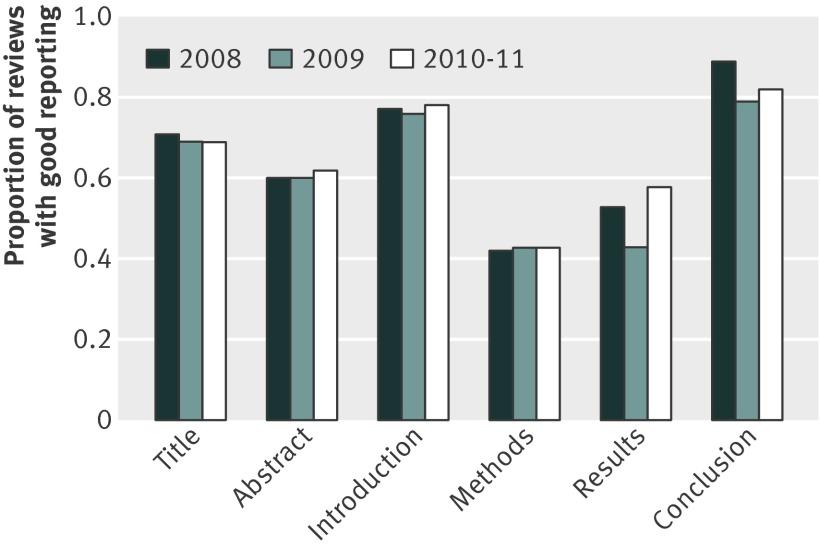
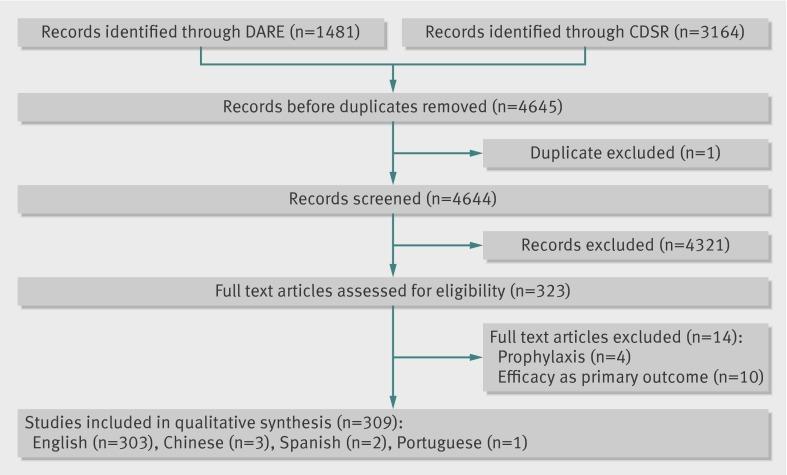
Of 4644 reviews identified, 309 were systematic reviews or meta-analyses primarily assessing harms (13 from CDSR; 296 from DARE). Despite a short time interval, the comparison between the years of 2008 and 2010-11 showed no difference on the quality of reporting over time (P=0.079). Titles in fewer than half the reviews (proportion of reviews 0.46 (95% confidence interval 0.40 to 0.52)) did not mention any harm related terms. Almost one third of DARE reviews (0.26 (0.22 to 0.31)) did not clearly define the adverse events reviewed, nor did they specify the study designs selected for inclusion in their methods section. Almost half of reviews (n=170) did not consider patient risk factors or length of follow-up when reviewing harms of an intervention. Of 67 reviews of complications related to surgery or other procedures, only four (0.05 (0.01 to 0.14)) reported professional qualifications of the individuals involved. The overall, unweighted, proportion of reviews with good reporting was 0.56 (0.55 to 0.57); corresponding proportions were 0.55 (0.53 to 0.57) in 2008, 0.55 (0.54 to 0.57) in 2009, and 0.57 (0.55 to 0.58) in 2010-11.
CONCLUSION
Systematic reviews compound the poor reporting of harms data in primary studies by failing to report on harms or doing so inadequately. Improving reporting of adverse events in systematic reviews is an important step towards a balanced assessment of an intervention.
目的
检查系统评价中危害报告的质量,并确定是否需要制定专门针对危害评价的报告指南。
设计
系统评价。
资料来源
Cochrane 系统评价数据库(CDSR)和效果评价摘要数据库(DARE)。
检索方法
对 2008 年 1 月至 2011 年 4 月发表的以不良事件为主要结局的系统评价进行数据库检索。不良事件包括与任何医疗干预相关的不良反应、危害或并发症。也包括主要目的是调查干预措施完全安全性概况的文章。我们制定了一份 37 项条目清单,以衡量每项评价中危害报告的质量;数据以二项结果(每项条目为“是”或“否”)收集。
结果
在 4644 篇综述中,有 309 篇是主要评估危害的系统评价或荟萃分析(13 篇来自 CDSR;296 篇来自 DARE)。尽管时间间隔较短,但 2008 年和 2010-11 年之间的比较显示,随着时间的推移,报告质量没有差异(P=0.079)。不到一半的综述标题(综述比例为 0.46(95%置信区间 0.40 至 0.52))没有提到任何与危害相关的术语。近三分之一的 DARE 综述(0.26(0.22 至 0.31))没有明确界定所审查的不良事件,也没有在方法部分中说明选择纳入的研究设计。近一半的综述(n=170)在评价干预措施的危害时没有考虑患者的危险因素或随访时间。在 67 篇与手术或其他程序相关的并发症的综述中,只有 4 篇(0.05(0.01 至 0.14))报告了参与人员的专业资格。总体而言,未加权的报告良好的综述比例为 0.56(0.55 至 0.57);2008 年、2009 年和 2010-11 年的相应比例分别为 0.55(0.53 至 0.57)、0.55(0.54 至 0.57)和 0.57(0.55 至 0.58)。
结论
系统评价未能充分报告危害数据或报告不足,从而加剧了原始研究中危害数据报告不良的情况。改善系统评价中不良事件的报告是对干预措施进行平衡评估的重要步骤。
 Zotero 插件