
随机对照试验可能低估药物效果:平衡安慰剂试验设计。
Randomised controlled trials may underestimate drug effects: balanced placebo trial design.
作者信息
Lund Karen, Vase Lene, Petersen Gitte L, Jensen Troels S, Finnerup Nanna B
机构信息
Danish Pain Research Center, Aarhus University Hospital, Aarhus, Denmark.
Department of Psychology, School of Business and Social Sciences, Aarhus University, Aarhus, Denmark.
出版信息
PLoS One. 2014 Jan 8;9(1):e84104. doi: 10.1371/journal.pone.0084104. eCollection 2014.
BACKGROUND
It is an inherent assumption in randomised controlled trials that the drug effect can be estimated by subtracting the response during placebo from the response during active drug treatment.
OBJECTIVE
To test the assumption of additivity. The primary hypothesis was that the total treatment effect is smaller than the sum of the drug effect and the placebo effect. The secondary hypothesis was that non-additivity was most pronounced in participants with large placebo effects.
METHODS
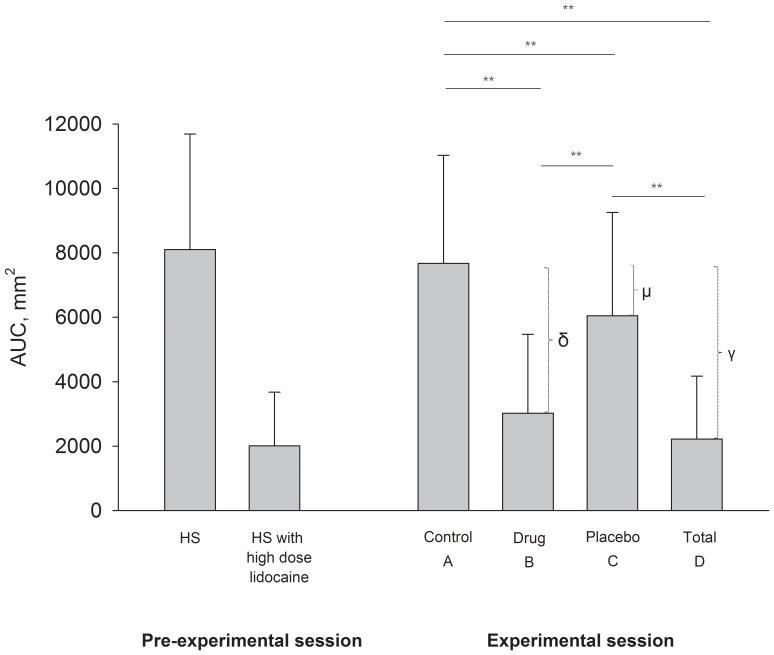
We used a within-subject randomised blinded balanced placebo design and included 48 healthy volunteers (50% males), mean (SD) age 23.4 (6.2) years. Experimental pain was induced by injections of hypertonic saline into the masseter muscle. Participants received four injections with hypertonic saline along with lidocaine or matching placebo in randomised order: A: received hypertonic saline/told hypertonic saline; B: received hypertonic saline+lidocaine/told hypertonic saline; C: received hypertonic saline+placebo/told hypertonic saline+pain killer; D: received hypertonic saline+lidocaine/told hypertonic saline+pain killer. The primary outcome measure was the area under the curve (AUC, mm(2)) of pain intensity during injections.
RESULTS
There was a significant difference between the sum of the drug effect and the placebo effect (mean AUC 6279 mm(2) (95% CI, 4936-7622)) and the total treatment effect (mean AUC 5455 mm(2) (95% CI, 4585-6324)) (P = 0.049). This difference was larger for participants with large versus small placebo effects (P = 0.015), and the difference correlated significantly with the size of the placebo effect (r = 0.65, P = 0.006).
CONCLUSION
Although this study examined placebo effects and not the whole placebo response as in randomised controlled trials, it does suggest that the additivity assumption may be incorrect, and that the estimated drug effects in randomised controlled trials may be underestimated, particularly in studies reporting large placebo responses. The implications for randomised controlled trials and systematic reviews need to be discussed.
背景
在随机对照试验中有一个内在假设,即药物效果可通过用活性药物治疗期间的反应减去安慰剂期间的反应来估计。
目的
检验可加性假设。主要假设是总治疗效果小于药物效果与安慰剂效果之和。次要假设是在安慰剂效果大的参与者中,非可加性最为明显。
方法
我们采用了受试者内随机双盲平衡安慰剂设计,纳入了48名健康志愿者(50%为男性),平均(标准差)年龄23.4(6.2)岁。通过向咬肌注射高渗盐水诱导实验性疼痛。参与者随机接受四次高渗盐水注射,同时注射利多卡因或匹配的安慰剂:A:接受高渗盐水/被告知是高渗盐水;B:接受高渗盐水+利多卡因/被告知是高渗盐水;C:接受高渗盐水+安慰剂/被告知是高渗盐水+止痛药;D:接受高渗盐水+利多卡因/被告知是高渗盐水+止痛药。主要结局指标是注射期间疼痛强度的曲线下面积(AUC,mm²)。
结果
药物效果与安慰剂效果之和(平均AUC 6279 mm²(95%CI,4936 - 7622))与总治疗效果(平均AUC 5455 mm²(95%CI,4585 - 6324))之间存在显著差异(P = 0.049)。对于安慰剂效果大的参与者和小的参与者,这种差异更大(P = 0.015),并且该差异与安慰剂效果的大小显著相关(r = 0.65,P = 0.006)。
结论
尽管本研究考察的是安慰剂效果而非随机对照试验中的整个安慰剂反应,但确实表明可加性假设可能不正确,随机对照试验中估计的药物效果可能被低估,尤其是在报告有大的安慰剂反应的研究中。需要讨论其对随机对照试验和系统评价的影响。



 Zotero 插件