
度洛西汀每日一次60毫克治疗重度抑郁症的疗效与安全性:专家评论综述
Efficacy and safety of duloxetine 60 mg once daily in major depressive disorder: a review with expert commentary.
作者信息
Ball Susan G, Desaiah Durisala, Zhang Qi, Thase Michael E, Perahia David G S
机构信息
Lilly Research Laboratory, Eli Lilly and Company, Indianapolis, IN, USA;
Perelman School of Medicine of the University of Pennsylvania, Philadelphia, PA, USA;
出版信息
Drugs Context. 2013 Jan 3;2013:212245. doi: 10.7573/dic.212245.
OBJECTIVE
Major depressive disorder (MDD) is a significant public health concern and challenges health care providers to intervene with appropriate treatment. This article provides an overview of efficacy and safety information for duloxetine 60 mg/day in the treatment of MDD, including its effect on painful physical symptoms (PPS).
DESIGN
A literature search was conducted for articles and pooled analyses reporting information regarding the use of duloxetine 60 mg/day in placebo-controlled trials.
SETTING
Placebo-controlled, active-comparator, short- and long-term studies were reviewed.
PARTICIPANTS
Adult (≥18 years) patients with MDD.
MEASUREMENTS
Effect sizes for continuous outcome (change from baseline to endpoint) and categorical outcome (response and remission rates) were calculated using the primary measures of 17-item Hamilton Rating Scale for Depression (HAMD-17) or Montgomery-Åsberg Depression Rating Scale (MADRS) total score. The Brief Pain Inventory and Visual Analogue Scales were used to assess improvements in PPS. Glass estimation method was used to calculate effect sizes, and numbers needed to treat (NNT) were calculated based on HAMD-17 and MADRS total scores for remission and response rates. Safety data were examined via the incidence of treatment-emergent adverse events and by mean changes in vital-sign measures.
RESULTS
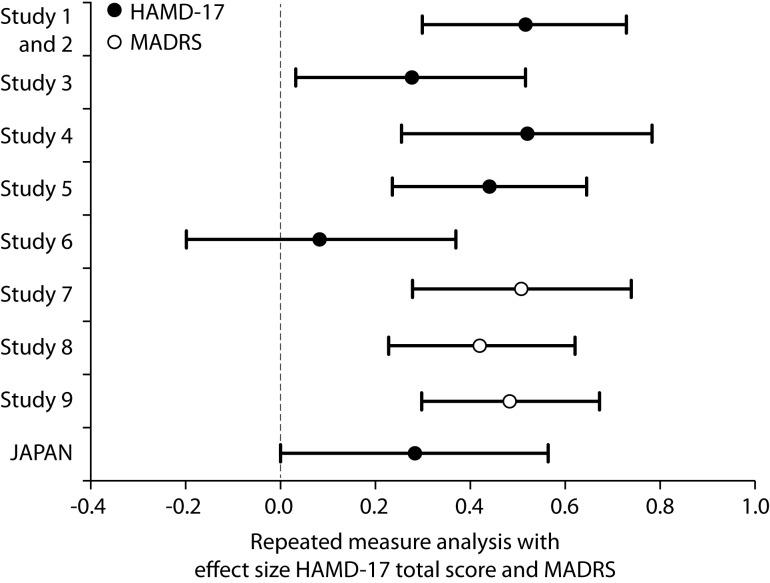
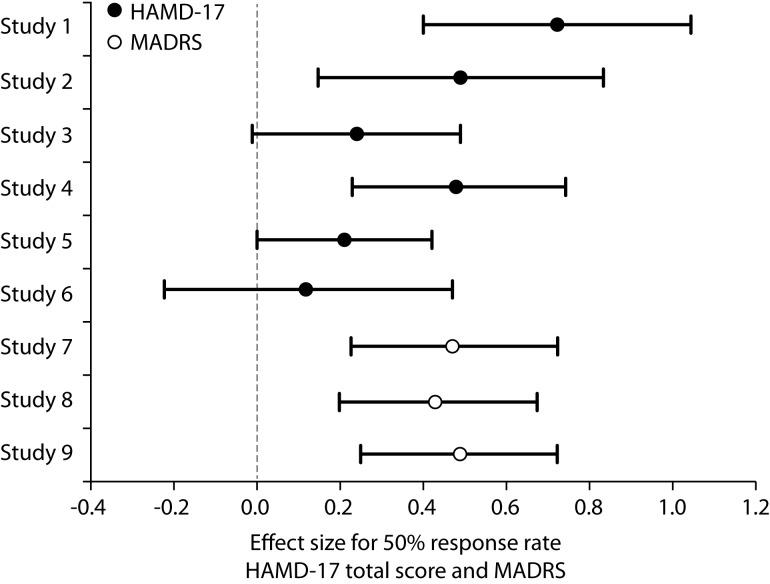
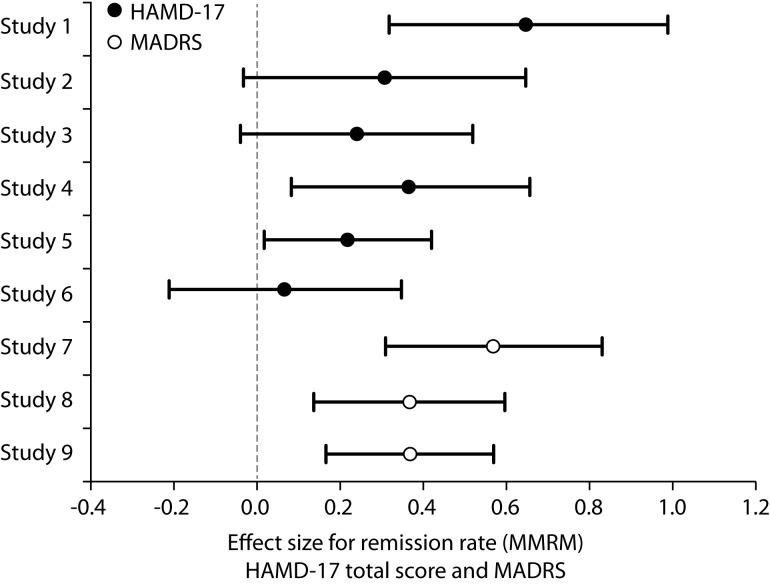
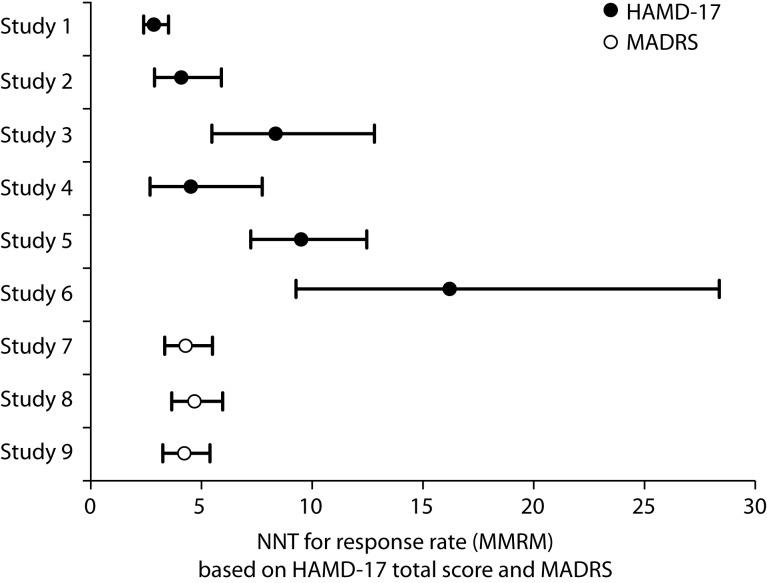
Treatment with duloxetine was associated with small-to-moderate effect sizes in the range of 0.12 to 0.72 for response rate and 0.07 to 0.65 for remission rate. NNTs were in the range of 3 to 16 for response and 3 to 29 for remission. Statistically significant improvements (p≤0.05) were observed in duloxetine-treated patients compared to placebo-treated patients in PPS and quality of life. The safety profile of the 60-mg dose was consistent with duloxetine labeling, with the most commonly observed significant adverse events being nausea, dry mouth, diarrhea, dizziness, constipation, fatigue, and decreased appetite.
CONCLUSION
These results reinforce the efficacy and tolerability of duloxetine 60 mg/day as an effective short- and long-term treatment for adults with MDD. The evidence of the independent analgesic effect of duloxetine 60 mg/day supports its use as a treatment for patients with PPS associated with depression. This review is limited by the fact that it included randomized clinical trials with different study designs. Furthermore, data from randomized controlled trials may not generalize well to real clinical practice.
目的
重度抑郁症(MDD)是一个重大的公共卫生问题,对医疗保健提供者提出了采用适当治疗方法进行干预的挑战。本文概述了度洛西汀60毫克/天治疗MDD的疗效和安全性信息,包括其对疼痛性躯体症状(PPS)的影响。
设计
对报告度洛西汀60毫克/天在安慰剂对照试验中使用情况的文章和汇总分析进行文献检索。
研究背景
对安慰剂对照、活性对照、短期和长期研究进行了综述。
参与者
成年(≥18岁)MDD患者。
测量指标
使用17项汉密尔顿抑郁量表(HAMD-17)或蒙哥马利-阿斯伯格抑郁量表(MADRS)总分的主要测量指标,计算连续结局(从基线到终点的变化)和分类结局(缓解率和有效率)的效应量。使用简明疼痛量表和视觉模拟量表评估PPS的改善情况。采用Glass估计方法计算效应量,并根据HAMD-17和MADRS总分的缓解率和有效率计算治疗所需人数(NNT)。通过治疗中出现的不良事件发生率和生命体征测量的平均变化来检查安全性数据。
结果
度洛西汀治疗的有效率效应量为0.12至0.72,缓解率效应量为0.07至0.65,范围为小到中等。NNT在有效率方面为3至16,在缓解率方面为3至29。与安慰剂治疗的患者相比,度洛西汀治疗的患者在PPS和生活质量方面有统计学显著改善(p≤0.05)。60毫克剂量的安全性概况与度洛西汀标签一致,最常见的显著不良事件是恶心、口干、腹泻、头晕、便秘、疲劳和食欲下降。
结论
这些结果强化了度洛西汀60毫克/天作为成年MDD患者有效短期和长期治疗方法的疗效和耐受性。度洛西汀60毫克/天具有独立镇痛作用的证据支持其用于治疗与抑郁症相关的PPS患者。本综述的局限性在于纳入了不同研究设计的随机临床试验。此外,随机对照试验的数据可能无法很好地推广到实际临床实践中。

 Zotero 插件