
将来自近亲家庭的序列数据与远交群体的遗传数据相结合,确定PLB1为类风湿性关节炎风险候选基因。
Integration of sequence data from a Consanguineous family with genetic data from an outbred population identifies PLB1 as a candidate rheumatoid arthritis risk gene.
作者信息
Okada Yukinori, Diogo Dorothee, Greenberg Jeffrey D, Mouassess Faten, Achkar Walid A L, Fulton Robert S, Denny Joshua C, Gupta Namrata, Mirel Daniel, Gabriel Stacy, Li Gang, Kremer Joel M, Pappas Dimitrios A, Carroll Robert J, Eyler Anne E, Trynka Gosia, Stahl Eli A, Cui Jing, Saxena Richa, Coenen Marieke J H, Guchelaar Henk-Jan, Huizinga Tom W J, Dieudé Philippe, Mariette Xavier, Barton Anne, Canhão Helena, Fonseca João E, de Vries Niek, Tak Paul P, Moreland Larry W, Bridges S Louis, Miceli-Richard Corinne, Choi Hyon K, Kamatani Yoichiro, Galan Pilar, Lathrop Mark, Raj Towfique, De Jager Philip L, Raychaudhuri Soumya, Worthington Jane, Padyukov Leonid, Klareskog Lars, Siminovitch Katherine A, Gregersen Peter K, Mardis Elaine R, Arayssi Thurayya, Kazkaz Layla A, Plenge Robert M
机构信息
Division of Rheumatology, Immunology, and Allergy, Brigham and Women's Hospital, Harvard Medical School, Boston, Massachusetts, United States of America ; Division of Genetics, Brigham and Women's Hospital, Harvard Medical School, Boston, Massachusetts, United States of America ; Program in Medical and Population Genetics, Broad Institute, Cambridge, Massachusetts, United States of America ; Department of Human Genetics and Disease Diversity, Tokyo Medical and Dental University Graduate School of Medical and Dental Sciences, Tokyo, Japan ; Laboratory for Statistical Analysis, Center for Integrative Medical Sciences, RIKEN, Yokohama, Japan.
Division of Rheumatology, Immunology, and Allergy, Brigham and Women's Hospital, Harvard Medical School, Boston, Massachusetts, United States of America ; Division of Genetics, Brigham and Women's Hospital, Harvard Medical School, Boston, Massachusetts, United States of America ; Program in Medical and Population Genetics, Broad Institute, Cambridge, Massachusetts, United States of America.
出版信息
PLoS One. 2014 Feb 10;9(2):e87645. doi: 10.1371/journal.pone.0087645. eCollection 2014.
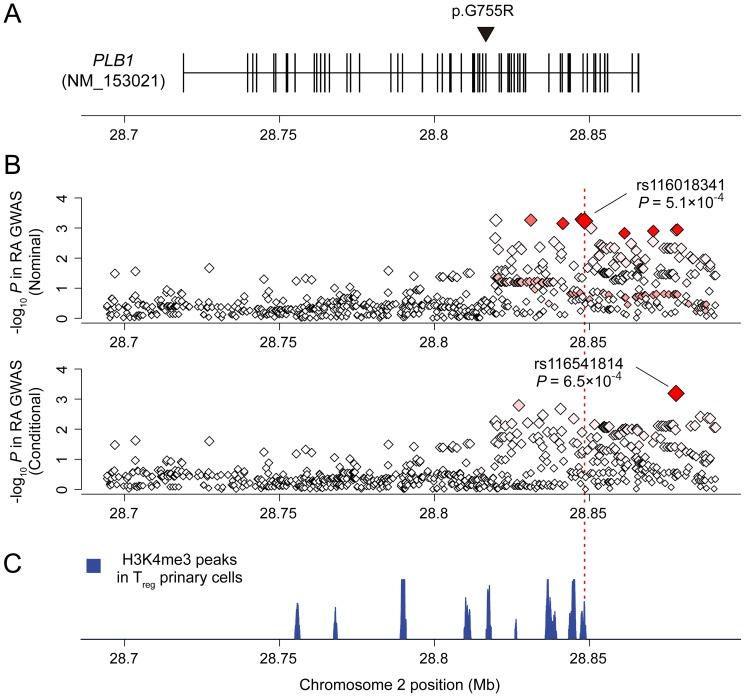
Integrating genetic data from families with highly penetrant forms of disease together with genetic data from outbred populations represents a promising strategy to uncover the complete frequency spectrum of risk alleles for complex traits such as rheumatoid arthritis (RA). Here, we demonstrate that rare, low-frequency and common alleles at one gene locus, phospholipase B1 (PLB1), might contribute to risk of RA in a 4-generation consanguineous pedigree (Middle Eastern ancestry) and also in unrelated individuals from the general population (European ancestry). Through identity-by-descent (IBD) mapping and whole-exome sequencing, we identified a non-synonymous c.2263G>C (p.G755R) mutation at the PLB1 gene on 2q23, which significantly co-segregated with RA in family members with a dominant mode of inheritance (P = 0.009). We further evaluated PLB1 variants and risk of RA using a GWAS meta-analysis of 8,875 RA cases and 29,367 controls of European ancestry. We identified significant contributions of two independent non-coding variants near PLB1 with risk of RA (rs116018341 [MAF = 0.042] and rs116541814 [MAF = 0.021], combined P = 3.2 × 10(-6)). Finally, we performed deep exon sequencing of PLB1 in 1,088 RA cases and 1,088 controls (European ancestry), and identified suggestive dispersion of rare protein-coding variant frequencies between cases and controls (P = 0.049 for C-alpha test and P = 0.055 for SKAT). Together, these data suggest that PLB1 is a candidate risk gene for RA. Future studies to characterize the full spectrum of genetic risk in the PLB1 genetic locus are warranted.
将来自患有高外显率疾病形式的家族的遗传数据与来自远交群体的遗传数据相结合,是一种很有前景的策略,可用于揭示类风湿关节炎(RA)等复杂性状风险等位基因的完整频率谱。在此,我们证明,在一个基因位点磷脂酶B1(PLB1)上的罕见、低频和常见等位基因,可能在一个四代近亲家系(中东血统)以及一般人群中的无关个体(欧洲血统)中导致RA风险。通过同源性映射(IBD)和全外显子测序,我们在2q23的PLB1基因上鉴定出一个非同义c.2263G>C(p.G755R)突变,该突变在具有显性遗传模式的家族成员中与RA显著共分离(P = 0.009)。我们使用对8875例RA病例和29367例欧洲血统对照的全基因组关联研究(GWAS)荟萃分析,进一步评估了PLB1变异与RA风险。我们鉴定出PLB1附近两个独立的非编码变异对RA风险有显著贡献(rs116018341 [MAF = 0.042]和rs116541814 [MAF = 0.021],合并P = 3.2 × 10(-6))。最后,我们对1088例RA病例和1088例对照(欧洲血统)进行了PLB1的深度外显子测序,并鉴定出病例和对照之间罕见蛋白质编码变异频率的提示性差异(C-alpha检验P = 0.049,SKAT检验P = 0.055)。总之,这些数据表明PLB1是RA的一个候选风险基因。未来有必要开展研究来表征PLB1基因座遗传风险的全谱。


 Zotero 插件