
九大常见癌症中的体细胞突变模式和过程。
Patterns and processes of somatic mutations in nine major cancers.
机构信息
Department of Biomedical Informatics, Vanderbilt University School of Medicine, Nashville, TN 37203, USA.
出版信息
BMC Med Genomics. 2014 Feb 19;7:11. doi: 10.1186/1755-8794-7-11.
BACKGROUND
Cancer genomes harbor hundreds to thousands of somatic nonsynonymous mutations. DNA damage and deficiency of DNA repair systems are two major forces to cause somatic mutations, marking cancer genomes with specific somatic mutation patterns. Recently, several pan-cancer genome studies revealed more than 20 mutation signatures across multiple cancer types. However, detailed cancer-type specific mutation signatures and their different features within (intra-) and between (inter-) cancer types remain largely unexplored.
METHODS
We employed a matrix decomposition algorithm, namely Non-negative Matrix Factorization, to survey the somatic mutations in nine major human cancers, involving a total of ~2100 genomes.
RESULTS
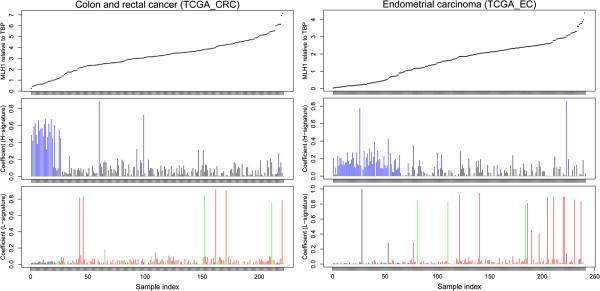
Our results revealed 3-5 independent mutational signatures in each cancer, implying that a range of 3-5 predominant mutational processes likely underlie each cancer genome. Both mutagen exposure (tobacco and sun) and changes in DNA repair systems (APOBEC family, POLE, and MLH1) were found as mutagenesis forces, each of which marks the genome with an evident mutational signature. We studied the features of several signatures and their combinatory patterns within and across cancers. On one hand, we found each signature may influence a cancer genome with different influential magnitudes even in the same cancer type and the signature-specific load reflects intra-cancer heterogeneity (e.g., the smoking-related signature in lung cancer smokers and never smokers). On the other hand, inter-cancer heterogeneity is characterized by combinatory patterns of mutational signatures, where no cancers share the same signature profile, even between two lung cancer subtypes (lung adenocarcinoma and squamous cell lung cancer).
CONCLUSIONS
Our work provides a detailed overview of the mutational characteristics in each of nine major cancers and highlights that the mutational signature profile is representative of each cancer.
背景
癌症基因组中存在数百到数千个体细胞非同义突变。DNA 损伤和 DNA 修复系统缺陷是导致体细胞突变的两个主要因素,使癌症基因组具有特定的体细胞突变模式。最近,几项泛癌症基因组研究揭示了超过 20 种突变特征,涉及多种癌症类型。然而,详细的癌症类型特异性突变特征及其在癌症类型内(内在)和癌症类型之间(外在)的不同特征在很大程度上仍未得到探索。
方法
我们采用矩阵分解算法,即非负矩阵分解,对 9 种主要人类癌症中的体细胞突变进行了调查,总共涉及约 2100 个基因组。
结果
我们的结果显示,每种癌症中有 3-5 个独立的突变特征,这意味着一系列 3-5 个主要的突变过程可能是每个癌症基因组的基础。诱变剂暴露(烟草和阳光)和 DNA 修复系统的变化(APOBEC 家族、POLE 和 MLH1)都被认为是诱变剂,它们各自用明显的突变特征标记基因组。我们研究了几个特征及其在癌症内和癌症间的组合模式的特征。一方面,我们发现每个特征可能以不同的影响程度影响癌症基因组,即使在相同的癌症类型中,特征特异性负荷反映了癌症内的异质性(例如,肺癌吸烟者和非吸烟者中的吸烟相关特征)。另一方面,癌症间的异质性表现为突变特征的组合模式,没有两个癌症具有相同的特征谱,即使在两种肺癌亚型(肺腺癌和鳞状细胞肺癌)之间也是如此。
结论
我们的工作提供了每种主要癌症突变特征的详细概述,并强调了突变特征谱是每种癌症的代表。


 Zotero 插件