
2 型糖尿病流行社会中的糖尿病肾病及其危险因素:基于沙特国家糖尿病登记处的研究。
Diabetic nephropathy and its risk factors in a society with a type 2 diabetes epidemic: a Saudi National Diabetes Registry-based study.
机构信息
University Diabetes Center, College of Medicine, King Saud University, Riyadh, Saudi Arabia.
Registry Department, University Diabetes Center, King Saud University, Riyadh, Saudi Arabia.
出版信息
PLoS One. 2014 Feb 21;9(2):e88956. doi: 10.1371/journal.pone.0088956. eCollection 2014.
AIMS
The prevalence of diabetic nephropathy and its risk factors have not been studied in a society known to have diabetes epidemic like Saudi Arabia. Using a large data base registry will provide a better understanding and accurate assessment of this chronic complication and its related risk factors.
METHODOLOGY
A total of 54,670 patients with type 2 diabetes aged ≥ 25 years were selected from the Saudi National Diabetes Registry (SNDR) and analyzed for the presence of diabetic nephropathy. The American Diabetes Association (ADA) criterion was used to identify cases with microalbuminuria, macroalbuminuria and end stage renal disease (ESRD) for prevalence estimation and risk factor assessment.
RESULTS
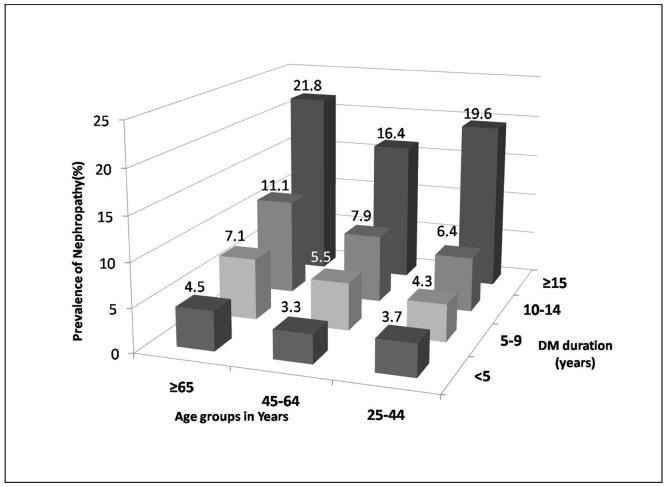
The overall prevalence of diabetic nephropathy was 10.8%, divided into 1.2% microalbuminuria, 8.1%macroalbuninuria and 1.5% ESRD. Age and diabetes duration as important risk factors have a strong impact on the prevalence of diabetic nephropathy, ranging from 3.7% in patients aged 25-44 years and a duration of >5 years, to 21.8% in patients ≥ 65 years with a diabetes duration of ≥ 15 years. Diabetes duration, retinopathy, neuropathy, hypertension, age >45 years, hyperlipidemia, male gender, smoking, and chronologically, poor glycemic control has a significantly high risk for diabetic nephropathy.
CONCLUSION
The prevalence of diabetic nephropathy is underestimated as a result of a shortage of screening programs. Risk factors related to diabetic nephropathy in this society are similar to other societies. There is thus an urgent need for screening and prevention programs for diabetic nephropathy among the Saudi population.
目的
在一个已知存在糖尿病流行的社会(如沙特阿拉伯)中,尚未对糖尿病肾病的患病率及其危险因素进行研究。利用大型数据库登记处,将能更好地了解和准确评估这种慢性并发症及其相关危险因素。
方法
从沙特国家糖尿病登记处(SNDR)中选择了 54670 名年龄≥25 岁的 2 型糖尿病患者,对其是否存在糖尿病肾病进行分析。采用美国糖尿病协会(ADA)标准来确定微量白蛋白尿、大量白蛋白尿和终末期肾病(ESRD)患者,以进行患病率估计和危险因素评估。
结果
糖尿病肾病的总患病率为 10.8%,分为 1.2%微量白蛋白尿、8.1%大量白蛋白尿和 1.5%ESRD。年龄和糖尿病病程是重要的危险因素,对糖尿病肾病的患病率有很大影响,范围从年龄 25-44 岁且病程>5 年的 3.7%,到年龄≥65 岁且病程≥15 年的 21.8%。糖尿病病程、视网膜病变、神经病变、高血压、年龄>45 岁、血脂异常、男性、吸烟以及血糖控制不佳等因素与糖尿病肾病的发生具有显著相关性。
结论
由于筛查计划不足,糖尿病肾病的患病率被低估。该社会中与糖尿病肾病相关的危险因素与其他社会相似。因此,迫切需要在沙特人群中开展糖尿病肾病的筛查和预防计划。


 Zotero 插件