
TRPV1在小鼠足三里穴位(ST36)的大量表达及功能参与:机械敏感的TRPV1作为“针刺反应通道”
Abundant expression and functional participation of TRPV1 at Zusanli acupoint (ST36) in mice: mechanosensitive TRPV1 as an "acupuncture-responding channel".
作者信息
Wu Shu-Yih, Chen Wei-Hsin, Hsieh Ching-Liang, Lin Yi-Wen
机构信息
Graduate Institute of Acupuncture Science, College of Chinese Medicine, China Medical University, 91 Hsueh-Shih Road, Taichung 40402, Taiwan.
出版信息
BMC Complement Altern Med. 2014 Mar 11;14:96. doi: 10.1186/1472-6882-14-96.
BACKGROUND
Acupuncture is a therapy that involves applying mechanical stimulation to acupoints using needles. Although acupuncture is believed to trigger neural regulation by opioids or adenosine, still little is known about how physical stimulation is turned into neurological signaling. The transient receptor potential vanilloid receptors 1 and 4 (TRPV1 and TRPV4) and the acid-sensing ion channel 3 (ASIC3) are regarded as mechanosensitive channels. This study aimed to clarify their role at the Zusanli acupoint (ST36) and propose possible sensing pathways linking channel activation to neurological signaling.
METHODS
First, tissues from different anatomical layers of ST36 and the sham point were sampled, and channel expressions between the two points were compared using western blotting. Second, immunofluorescence was performed at ST36 to reveal distribution pattern of the channels. Third, agonist of the channels were injected into ST36 and tested in a mouse inflammatory pain model to seek if agonist injection could replicate acupuncture-like analgesic effect. Last, the components of proposed downstream sensing pathway were tested with western blotting to determine if they were expressed in tissues with positive mechanosensitive channel expression.
RESULTS
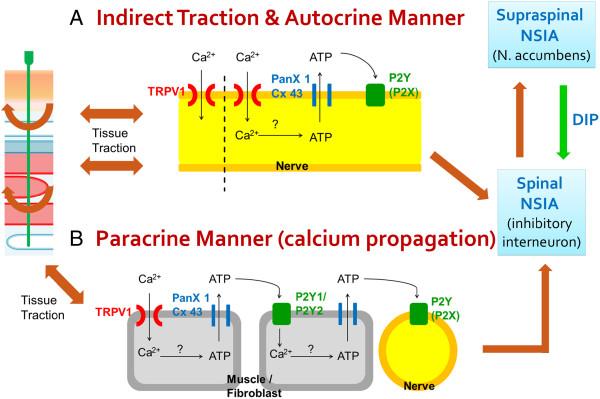
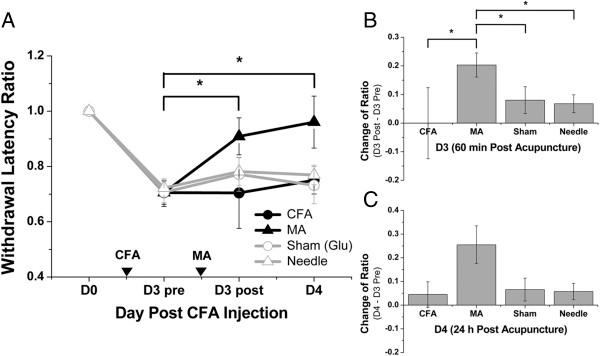
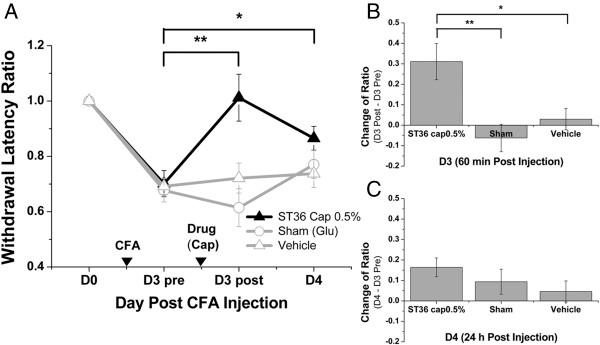
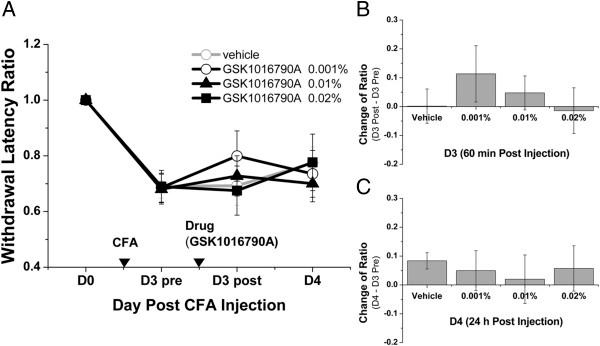
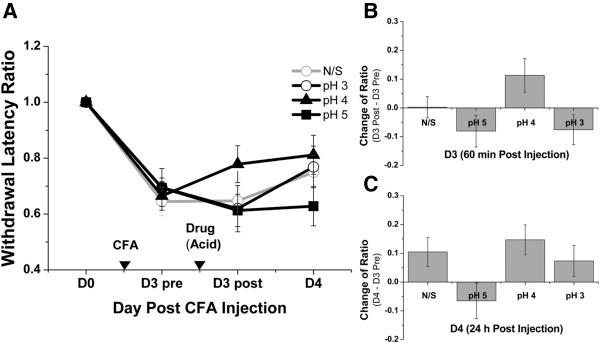
The results from western blotting demonstrated an abundance of TRPV1, TRPV4, and ASIC3 in anatomical layers of ST36. Furthermore, immunofluorescence showed these channels were expressed in both neural and non-neural cells at ST36. However, only capsaicin, a TRPV1 agonist, replicated the analgesic effect of acupuncture when injected into ST36. Components of calcium wave propagation (CWP, the proposed downstream sensing pathway) were also expressed in tissues with abundant TRPV1 expression, the muscle and epimysium layers.
CONCLUSIONS
The results demonstrated mechanosensitive channel TRPV1 is highly expressed at ST36 and possibly participated in acupuncture related analgesia. Since CWP was reported by other to occur during acupuncture and its components were shown here to express in tissues with positive TRPV1 expression. These findings suggest TRPV1 might act as acupuncture-responding channel by sensing physical stimulation from acupuncture and conducting the signaling via CWP to nerve terminals. This study provided a better understanding between physical stimulation from acupuncture to neurological signaling.
背景
针灸是一种通过针刺穴位施加机械刺激的疗法。尽管人们认为针灸可通过阿片类物质或腺苷触发神经调节,但对于物理刺激如何转化为神经信号仍知之甚少。瞬时受体电位香草酸受体1和4(TRPV1和TRPV4)以及酸敏感离子通道3(ASIC3)被视为机械敏感通道。本研究旨在阐明它们在足三里穴(ST36)中的作用,并提出将通道激活与神经信号联系起来的可能传感途径。
方法
首先,采集ST36和假穴不同解剖层的组织,采用蛋白质印迹法比较两点之间的通道表达。其次,在ST36进行免疫荧光以揭示通道的分布模式。第三,将通道激动剂注入ST36,并在小鼠炎性疼痛模型中进行测试,以探究激动剂注射是否能复制针刺样镇痛效果。最后,用蛋白质印迹法检测所提出的下游传感途径的成分,以确定它们是否在机械敏感通道表达阳性的组织中表达。
结果
蛋白质印迹法结果显示ST36的解剖层中大量存在TRPV1、TRPV4和ASIC3。此外,免疫荧光显示这些通道在ST36的神经细胞和非神经细胞中均有表达。然而,只有TRPV1激动剂辣椒素注入ST36时能复制针刺的镇痛效果。钙波传播(CWP,所提出的下游传感途径)的成分也在TRPV1表达丰富的组织即肌肉和肌外膜层中表达。
结论
结果表明机械敏感通道TRPV1在ST36高度表达,并可能参与针刺相关镇痛。由于其他人报道CWP在针刺过程中发生,且此处显示其成分在TRPV1表达阳性的组织中表达。这些发现表明TRPV1可能通过感知针刺的物理刺激并经由CWP将信号传导至神经末梢,从而作为针刺反应通道。本研究为针刺的物理刺激与神经信号之间的关系提供了更好的理解。




 Zotero 插件