
40岁时的生活方式风险因素与剩余预期寿命:一项德国队列研究。
Lifestyle risk factors and residual life expectancy at age 40: a German cohort study.
作者信息
Li Kuanrong, Hüsing Anika, Kaaks Rudolf
机构信息
Division of Cancer Epidemiology, German Cancer Research Centre, Heidelberg, Germany.
出版信息
BMC Med. 2014 Apr 7;12:59. doi: 10.1186/1741-7015-12-59.
BACKGROUND
Cigarette smoking, adiposity, unhealthy diet, heavy alcohol drinking and physical inactivity together are associated with about half of premature deaths in Western populations. The aim of this study was to estimate their individual and combined impacts on residual life expectancy (RLE).
METHODS
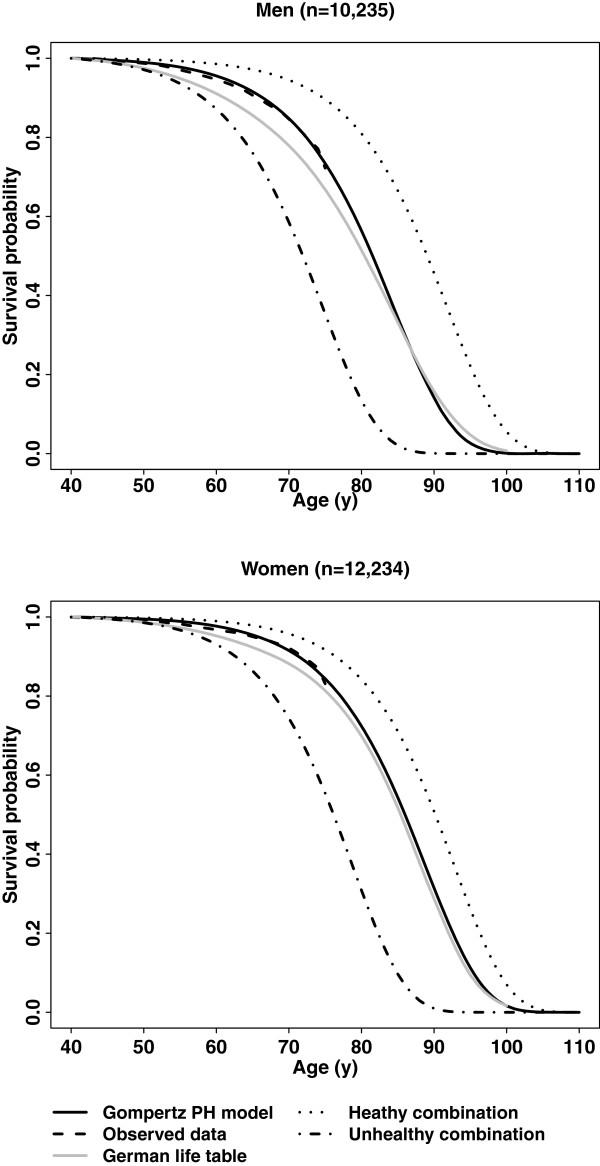
Lifestyle and mortality data from the EPIC-Heidelberg cohort, comprising 22,469 German adults ≥40 years and free of diabetes, cardiovascular disease and cancer at recruitment (1994-1998), were analyzed with multivariable Gompertz proportional hazards models to predict lifetime survival probabilities given specific baseline status of lifestyle risk factors. The life table method was then used to estimate the RLEs.
RESULTS
For 40-year-old adults, the most significant loss of RLE was associated with smoking (9.4 [95% confidence interval: 8.3, 10.6] years for male and 7.3 [6.0, 8.9] years for female heavy smokers [>10 cigarettes/day]; 5.3 [3.6, 7.1] years for men and 5.0 [3.2, 6.6] years for women smoking ≤10 cigarettes/day). Other lifestyle risk factors associated with major losses of RLE were low body mass index (BMI <22.5 kg/m(2), 3.5 [1.8, 5.1] years for men; 2.1 [0.5, 3.6] years for women), obesity (BMI ≥30, 3.1 [1.9, 4.4] years for men; 3.2 [1.8, 5.1] years for women), heavy alcohol drinking (>4 drinks/day, 3.1 [1.9, 4.0] years for men), and high processed/red meat consumption (≥120 g/day, 2.4 [1.0, 3.9] years for women). The obesity-associated loss of RLE was stronger in male never smokers, while the loss of RLE associated with low BMI was stronger in current smokers. The loss of RLE associated with low leisure time physical activity was moderate for women (1.1 [0.05, 2.1] years) and negligible for men (0.4 [-0.3, 1.2] years). The combined loss of RLE for heavy smoking, obesity, heavy alcohol drinking and high processed/red meat consumption, versus never smoking, optimal BMI (22.5 to 24.9), no/light alcohol drinking and low processed/red meat consumption, was 17.0 years for men and 13.9 years for women.
CONCLUSIONS
Promoting healthy lifestyles, particularly no cigarette smoking and maintaining healthy body weight, should be the core component of public health approaches to reducing premature deaths in Germany and similar affluent societies.
背景
在西方人群中,吸烟、肥胖、不健康饮食、大量饮酒和缺乏身体活动共同导致了约一半的过早死亡。本研究的目的是评估它们对剩余预期寿命(RLE)的个体及综合影响。
方法
对来自海德堡欧洲癌症与营养前瞻性调查(EPIC-Heidelberg)队列的生活方式和死亡率数据进行分析,该队列包括22469名年龄≥40岁的德国成年人,他们在招募时(1994 - 1998年)无糖尿病、心血管疾病和癌症。使用多变量Gompertz比例风险模型预测在特定生活方式风险因素基线状态下的终生生存概率。然后采用生命表法估计剩余预期寿命。
结果
对于40岁的成年人,剩余预期寿命损失最显著的与吸烟有关(男性重度吸烟者[>10支/天]为9.4[95%置信区间:8.3, 10.6]年,女性为7.3[6.0, 8.9]年;男性每天吸烟≤10支为5.3[3.6, 7.1]年,女性为5.0[3.2, 6.6]年)。与剩余预期寿命大幅损失相关的其他生活方式风险因素包括低体重指数(BMI<22.5kg/m²,男性为3.5[1.8, 5.1]年;女性为2.1[0.5, 3.6]年)、肥胖(BMI≥30,男性为3.1[1.9, 4.4]年;女性为3.2[1.8, 5.1]年)、大量饮酒(>4杯/天,男性为3.1[1.9, 4.0]年)以及高加工/红肉摄入量(≥120g/天,女性为2.4[1.0, 3.9]年)。肥胖相关的剩余预期寿命损失在男性从不吸烟者中更强,而低体重指数相关的剩余预期寿命损失在当前吸烟者中更强。与低休闲时间身体活动相关的剩余预期寿命损失对女性为中度(1.1[0.05, 2.1]年),对男性可忽略不计(0.4[-0.3, 1.2]年)。与从不吸烟、最佳体重指数(22.5至24.9)、不饮酒/少量饮酒以及低加工/红肉摄入量相比,重度吸烟、肥胖、大量饮酒和高加工/红肉摄入量导致的剩余预期寿命综合损失,男性为17.0年,女性为13.9年。
结论
促进健康的生活方式,尤其是不吸烟和保持健康体重,应成为德国及类似富裕社会减少过早死亡的公共卫生方法的核心组成部分。
 Zotero 插件