
法国全科医生对慢性神经性疼痛临床指南的遵循情况:一项横断面、随机、“电子”病例 vignette 调查的结果
Adherence of French GPs to chronic neuropathic pain clinical guidelines: results of a cross-sectional, randomized, "e" case-vignette survey.
作者信息
Martinez Valéria, Attal Nadine, Vanzo Bertrand, Vicaut Eric, Gautier Jean Michel, Bouhassira Didier, Lantéri-Minet Michel
机构信息
Anesthésiologie-Réanimation, Hôpital Raymond-Poincaré, Garches, France; INSERM U-987, Centre d'Evaluation et de Traitement de la Douleur, CHU Ambroise Paré, Boulogne-Billancourt, France.
INSERM U-987, Centre d'Evaluation et de Traitement de la Douleur, CHU Ambroise Paré, Boulogne-Billancourt, France; Université Versailles-Saint-Quentin, Versailles, France.
出版信息
PLoS One. 2014 Apr 18;9(4):e93855. doi: 10.1371/journal.pone.0093855. eCollection 2014.
BACKGROUND AND AIMS
The French Pain Society published guidelines for neuropathic pain management in 2010. Our aim was to evaluate the compliance of GPs with these guidelines three years later.
METHODS
We used "e" case vignette methodology for this non interventional study. A national panel of randomly selected GPs was included. We used eight "e" case-vignettes relating to chronic pain, differing in terms of the type of pain (neuropathic/non neuropathic), etiology (cancer, postoperative pain, low back pain with or without radicular pain, diabetes) and symptoms. GPs received two randomly selected consecutive "e" case vignettes (with/without neuropathic pain). We analyzed their ability to recognize neuropathic pain and to prescribe appropriate first-line treatment.
RESULTS
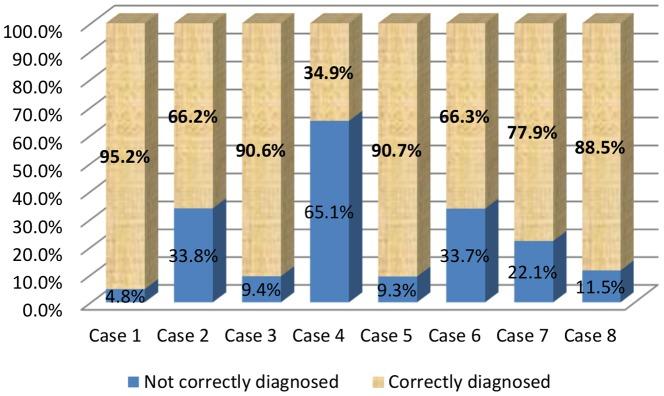
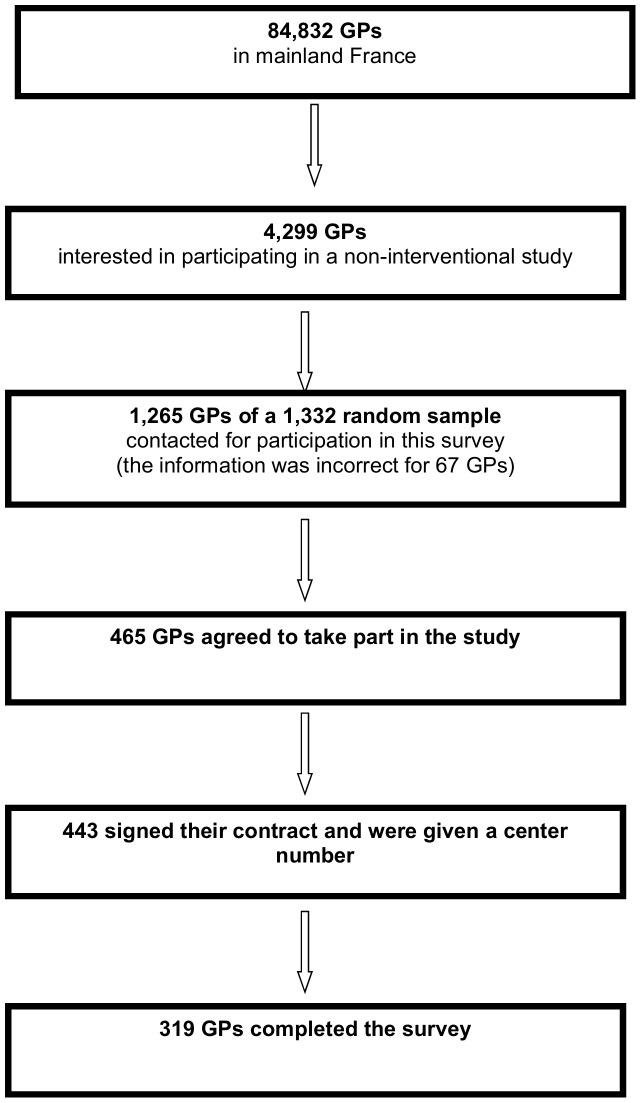
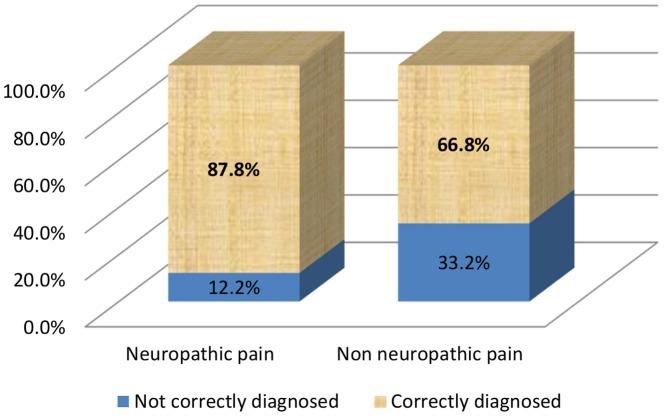
From the 1265 GPs in the database, we recruited 443 (35.0%), 334 of whom logged onto the web site (26.4%) and 319 (25.2%) of whom completed the survey. Among these GPs, 170 (53.3%) were aware of the guidelines, 136 (42.6%) were able to follow them, and 110 (34.5%) used the DN4 diagnostic tool. Sensitivity for neuropathic pain recognition was 87.8% (CI: 84.2%; 91.4%). However, postoperative neuropathic pain was less well diagnosed (77.9%; CI: 69.6%; 86.2%) than diabetic pain (95.2%; CI: 90.0%; 100.0%), cancer pain (90.6%; CI: 83.5%; 97.8%) and typical radicular pain (90.7%; CI: 84.9%; 96.5%). When neuropathic pain was correctly recognized, the likelihood of appropriate first-line treatment prescription was 90.6% (CI: 87.4%; 93.8%). The treatments proposed were pregabaline (71.8%), gabapentine (43.9%), amiptriptylline (23.2%) and duloxetine (18.2%). However, ibuprofen (11%), acetaminophen-codeine (29.5%) and clonazepam (10%) were still prescribed.
CONCLUSIONS
The compliance of GPs with clinical practice guidelines appeared to be satisfactory, but differed between etiologies.
背景与目的
法国疼痛协会于2010年发布了神经性疼痛管理指南。我们的目的是在三年后评估全科医生对这些指南的遵循情况。
方法
我们在这项非干预性研究中采用了“电子”病例 vignette 方法。纳入了一个随机挑选的全国全科医生小组。我们使用了八个与慢性疼痛相关的“电子”病例 vignette,在疼痛类型(神经性/非神经性)、病因(癌症、术后疼痛、伴有或不伴有神经根性疼痛的腰痛、糖尿病)和症状方面存在差异。全科医生收到两个随机挑选的连续“电子”病例 vignette(有/无神经性疼痛)。我们分析了他们识别神经性疼痛并开出适当一线治疗方案的能力。
结果
在数据库中的1265名全科医生中,我们招募了443名(35.0%),其中334名登录了网站(26.4%),319名(25.2%)完成了调查。在这些全科医生中,170名(53.3%)知晓该指南,136名(42.6%)能够遵循该指南,110名(34.5%)使用了DN4诊断工具。神经性疼痛识别的敏感性为87.8%(置信区间:84.2%;91.4%)。然而,术后神经性疼痛的诊断效果(77.9%;置信区间:69.6%;86.2%)不如糖尿病性疼痛(95.2%;置信区间:90.0%;100.0%)、癌症疼痛(90.6%;置信区间:83.5%;97.8%)和典型神经根性疼痛(90.7%;置信区间:84.9%;96.5%)。当神经性疼痛被正确识别时,开出适当一线治疗方案的可能性为90.6%(置信区间:87.4%;93.8%)。所提议的治疗药物为普瑞巴林(71.8%)、加巴喷丁(43.9%)、阿米替林(23.2%)和度洛西汀(18.2%)。然而,布洛芬(11%)、对乙酰氨基酚 - 可待因(29.5%)和氯硝西泮(10%)仍被开出。
结论
全科医生对临床实践指南的遵循情况似乎令人满意,但不同病因之间存在差异。


 Zotero 插件