
将转录组数据整合到基于约束的代谢模型中的方法的系统评估。
Systematic evaluation of methods for integration of transcriptomic data into constraint-based models of metabolism.
作者信息
Machado Daniel, Herrgård Markus
机构信息
The Novo Nordisk Foundation Center for Biosustainability, Technical University of Denmark, Horsholm, Denmark.
出版信息
PLoS Comput Biol. 2014 Apr 24;10(4):e1003580. doi: 10.1371/journal.pcbi.1003580. eCollection 2014 Apr.
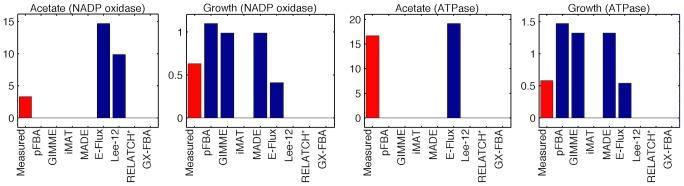
Constraint-based models of metabolism are a widely used framework for predicting flux distributions in genome-scale biochemical networks. The number of published methods for integration of transcriptomic data into constraint-based models has been rapidly increasing. So far the predictive capability of these methods has not been critically evaluated and compared. This work presents a survey of recently published methods that use transcript levels to try to improve metabolic flux predictions either by generating flux distributions or by creating context-specific models. A subset of these methods is then systematically evaluated using published data from three different case studies in E. coli and S. cerevisiae. The flux predictions made by different methods using transcriptomic data are compared against experimentally determined extracellular and intracellular fluxes (from 13C-labeling data). The sensitivity of the results to method-specific parameters is also evaluated, as well as their robustness to noise in the data. The results show that none of the methods outperforms the others for all cases. Also, it is observed that for many conditions, the predictions obtained by simple flux balance analysis using growth maximization and parsimony criteria are as good or better than those obtained using methods that incorporate transcriptomic data. We further discuss the differences in the mathematical formulation of the methods, and their relation to the results we have obtained, as well as the connection to the underlying biological principles of metabolic regulation.
基于约束的代谢模型是预测基因组规模生化网络中通量分布的广泛使用的框架。将转录组数据整合到基于约束的模型中的已发表方法的数量一直在迅速增加。到目前为止,这些方法的预测能力尚未得到严格评估和比较。这项工作对最近发表的使用转录水平来尝试通过生成通量分布或创建特定上下文模型来改善代谢通量预测的方法进行了综述。然后,使用来自大肠杆菌和酿酒酵母的三个不同案例研究的已发表数据,对这些方法的一个子集进行系统评估。将使用转录组数据的不同方法所做的通量预测与实验确定的细胞外和细胞内通量(来自13C标记数据)进行比较。还评估了结果对方法特定参数的敏感性,以及它们对数据噪声的鲁棒性。结果表明,没有一种方法在所有情况下都优于其他方法。此外,还观察到,在许多条件下,使用生长最大化和简约标准的简单通量平衡分析获得的预测与使用纳入转录组数据的方法获得的预测一样好或更好。我们进一步讨论了这些方法在数学公式上的差异,它们与我们获得的结果的关系,以及与代谢调节的潜在生物学原理的联系。


 Zotero 插件