
外周血中Y染色体的嵌合性缺失与较短的生存期及较高的癌症风险相关。
Mosaic loss of chromosome Y in peripheral blood is associated with shorter survival and higher risk of cancer.
作者信息
Forsberg Lars A, Rasi Chiara, Malmqvist Niklas, Davies Hanna, Pasupulati Saichand, Pakalapati Geeta, Sandgren Johanna, Diaz de Ståhl Teresita, Zaghlool Ammar, Giedraitis Vilmantas, Lannfelt Lars, Score Joannah, Cross Nicholas C P, Absher Devin, Janson Eva Tiensuu, Lindgren Cecilia M, Morris Andrew P, Ingelsson Erik, Lind Lars, Dumanski Jan P
机构信息
1] Department of Immunology, Genetics and Pathology, Uppsala University, Uppsala, Sweden. [2] Science for Life Laboratory, Uppsala University, Uppsala, Sweden.
1] Department of Immunology, Genetics and Pathology, Uppsala University, Uppsala, Sweden. [2] Science for Life Laboratory, Uppsala University, Uppsala, Sweden. [3] Department of Medical Sciences, Uppsala University, Uppsala, Sweden.
出版信息
Nat Genet. 2014 Jun;46(6):624-8. doi: 10.1038/ng.2966. Epub 2014 Apr 28.
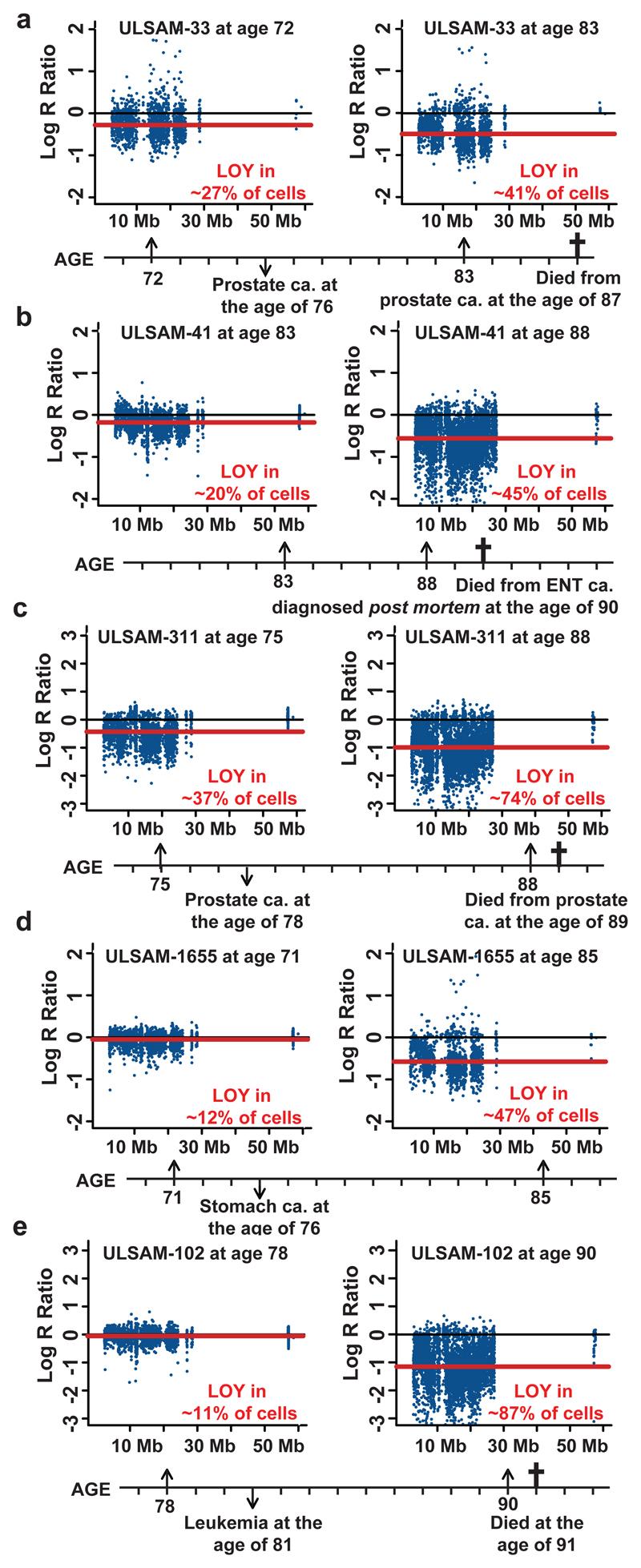
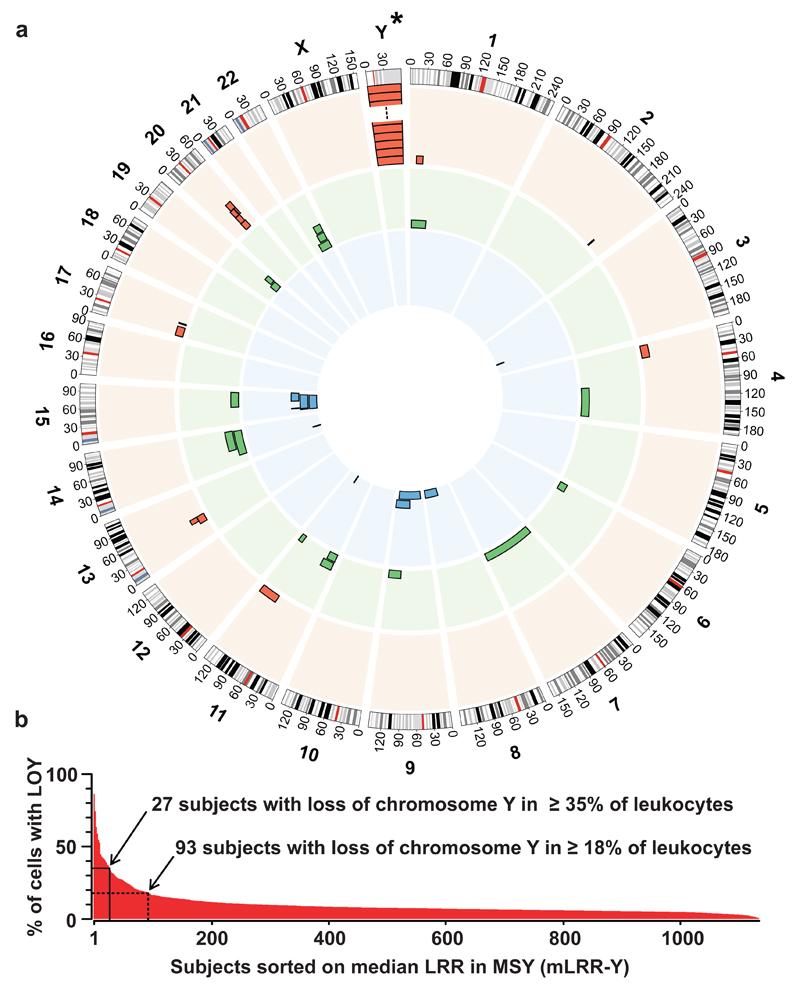
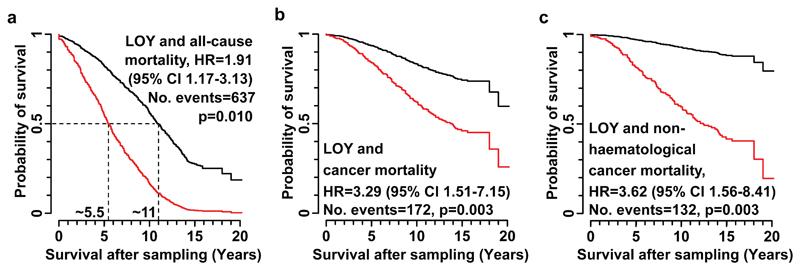
Incidence and mortality for sex-unspecific cancers are higher among men, a fact that is largely unexplained. Furthermore, age-related loss of chromosome Y (LOY) is frequent in normal hematopoietic cells, but the phenotypic consequences of LOY have been elusive. From analysis of 1,153 elderly men, we report that LOY in peripheral blood was associated with risks of all-cause mortality (hazards ratio (HR) = 1.91, 95% confidence interval (CI) = 1.17-3.13; 637 events) and non-hematological cancer mortality (HR = 3.62, 95% CI = 1.56-8.41; 132 events). LOY affected at least 8.2% of the subjects in this cohort, and median survival times among men with LOY were 5.5 years shorter. Association of LOY with risk of all-cause mortality was validated in an independent cohort (HR = 3.66) in which 20.5% of subjects showed LOY. These results illustrate the impact of post-zygotic mosaicism on disease risk, could explain why males are more frequently affected by cancer and suggest that chromosome Y is important in processes beyond sex determination. LOY in blood could become a predictive biomarker of male carcinogenesis.
非性别特异性癌症的发病率和死亡率在男性中更高,这一事实在很大程度上无法解释。此外,正常造血细胞中与年龄相关的Y染色体丢失(LOY)很常见,但LOY的表型后果一直难以捉摸。通过对1153名老年男性的分析,我们报告外周血中的LOY与全因死亡率风险(风险比(HR)=1.91,95%置信区间(CI)=1.17-3.13;637例事件)和非血液系统癌症死亡率(HR = 3.62,95% CI = 1.56-8.41;132例事件)相关。LOY影响了该队列中至少8.2%的受试者,LOY男性的中位生存时间缩短了5.5年。LOY与全因死亡率风险的关联在一个独立队列中得到验证(HR = 3.66),其中20.5%的受试者显示LOY。这些结果说明了合子后嵌合体对疾病风险的影响,可以解释为什么男性更容易患癌症,并表明Y染色体在性别决定以外的过程中很重要。血液中的LOY可能成为男性致癌作用的预测生物标志物。

 Zotero 插件