
遗传性乳腺癌和卵巢癌:巴西患者点突变和拷贝数变异的评估。
Hereditary breast and ovarian cancer: assessment of point mutations and copy number variations in Brazilian patients.
机构信息
Laboratory of Genomics and Molecular Biology, CIPE - A, C, Camargo Cancer Center, São Paulo, Brazil.
出版信息
BMC Med Genet. 2014 May 15;15:55. doi: 10.1186/1471-2350-15-55.
BACKGROUND
Germ line mutations in BRCA1 and BRCA2 (BRCA1/2) and other susceptibility genes have been identified as genetic causes of hereditary breast and ovarian cancer (HBOC). To identify the disease-causing mutations in a cohort of 120 Brazilian women fulfilling criteria for HBOC, we carried out a comprehensive screening of BRCA1/2, TP53 R337H, CHEK2 1100delC, followed by an analysis of copy number variations in 14 additional breast cancer susceptibility genes (PTEN, ATM, NBN, RAD50, RAD51, BRIP1, PALB2, MLH1, MSH2, MSH6, TP53, CDKN2A, CDH1 and CTNNB1).
METHODS
Capillary sequencing and multiplex ligation-dependent probe amplification (MLPA) were used for detecting point mutations and copy number variations (CNVs), respectively, for the BRCA1 and BRCA2 genes; capillary sequencing was used for point mutation for both variants TP53 R337H and CHEK2 1100delC, and finally array comparative genomic hybridization (array-CGH) was used for identifying CNVs in the 14 additional genes.
RESULTS
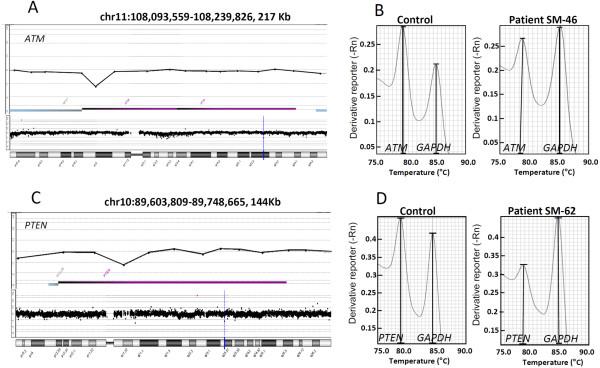
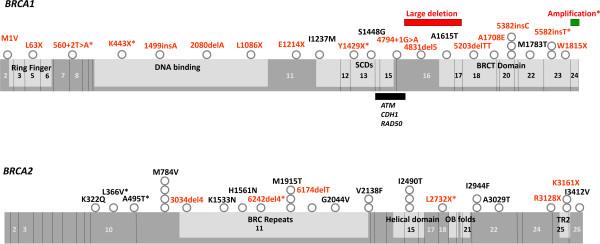
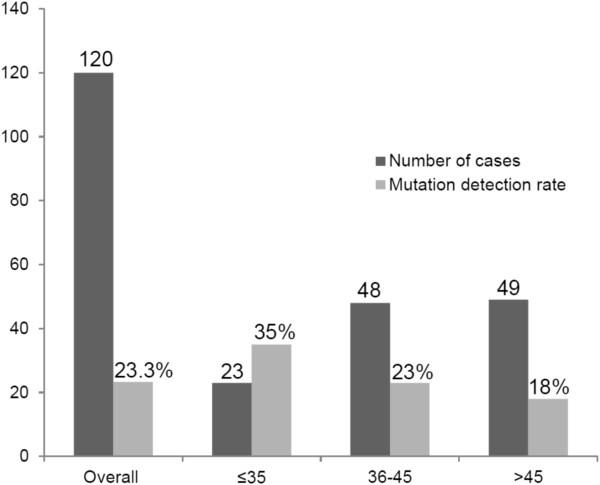
The positive detection rate in our series was 26%. BRCA1 pathogenic mutations were found in 20 cases, including two cases with CNVs, whereas BRCA2 mutations were found in 7 cases. We also found three patients with the TP53 R337H mutation and one patient with the CHEK2 1100delC mutation. Seven (25%) pathogenic mutations in BRCA1/2 were firstly described, including a splice-site BRCA1 mutation for which pathogenicity was confirmed by the presence of an aberrant transcript showing the loss of the last 62 bp of exon 7. Microdeletions of exon 4 in ATM and exon 2 in PTEN were identified in BRCA2-mutated and BRCA1/2-negative patients, respectively.
CONCLUSIONS
In summary, our results showed a high frequency of BRCA1/2 mutations and a higher prevalence of BRCA1 (64.5%) gene. Moreover, the detection of the TP53 R337H variant in our series and the fact that this variant has a founder effect in our population prompted us to suggest that all female breast cancer patients with clinical criteria for HBOC and negative for BRCA1/2 genes should be tested for the TP53 R337H variant. Furthermore, the presence of genomic structural rearrangement resulting in CNVs in other genes that predispose breast cancer in conjunction with BRCA2 point mutations demonstrated a highly complex genetic etiology in Brazilian breast cancer families.
背景
BRCA1 和 BRCA2(BRCA1/2)和其他易感基因中的种系突变已被确定为遗传性乳腺癌和卵巢癌(HBOC)的遗传原因。为了确定符合 HBOC 标准的 120 名巴西女性队列中的致病突变,我们对 BRCA1/2、TP53 R337H、CHEK2 1100delC 进行了全面筛查,随后对 14 个额外的乳腺癌易感基因(PTEN、ATM、NBN、RAD50、RAD51、BRIP1、PALB2、MLH1、MSH2、MSH6、TP53、CDKN2A、CDH1 和 CTNNB1)进行了拷贝数变异分析。
方法
毛细管测序和多重连接依赖性探针扩增(MLPA)分别用于检测 BRCA1 和 BRCA2 基因的点突变和拷贝数变异(CNVs);毛细管测序用于检测 TP53 R337H 和 CHEK2 1100delC 两个变体的点突变,最后使用阵列比较基因组杂交(array-CGH)来鉴定 14 个额外基因中的 CNVs。
结果
我们的系列检测阳性率为 26%。发现 20 例 BRCA1 致病性突变,其中 2 例存在 CNVs,而 BRCA2 突变 7 例。我们还发现 3 例 TP53 R337H 突变患者和 1 例 CHEK2 1100delC 突变患者。BRCA1/2 中发现了 7 种(25%)致病性突变,其中包括一种剪接位点 BRCA1 突变,通过存在缺失最后 62 bp 外显子 7 的异常转录本证实了其致病性。ATM 外显子 4 和 PTEN 外显子 2 的微缺失分别在 BRCA2 突变和 BRCA1/2 阴性患者中发现。
结论
总之,我们的结果显示 BRCA1/2 突变的频率较高,BRCA1(64.5%)基因的患病率较高。此外,我们的研究系列中检测到 TP53 R337H 变体,并且该变体在我们人群中存在启动子效应,这促使我们建议所有具有 HBOC 临床标准且 BRCA1/2 基因阴性的女性乳腺癌患者均应检测 TP53 R337H 变体。此外,与 BRCA2 点突变一起导致其他乳腺癌易感基因的基因组结构重排导致 CNVs 的存在表明巴西乳腺癌家族具有高度复杂的遗传病因。

 Zotero 插件