
对青少年抑郁症不一致的同卵双胞胎进行全基因组甲基化分析。
Genome-wide methylomic analysis of monozygotic twins discordant for adolescent depression.
作者信息
Dempster Emma L, Wong Chloe C Y, Lester Kathryn J, Burrage Joe, Gregory Alice M, Mill Jonathan, Eley Thalia C
机构信息
University of Exeter Medical School, Exeter University, Exeter.
Social Genetic Developmental Psychiatry Centre, Institute of Psychiatry, King's College London.
出版信息
Biol Psychiatry. 2014 Dec 15;76(12):977-83. doi: 10.1016/j.biopsych.2014.04.013. Epub 2014 May 6.
BACKGROUND
Adolescent depression is a common neuropsychiatric disorder that often continues into adulthood and is associated with a wide range of poor outcomes including suicide. Although numerous studies have looked at genetic markers associated with depression, the role of epigenetic variation remains relatively unexplored.
METHODS
Monozygotic (MZ) twins were selected from an adolescent twin study designed to investigate the interplay of genetic and environmental factors in the development of emotional and behavioral difficulties. There were 18 pairs of MZ twins identified in which one member scored consistently higher (group mean within the clinically significant range) on self-rated depression than the other. We assessed genome-wide patterns of DNA methylation in twin buccal cell DNA using the Infinium HumanMethylation450 BeadChip from Illumina. Quality control and data preprocessing was undertaken using the wateRmelon package. Differentially methylated probes (DMPs) were identified using an analysis strategy taking into account both the significance and the magnitude of DNA methylation differences. The top differentially methylated DMP was successfully validated by bisulfite-pyrosequencing, and identified DMPs were tested in postmortem brain samples obtained from patients with major depressive disorder (n = 14) and matched control subjects (n = 15).
RESULTS
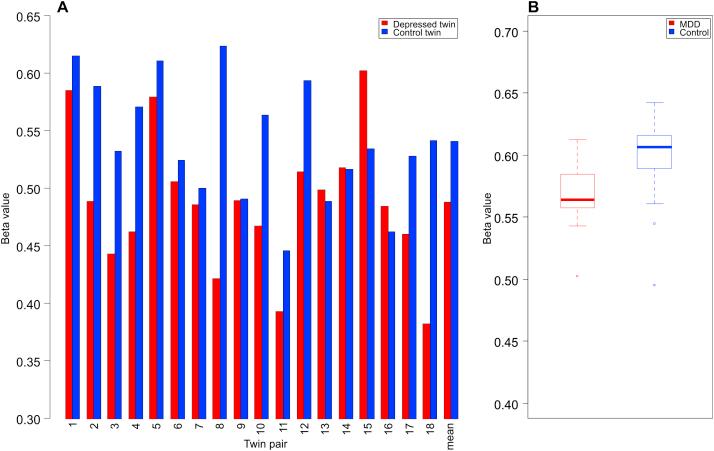
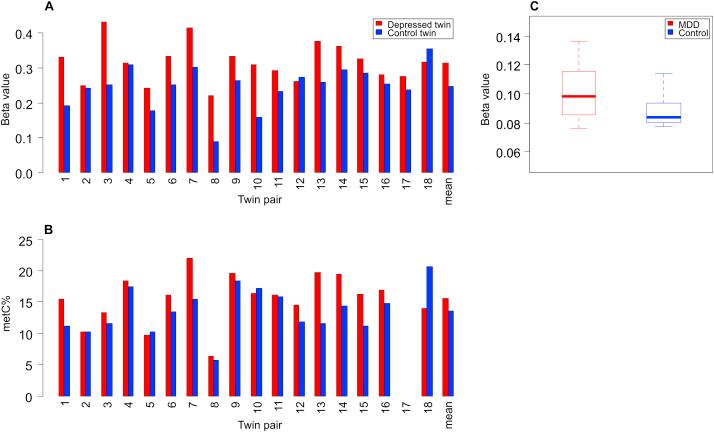
Two reproducible depression-associated DMPs were identified, including the top-ranked DMP that was located within STK32C, which encodes a serine/threonine kinase, of unknown function.
CONCLUSIONS
Our data indicate that DNA methylation differences are apparent in MZ twins discordant for adolescent depression and that some of the disease-associated variation observed in buccal cell DNA is mirrored in adult brain tissue obtained from individuals with clinical depression.
背景
青少年抑郁症是一种常见的神经精神疾病,常持续至成年,并与包括自杀在内的一系列不良后果相关。尽管众多研究已着眼于与抑郁症相关的遗传标记,但表观遗传变异的作用仍相对未被探索。
方法
从一项青少年双胞胎研究中选取同卵双胞胎,该研究旨在调查遗传和环境因素在情绪及行为障碍发展中的相互作用。共识别出18对同卵双胞胎,其中一对双胞胎在自评抑郁量表上的得分始终高于另一对(组均值在临床显著范围内)。我们使用Illumina公司的Infinium HumanMethylation450 BeadChip评估双胞胎颊细胞DNA中的全基因组DNA甲基化模式。使用wateRmelon软件包进行质量控制和数据预处理。通过一种兼顾DNA甲基化差异的显著性和幅度的分析策略来识别差异甲基化探针(DMP)。排名最高的差异甲基化DMP通过亚硫酸氢盐焦磷酸测序成功验证,并在从重度抑郁症患者(n = 14)和匹配的对照受试者(n = 15)获取的死后脑样本中对识别出的DMP进行检测。
结果
识别出两个可重复的与抑郁症相关的DMP,包括排名最高的位于STK32C内的DMP,STK32C编码一种功能未知的丝氨酸/苏氨酸激酶。
结论
我们的数据表明,在青少年抑郁症不一致的同卵双胞胎中,DNA甲基化差异明显,并且在颊细胞DNA中观察到的一些与疾病相关的变异在从临床抑郁症患者获取的成人大脑组织中也有体现。

 Zotero 插件