
传染性法氏囊病病毒在DF-1细胞系和鸡胚成纤维细胞中的生长与复制。
Growth and replication of infectious bursal disease virus in the DF-1 cell line and chicken embryo fibroblasts.
作者信息
Rekha Kaliyaperumal, Sivasubramanian Chandran, Chung Ill-Min, Thiruvengadam Muthu
机构信息
Department of Environmental and Herbal Science, Tamil University, Thanjavur, Tamil Nadu 613005, India.
Department of Applied Bioscience, College of Life and Environmental Sciences, Konkuk University, Seoul 143701, Republic of Korea.
出版信息
Biomed Res Int. 2014;2014:494835. doi: 10.1155/2014/494835. Epub 2014 May 14.
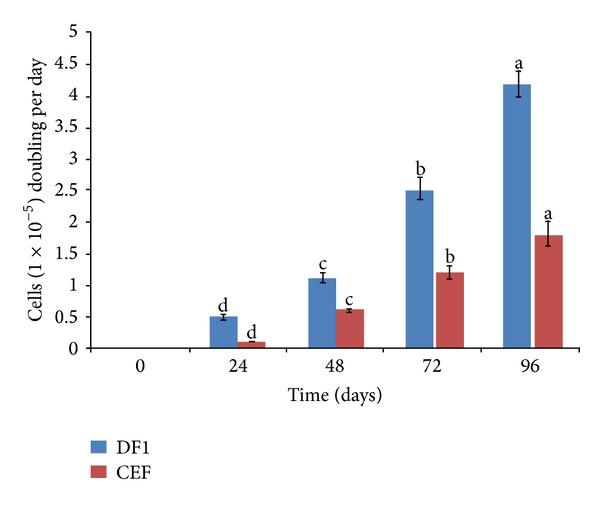
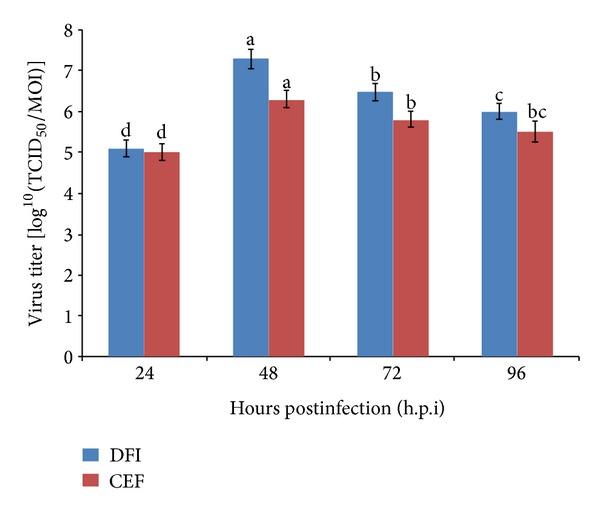
Infectious bursal disease virus (IBDV) causes a highly contagious disease in young chicks and leads to significant economic losses in the poultry industry. To determine a suitable cell line for IBDV infection, replication, and growth kinetics of the virus, DF-1 cells and chicken embryo fibroblasts (CEF) were used. The population doubling per day (Pd/D) was found to be higher in DF-1 as compared to CEF cells. A suitable time of infection (TOI) was established for increased production of virus and greater infectivity titers. The DF-1 and CEF cells were found to be susceptible to infection by producing marked cytopathic effects (CPEs), and the growth curves of IBDV in DF-1 and CEF cells were evaluated by infectivity assay using tissue culture infectious dose (TCID50). The cytopathic effects of the virus in DF-1 and CEF cells were found to be similar, but higher viral titers were detected in the DF-1 cells as compared to CEF. Thus the DF-1 cell line had a higher growth potential and infectivity, which will be of advantage in vaccine production.
传染性法氏囊病病毒(IBDV)在雏鸡中引发一种高度传染性疾病,并给家禽业造成重大经济损失。为确定适合IBDV感染、复制及病毒生长动力学研究的细胞系,使用了DF-1细胞和鸡胚成纤维细胞(CEF)。结果发现,与CEF细胞相比,DF-1细胞的每日群体倍增数(Pd/D)更高。确定了一个合适的感染时间(TOI),以提高病毒产量和感染性滴度。通过产生明显的细胞病变效应(CPE)发现DF-1和CEF细胞对感染敏感,并且使用组织培养感染剂量(TCID50)通过感染性测定评估了IBDV在DF-1和CEF细胞中的生长曲线。发现病毒在DF-1和CEF细胞中的细胞病变效应相似,但与CEF相比,在DF-1细胞中检测到更高的病毒滴度。因此,DF-1细胞系具有更高的生长潜力和感染性,这将有利于疫苗生产。



 Zotero 插件