
没食子酸乙酯通过调节胰岛素样 DAF-16 信号通路增强秀丽隐杆线虫的应激抗性和寿命。
Caffeic acid phenethylester increases stress resistance and enhances lifespan in Caenorhabditis elegans by modulation of the insulin-like DAF-16 signalling pathway.
机构信息
Institute of Toxicology, Heinrich-Heine-Universität, Düsseldorf, Germany; Institute of Food Chemistry, Westfälische Wilhelms-Universität, Münster, Germany; Institute of Agricultural and Nutritional Sciences, Martin-Luther-Universität Halle-Wittenberg, Halle/Saale, Germany.
Institute of Toxicology, Heinrich-Heine-Universität, Düsseldorf, Germany.
出版信息
PLoS One. 2014 Jun 25;9(6):e100256. doi: 10.1371/journal.pone.0100256. eCollection 2014.
UNLABELLED
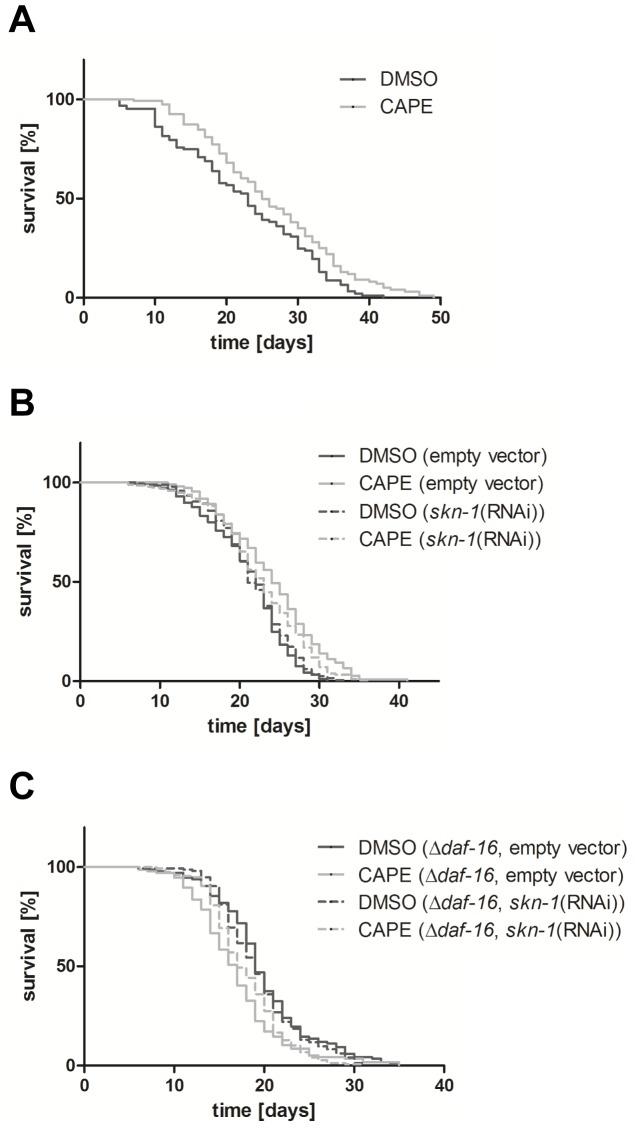
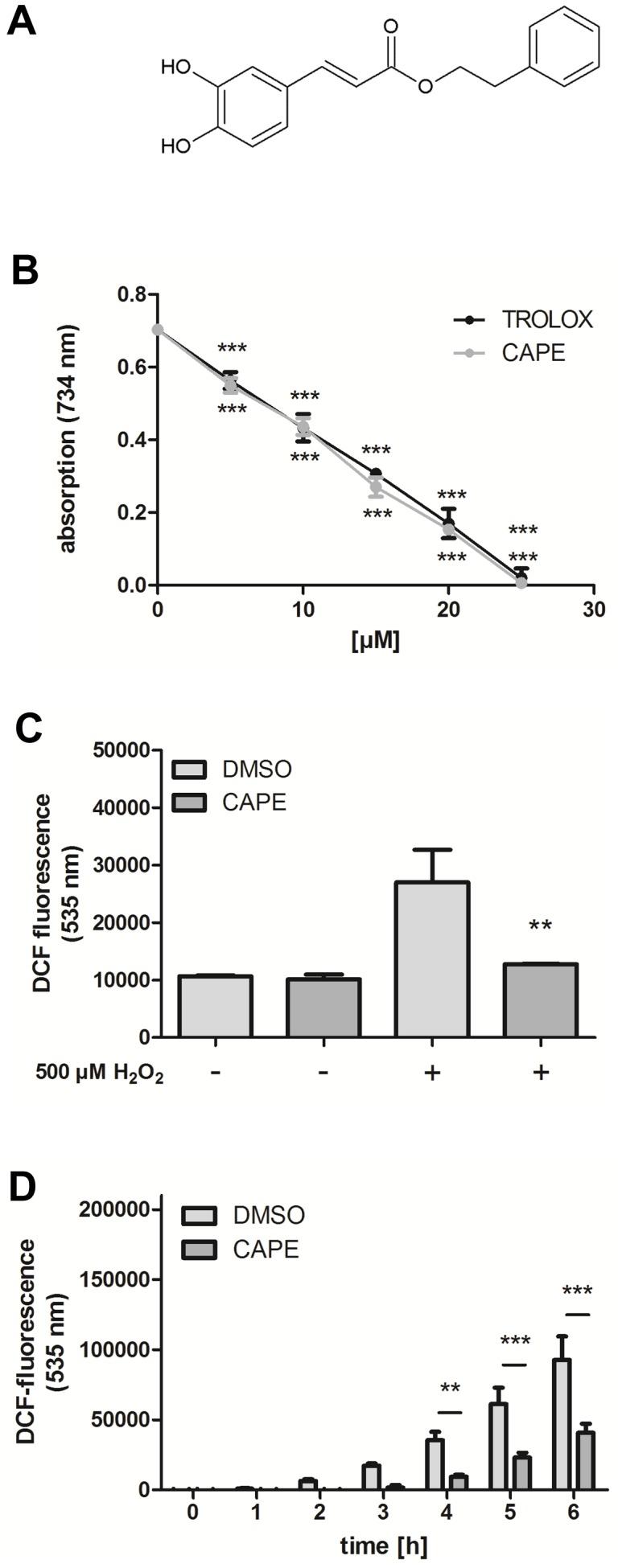
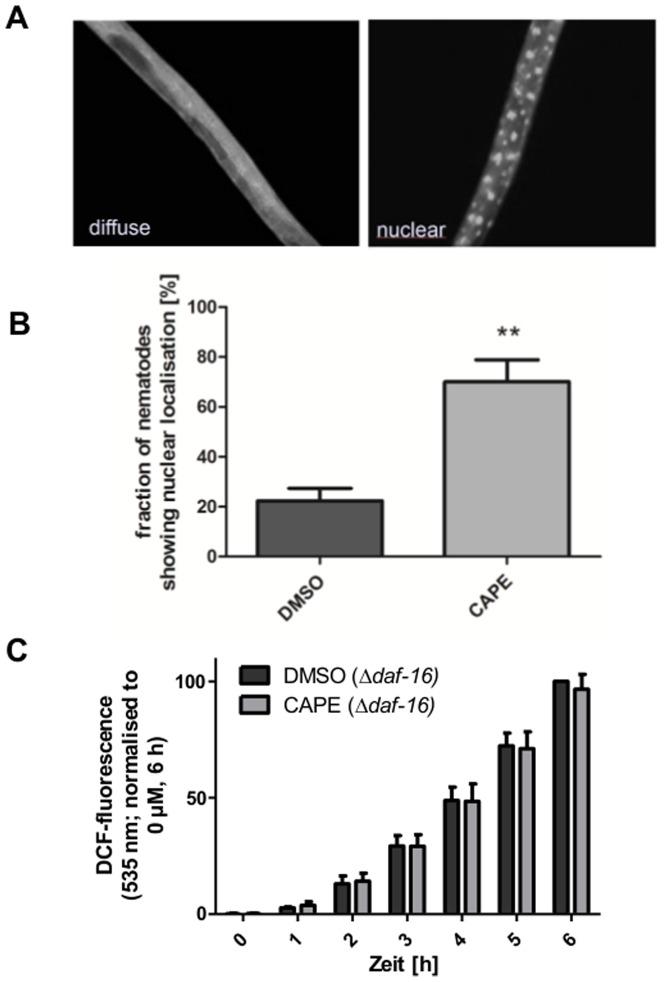
CAPE is an active constituent of propolis which is widely used in traditional medicine. This hydroxycinnamic acid derivate is a known activator of the redox-active Nrf2 signalling pathway in mammalian cells. We used C. elegans to investigate the effects of this compound on accumulation of reactive oxygen species and the modulation of the pivotal redox-active pathways SKN-1 and DAF-16 (homologues of Nrf2 and FoxO, respectively) in this model organism; these results were compared to the effects in Hct116 human colon carcinoma cells. CAPE exerts a strong antioxidative effect in C. elegans: The increase of reactive oxygen species induced by thermal stress was diminished by about 50%. CAPE caused a nuclear translocation of DAF-16, but not SKN-1. CAPE increased stress resistance of the nematode against thermal stress and finally a prolongation of the median and maximum lifespan by 9 and 17%, respectively. This increase in stress resistance and lifespan was dependent on DAF-16 as shown in experiments using a DAF-16 loss of function mutant strain. Life prolongation was retained under SKN-1 RNAi conditions showing that the effect is SKN-1 independent. The results of CAPE obtained in C. elegans differed from the results obtained in Hct116 colon carcinoma cells: CAPE also caused strong antioxidative effects in the mammalian cells, but no activation of the FoxO4 signalling pathway was detectable. Instead, an activation of the Nrf2 signalling pathway was shown by luciferase assay and western blots.
CONCLUSION
CAPE activates the insulin-like DAF-16, but not the SKN-1 signalling pathway in C. elegans and therefore enhances the stress resistance and lifespan of this organism. Since modulation of the DAF-16 pathway was found to be a pivotal effect of CAPE in C. elegans, this has to be taken into account for the investigation of the molecular mechanisms of the traditional use of propolis.
未加标签
CAPE 是广泛应用于传统医学中的蜂胶的一种活性成分。这种羟基肉桂酸衍生物是哺乳动物细胞中已知的活性氧 Nrf2 信号通路的激活剂。我们使用秀丽隐杆线虫来研究这种化合物对活性氧积累的影响,并在该模型生物中调节关键的活性氧途径 SKN-1 和 DAF-16(分别为 Nrf2 和 FoxO 的同源物);将这些结果与 Hct116 人结肠癌细胞的结果进行比较。CAPE 在秀丽隐杆线虫中表现出很强的抗氧化作用:热应激诱导的活性氧增加减少了约 50%。CAPE 导致 DAF-16 的核易位,但不导致 SKN-1 的核易位。CAPE 增加了线虫对热应激的应激抗性,最终使线虫的中位和最大寿命分别延长了 9%和 17%。这种应激抗性和寿命的增加依赖于 DAF-16,如使用 DAF-16 功能丧失突变株进行的实验所示。在 SKN-1 RNAi 条件下,寿命延长得以保留,表明该效应不依赖于 SKN-1。在秀丽隐杆线虫中获得的 CAPE 结果与在 Hct116 结肠癌细胞中获得的结果不同:CAPE 也在哺乳动物细胞中引起强烈的抗氧化作用,但不能检测到 FoxO4 信号通路的激活。相反,通过荧光素酶测定和 Western blot 显示了 Nrf2 信号通路的激活。
结论
CAPE 在秀丽隐杆线虫中激活胰岛素样 DAF-16,而不是 SKN-1 信号通路,因此增强了该生物的应激抗性和寿命。由于在秀丽隐杆线虫中发现 DAF-16 途径的调节是 CAPE 的关键作用,因此在研究蜂胶传统用途的分子机制时必须考虑到这一点。




 Zotero 插件