
伯氨喹或其他8-氨基喹啉用于减少恶性疟原虫传播。
Primaquine or other 8-aminoquinoline for reducing P. falciparum transmission.
作者信息
Graves Patricia M, Gelband Hellen, Garner Paul
机构信息
EpiVec Consulting, 606 Kimberly Lane NE, Atlanta, USA, GA 30306.
出版信息
Cochrane Database Syst Rev. 2014 Jun 30(6):CD008152. doi: 10.1002/14651858.CD008152.pub3.
BACKGROUND
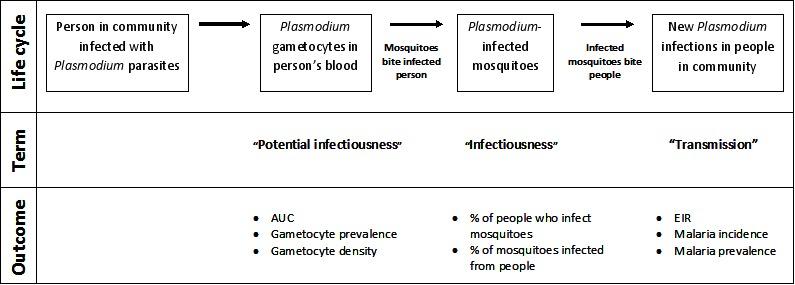
Mosquitoes become infected with Plasmodium when they ingest gametocyte-stage parasites from an infected person's blood. Plasmodium falciparum gametocytes are sensitive to the drug primaquine (PQ) and other 8-aminoquinolines (8AQ); these drugs could prevent parasite transmission from infected people to mosquitoes, and consequently reduce the incidence of malaria. However, PQ will not directly benefit the individual, and could be harmful to those with glucose-6-phosphate dehydrogenase (G6PD) deficiency.In 2010, The World Health Organization (WHO) recommended a single dose of PQ at 0.75 mg/kg, alongside treatment for P. falciparum malaria to reduce transmission in areas approaching malaria elimination. In 2013 the WHO revised this to 0.25 mg/kg due to concerns about safety.
OBJECTIVES
To assess whether giving PQ or an alternative 8AQ alongside treatment for P. falciparum malaria reduces malaria transmission, and to estimate the frequency of severe or haematological adverse events when PQ is given for this purpose.
SEARCH METHODS
We searched the following databases up to 10 Feb 2014 for trials: the Cochrane Infectious Diseases Group Specialized Register; the Cochrane Central Register of Controlled Trials (CENTRAL), published in The Cochrane Library; MEDLINE; EMBASE; LILACS; metaRegister of Controlled Trials (mRCT); and the WHO trials search portal using 'malaria*', 'falciparum', and 'primaquine' as search terms. In addition, we searched conference proceedings and reference lists of included studies, and contacted researchers and organizations.
SELECTION CRITERIA
Randomized controlled trials (RCTs) or quasi-RCTs comparing PQ (or alternative 8AQ) given as a single dose or short course alongside treatment for P. falciparum malaria with malaria treatment given without PQ/8AQ in adults or children.
DATA COLLECTION AND ANALYSIS
Two authors independently screened all abstracts, applied inclusion criteria, and extracted data. We sought evidence of an impact on transmission (community incidence), infectiousness (mosquitoes infected from humans) and potential infectiousness (gametocyte measures). We calculated the area under the curve (AUC) for gametocyte density over time for comparisons for which data were available. We sought data on haematological and other adverse effects, as well as secondary outcomes of asexual clearance time and recrudescence. We stratified by whether the malaria treatment regimen included an artemisinin derivative or not; by PQ dose category (low < 0.4 mg/kg; medium ≥ 0.4 to < 0.6 mg/kg; high ≥ 0.6 mg/kg); and by PQ schedules. We used the GRADE approach to assess evidence quality.
MAIN RESULTS
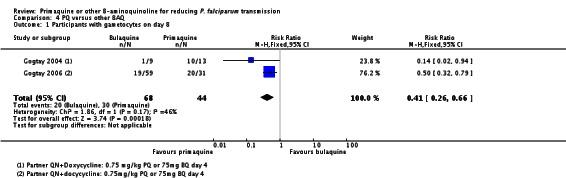
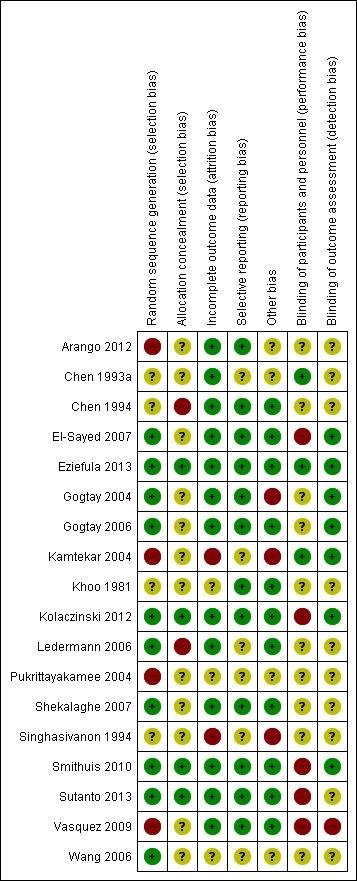
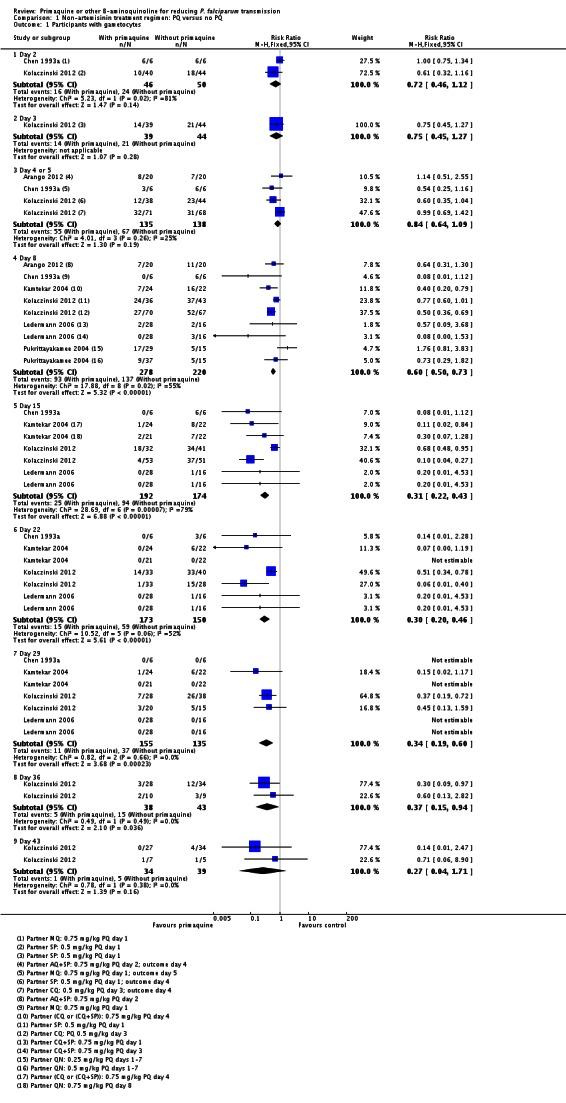
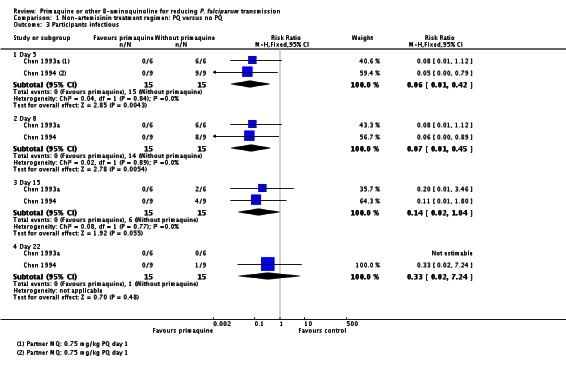
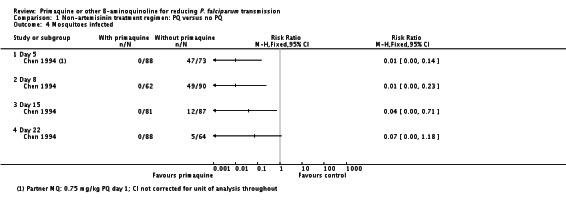
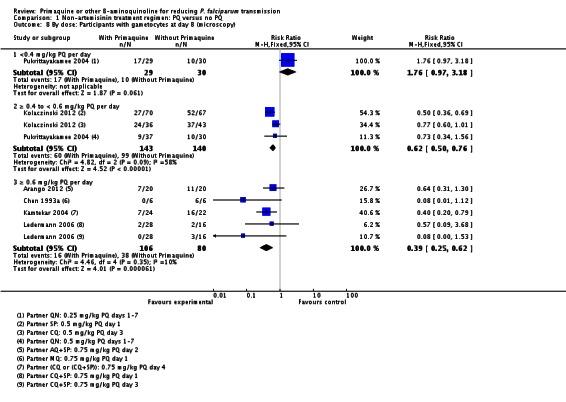
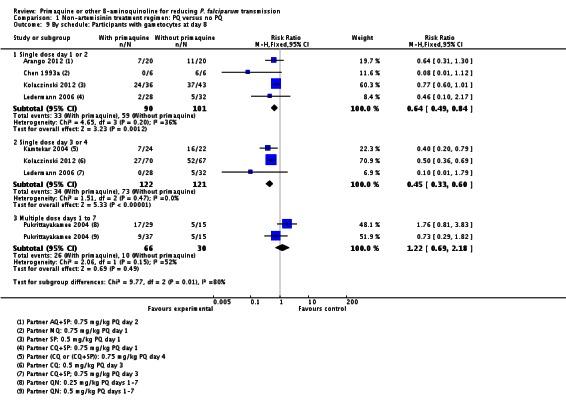
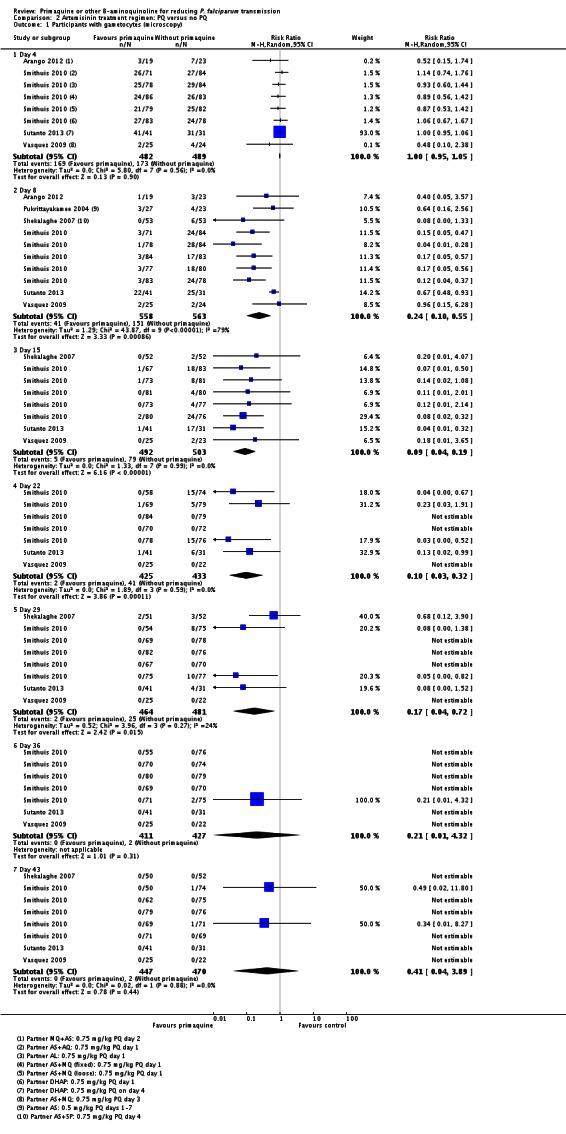
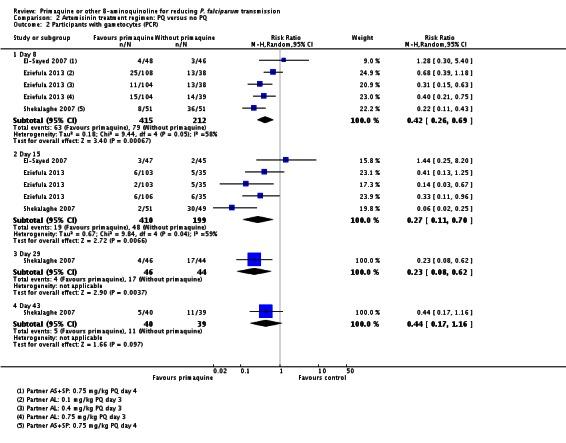
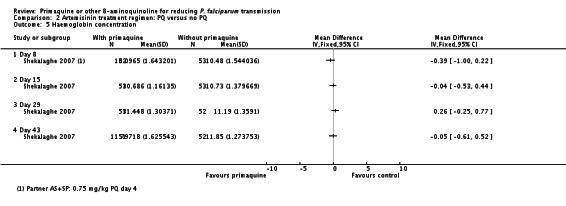
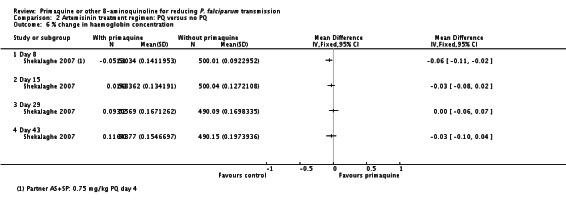
We included 17 RCTs and one quasi-RCT. Eight studies tested for G6PD status: six then excluded participants with G6PD deficiency, one included only those with G6PD deficiency, and one included all irrespective of status. The remaining ten trials either did not report on whether they tested (8), or reported that they did not test (2). Nine trials included study arms with artemisinin-based malaria treatment regimens, and eleven included study arms with non-artemisinin-based treatments.Only two trials evaluated PQ given at low doses (0.25 mg/kg in one and 0.1 mg/kg in the other). PQ with artemisinin-based treatments: No trials evaluated effects on malaria transmission directly (incidence, prevalence, or entomological inoculation rate), and none evaluated infectiousness to mosquitoes. For potential infectiousness, the proportion of people with detectable gametocytaemia on day eight was reduced by around two thirds with high dose PQ category (RR 0.29, 95% CI 0.22 to 0.37, seven trials, 1380 participants, high quality evidence), and with medium dose PQ category (RR 0.34, 95% CI 0.19 to 0.59, two trials, 269 participants, high quality evidence), but the trial evaluating low dose PQ category (0.1 mg/kg) did not demonstrate an effect (RR 0.67, 95% CI 0.44 to 1.02, one trial, 223 participants, low quality evidence). Reductions in log(10)AUC estimates for gametocytaemia on days 1 to 43 with medium and high doses ranged from 24.3% to 87.5%. For haemolysis, one trial reported percent change in mean haemoglobin against baseline, and did not detect a difference between the two arms (very low quality evidence). PQ with non-artemisinin treatments: No trials assessed effects on malaria transmission directly. Two small trials from the same laboratory evaluated infectiousness to mosquitoes, and report that infectivity was eliminated on day 8 in 15/15 patients receiving high dose PQ compared to 1/15 in the control group (low quality evidence). For potential infectiousness, the proportion of people with detectable gametocytaemia on day 8 was reduced by around half with high dose PQ category (RR 0.44, 95% CI 0.27 to 0.70, three trials, 206 participants, high quality evidence), and by around a third with medium dose category (RR 0.62, 0.50 to 0.76, two trials, 283 participants, high quality evidence), but the single trial using low dose PQ category did not demonstrate a difference between groups (one trial, 59 participants, very low quality evidence). Reduction in log(10)AUC for gametocytaemia days 1 to 43 were 24.3% and 27.1% for two arms in one trial giving medium dose PQ. No trials systematically sought evidence of haemolysis.Two trials evaluated the 8AQ bulaquine, and suggest the effects may be greater than PQ, but the small number of participants (n = 112) preclude a definite conclusion.
AUTHORS' CONCLUSIONS: In individual patients, PQ added to malaria treatments reduces gametocyte prevalence when given in doses greater than 0.4 mg/kg. Whether this translates into preventing people transmitting malaria to mosquitoes has rarely been tested in controlled trials, but there appeared to be a strong reduction in infectiousness in the two small studies that evaluated this. No included trials evaluated whether this policy has an impact on community malaria transmission either in low-endemic settings approaching elimination, or in highly-endemic settings where many people are infected but have no symptoms and are unlikely to be treated.For the currently recommended low dose regimen, there is little direct evidence to be confident that the effect of reduction in gametocyte prevalence is preserved.Most trials excluded people with G6PD deficiency, and thus there is little reliable evidence from controlled trials of the safety of PQ in single dose or short course.
背景
蚊子在摄取受感染人血液中的配子体阶段寄生虫时会感染疟原虫。恶性疟原虫配子体对药物伯氨喹(PQ)和其他8-氨基喹啉(8AQ)敏感;这些药物可防止寄生虫从受感染的人传播给蚊子,从而降低疟疾发病率。然而,PQ不会直接使个体受益,并且可能对葡萄糖-6-磷酸脱氢酶(G6PD)缺乏者有害。2010年,世界卫生组织(WHO)建议在治疗恶性疟原虫疟疾时,同时给予0.75mg/kg的单剂量PQ,以减少接近疟疾消除地区的传播。2013年,由于对安全性的担忧,WHO将此剂量修订为0.25mg/kg。
目的
评估在治疗恶性疟原虫疟疾时给予PQ或替代8AQ是否能减少疟疾传播,并估计为此目的给予PQ时严重或血液学不良事件的发生频率。
检索方法
我们检索了截至2014年2月10日的以下数据库以查找试验:Cochrane传染病小组专业注册库;发表在《Cochrane图书馆》中的Cochrane对照试验中心注册库(CENTRAL);MEDLINE;EMBASE;LILACS;对照试验元注册库(mRCT);以及WHO试验搜索门户,使用“疟疾*”、“恶性疟原虫”和“伯氨喹”作为检索词。此外,我们检索了会议论文集和纳入研究的参考文献列表,并联系了研究人员和组织。
选择标准
随机对照试验(RCT)或半随机对照试验,比较在治疗恶性疟原虫疟疾时给予单剂量或短疗程的PQ(或替代8AQ)与不给予PQ/8AQ的疟疾治疗在成人或儿童中的情况。
数据收集与分析
两位作者独立筛选所有摘要,应用纳入标准并提取数据。我们寻找对传播(社区发病率)、传染性(从人类感染的蚊子)和潜在传染性(配子体测量)有影响的证据。对于有可用数据的比较,我们计算了配子体密度随时间的曲线下面积(AUC)。我们寻找关于血液学和其他不良反应的数据,以及无性清除时间和复发的次要结果。我们根据疟疾治疗方案是否包括青蒿素衍生物进行分层;根据PQ剂量类别(低剂量<0.4mg/kg;中剂量≥0.4至<0.6mg/kg;高剂量≥0.6mg/kg);以及根据PQ给药方案进行分层。我们使用GRADE方法评估证据质量。
主要结果
我们纳入了17项RCT和1项半随机对照试验。八项研究检测了G6PD状态:六项随后排除了G6PD缺乏的参与者,一项仅纳入了G6PD缺乏的参与者,一项纳入了所有参与者而不考虑其状态。其余十项试验要么未报告是否进行了检测(8项),要么报告未进行检测(2项)。九项试验包括基于青蒿素的疟疾治疗方案的研究组,十一项包括基于非青蒿素的治疗方案的研究组。只有两项试验评估了低剂量(一项为0.25mg/kg,另一项为0.1mg/kg)的PQ。基于青蒿素治疗的PQ:没有试验直接评估对疟疾传播的影响(发病率、患病率或昆虫接种率),也没有试验评估对蚊子的传染性。对于潜在传染性,高剂量PQ组在第8天可检测到配子血症的人群比例降低了约三分之二(RR 0.29,95%CI 0.22至0.37,七项试验,1380名参与者,高质量证据),中剂量PQ组也降低了约三分之二(RR 0.34,95%CI 0.19至0.59,两项试验,269名参与者,高质量证据),但评估低剂量PQ组(0.1mg/kg)的试验未显示出效果(RR 0.67,95%CI 0.44至1.02,一项试验,223名参与者,低质量证据)。中剂量和高剂量在第1至43天对配子血症的log(10)AUC估计值的降低范围为24.3%至87.5%。对于溶血,一项试验报告了平均血红蛋白相对于基线的百分比变化,未检测到两组之间的差异(极低质量证据)。基于非青蒿素治疗的PQ:没有试验直接评估对疟疾传播的影响。来自同一实验室的两项小型试验评估了对蚊子的传染性,并报告在接受高剂量PQ的15/15名患者中,第8天的传染性消除,而对照组为1/15(低质量证据)。对于潜在传染性,高剂量PQ组在第8天可检测到配子血症的人群比例降低了约一半(RR 0.44,95%CI 0.27至0.70,三项试验,206名参与者,高质量证据),中剂量组降低了约三分之一(RR 0.62,0.50至0.76,两项试验,283名参与者,高质量证据),但使用低剂量PQ组的单项试验未显示出组间差异(一项试验,59名参与者,极低质量证据)。在一项给予中剂量PQ的试验中,两个组在第1至43天对配子血症的log(10)AUC降低分别为24.3%和27.1%。没有试验系统地寻找溶血的证据。两项试验评估了8AQ布喹,表明其效果可能大于PQ,但参与者数量较少(n = 112),无法得出明确结论。
作者结论
在个体患者中,疟疾治疗中添加PQ,当剂量大于0.4mg/kg时可降低配子体患病率。在对照试验中,很少测试这是否能转化为防止人们将疟疾传播给蚊子,但在评估此情况的两项小型研究中,传染性似乎有显著降低。没有纳入的试验评估该政策在接近消除的低流行环境或许多人感染但无症状且不太可能接受治疗的高流行环境中对社区疟疾传播是否有影响。对于目前推荐的低剂量方案,几乎没有直接证据能确定降低配子体患病率的效果是否得以保持。大多数试验排除了G6PD缺乏的人,因此关于单剂量或短疗程PQ安全性的对照试验几乎没有可靠证据。








 Zotero 插件