
自闭症儿童的血清 microRNA 谱。
Serum microRNA profiles in children with autism.
机构信息
Department of Psychiatry, Hamamatsu University School of Medicine, 1-20-1 Handayama, Higashi-ku, Hamamatsu 431-3192, Japan.
Research Center for Child Mental Development, Hamamatsu University School of Medicine, Hamamatsu, 1-20-1 Handayama, Higashi-ku, Hamamatsu 431-3192, Japan.
出版信息
Mol Autism. 2014 Jul 30;5:40. doi: 10.1186/2040-2392-5-40. eCollection 2014.
BACKGROUND
As regulators of gene expression, microRNAs (miRNAs) play a key role in the transcriptional networks of the developing human brain. Circulating miRNAs in the serum and plasma are remarkably stable and are suggested to have promise as noninvasive biomarkers for neurological and neurodevelopmental disorders. We examined the serum expression profiles of neurologically relevant miRNAs in autism spectrum disorder (ASD), a complex neurodevelopmental disorder characterized by multiple deficits in communication, social interaction and behavior.
METHODS
Total RNA, including miRNA, was extracted from the serum samples of 55 individuals with ASD and 55 age- and sex-matched control subjects, and the mature miRNAs were selectively converted into cDNA. Initially, the expression of 125 mature miRNAs was compared between pooled control and ASD samples. The differential expression of 14 miRNAs was further validated by SYBR Green quantitative PCR of individual samples. Receiver-operating characteristic (ROC) analysis was used to evaluate the sensitivity and specificity of miRNAs. The target genes and pathways of miRNAs were predicted using DIANA mirPath software.
RESULTS
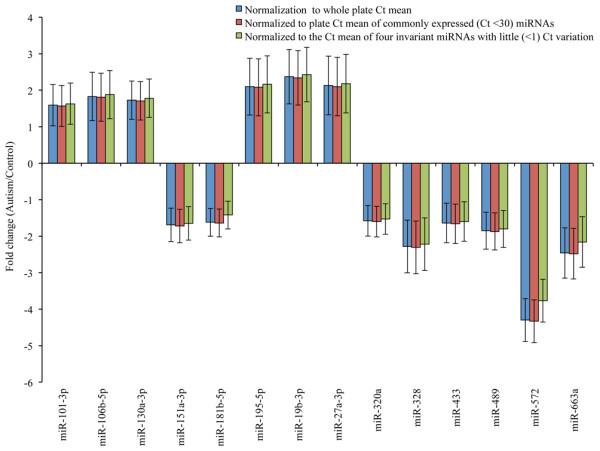
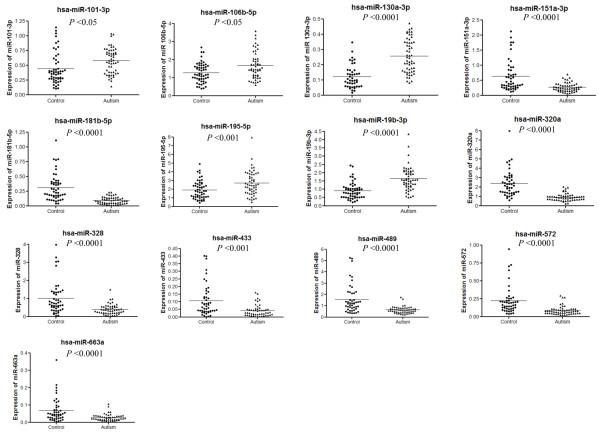
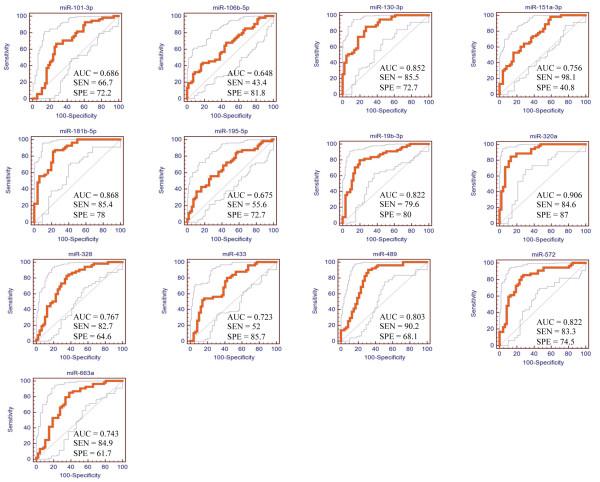
Thirteen miRNAs were differentially expressed in ASD individuals compared to the controls. MiR-151a-3p, miR-181b-5p, miR-320a, miR-328, miR-433, miR-489, miR-572, and miR-663a were downregulated, while miR-101-3p, miR-106b-5p, miR-130a-3p, miR-195-5p, and miR-19b-3p were upregulated. Five miRNAs showed good predictive power for distinguishing individuals with ASD. The target genes of these miRNAs were enriched in several crucial neurological pathways.
CONCLUSIONS
This is the first study of serum miRNAs in ASD individuals. The results suggest that a set of serum miRNAs might serve as a possible noninvasive biomarker for ASD.
背景
作为基因表达的调控因子,microRNAs(miRNAs)在人类大脑发育的转录网络中发挥着关键作用。血清和血浆中的循环 miRNAs 非常稳定,被认为有希望成为神经和神经发育障碍的非侵入性生物标志物。我们研究了自闭症谱系障碍(ASD)中与神经相关的 miRNAs 的血清表达谱,ASD 是一种复杂的神经发育障碍,其特征是在沟通、社交互动和行为方面存在多种缺陷。
方法
从 55 名 ASD 患者和 55 名年龄和性别匹配的对照者的血清样本中提取总 RNA,包括 miRNA,并将成熟的 miRNA 选择性地转化为 cDNA。最初,比较了混合对照和 ASD 样本中 125 个成熟 miRNA 的表达。通过对个体样本的 SYBR Green 定量 PCR 进一步验证了 14 个 miRNA 的差异表达。使用接收器操作特性(ROC)分析评估 miRNA 的灵敏度和特异性。使用 DIANA mirPath 软件预测 miRNA 的靶基因和途径。
结果
与对照组相比,ASD 个体中有 13 个 miRNA 表达差异。miR-151a-3p、miR-181b-5p、miR-320a、miR-328、miR-433、miR-489、miR-572 和 miR-663a 下调,而 miR-101-3p、miR-106b-5p、miR-130a-3p、miR-195-5p 和 miR-19b-3p 上调。5 个 miRNA 对区分 ASD 个体具有良好的预测能力。这些 miRNA 的靶基因富集在几个关键的神经通路中。
结论
这是 ASD 个体血清 miRNAs 的首次研究。结果表明,一组血清 miRNAs 可能作为 ASD 的一种潜在非侵入性生物标志物。

 Zotero 插件