
端粒长度评估的可重复性:一项国际合作研究。
Reproducibility of telomere length assessment: an international collaborative study.
作者信息
Martin-Ruiz Carmen M, Baird Duncan, Roger Laureline, Boukamp Petra, Krunic Damir, Cawthon Richard, Dokter Martin M, van der Harst Pim, Bekaert Sofie, de Meyer Tim, Roos Goran, Svenson Ulrika, Codd Veryan, Samani Nilesh J, McGlynn Liane, Shiels Paul G, Pooley Karen A, Dunning Alison M, Cooper Rachel, Wong Andrew, Kingston Andrew, von Zglinicki Thomas
机构信息
Newcastle University Institute for Ageing, Newcastle University, Newcastle, UK.
Institute of Cancer and Genetics, Cardiff University, Cardiff, UK.
出版信息
Int J Epidemiol. 2015 Oct;44(5):1673-83. doi: 10.1093/ije/dyu191. Epub 2014 Sep 19.
BACKGROUND
Telomere length is a putative biomarker of ageing, morbidity and mortality. Its application is hampered by lack of widely applicable reference ranges and uncertainty regarding the present limits of measurement reproducibility within and between laboratories.
METHODS
We instigated an international collaborative study of telomere length assessment: 10 different laboratories, employing 3 different techniques [Southern blotting, single telomere length analysis (STELA) and real-time quantitative PCR (qPCR)] performed two rounds of fully blinded measurements on 10 human DNA samples per round to enable unbiased assessment of intra- and inter-batch variation between laboratories and techniques.
RESULTS
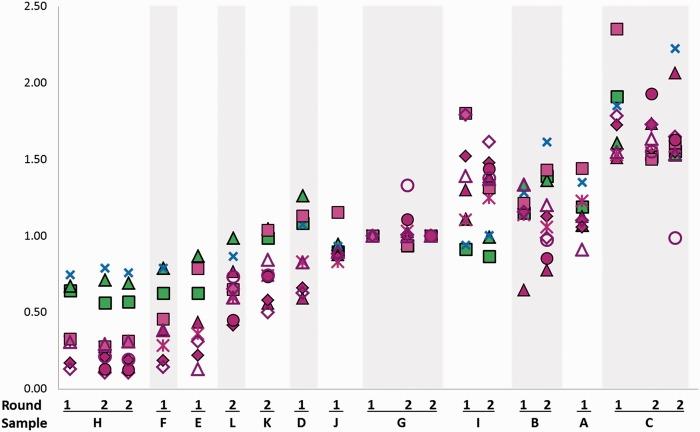
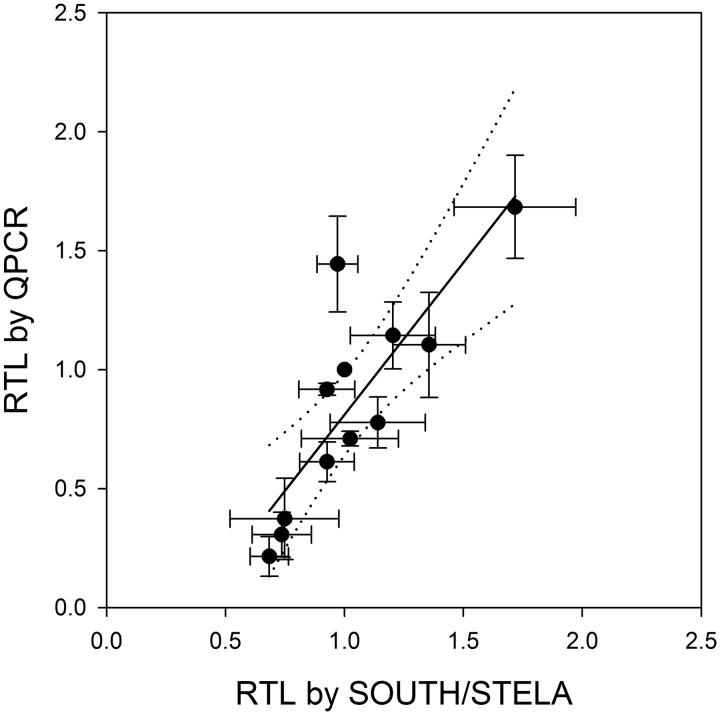
Absolute results from different laboratories differed widely and could thus not be compared directly, but rankings of relative telomere lengths were highly correlated (correlation coefficients of 0.63-0.99). Intra-technique correlations were similar for Southern blotting and qPCR and were stronger than inter-technique ones. However, inter-laboratory coefficients of variation (CVs) averaged about 10% for Southern blotting and STELA and more than 20% for qPCR. This difference was compensated for by a higher dynamic range for the qPCR method as shown by equal variance after z-scoring. Technical variation per laboratory, measured as median of intra- and inter-batch CVs, ranged from 1.4% to 9.5%, with differences between laboratories only marginally significant (P = 0.06). Gel-based and PCR-based techniques were not different in accuracy.
CONCLUSIONS
Intra- and inter-laboratory technical variation severely limits the usefulness of data pooling and excludes sharing of reference ranges between laboratories. We propose to establish a common set of physical telomere length standards to improve comparability of telomere length estimates between laboratories.
背景
端粒长度是衰老、发病和死亡的一种假定生物标志物。其应用受到缺乏广泛适用的参考范围以及实验室内部和之间测量重现性当前限度的不确定性的阻碍。
方法
我们发起了一项端粒长度评估的国际合作研究:10个不同实验室,采用3种不同技术[Southern印迹法、单端粒长度分析(STELA)和实时定量PCR(qPCR)],每轮对10个人类DNA样本进行两轮完全盲法测量,以能够无偏地评估实验室和技术之间的批内和批间变异。
结果
不同实验室的绝对结果差异很大,因此无法直接比较,但相对端粒长度的排名高度相关(相关系数为0.63 - 0.99)。Southern印迹法和qPCR的技术内相关性相似,且强于技术间相关性。然而,Southern印迹法和STELA的实验室间变异系数(CV)平均约为10%,qPCR则超过20%。如z评分后方差相等所示,qPCR方法较高的动态范围弥补了这一差异。每个实验室的技术变异,以批内和批间CV的中位数衡量,范围为1.4%至9.5%,实验室之间的差异仅略有显著性(P = 0.06)。基于凝胶和基于PCR的技术在准确性上没有差异。
结论
实验室内部和之间的技术变异严重限制了数据汇总的有用性,并排除了实验室之间参考范围的共享。我们建议建立一套通用的物理端粒长度标准,以提高实验室之间端粒长度估计的可比性。

 Zotero 插件