
SIRT6通过对KAP1进行核糖基化修饰来抑制LINE1逆转录转座子,但这种抑制作用在应激和衰老时失效。
SIRT6 represses LINE1 retrotransposons by ribosylating KAP1 but this repression fails with stress and age.
作者信息
Van Meter Michael, Kashyap Mehr, Rezazadeh Sarallah, Geneva Anthony J, Morello Timothy D, Seluanov Andrei, Gorbunova Vera
机构信息
Department of Biology, University of Rochester, Rochester, New York 14627, USA.
出版信息
Nat Commun. 2014 Sep 23;5:5011. doi: 10.1038/ncomms6011.
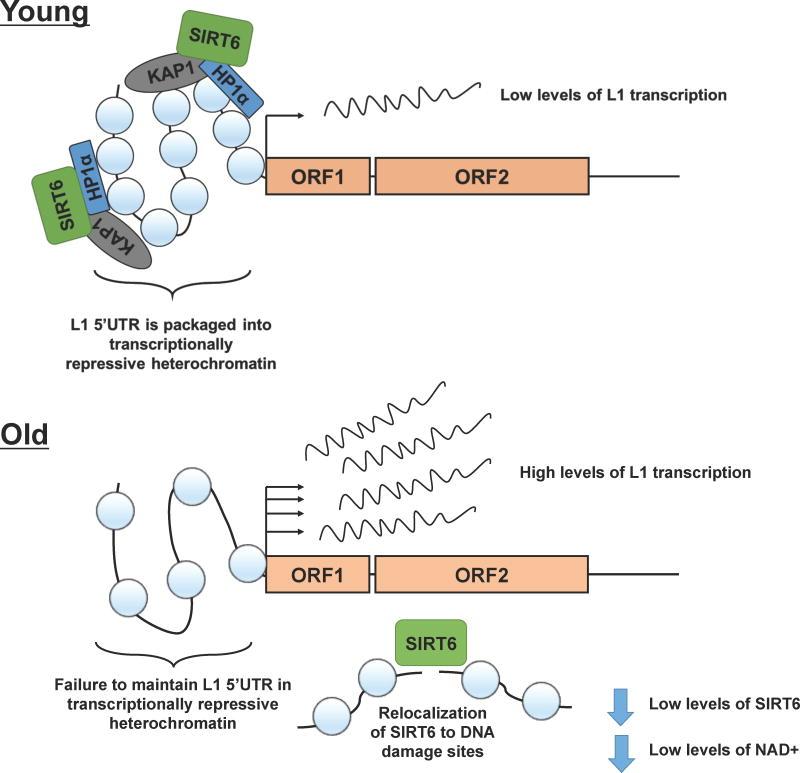
L1 retrotransposons are an abundant class of transposable elements that pose a threat to genome stability and may have a role in age-related pathologies such as cancer. Recent evidence indicates that L1s become more active in somatic tissues during the course of ageing; however the mechanisms underlying this phenomenon remain unknown. Here we report that the longevity regulating protein, SIRT6, is a powerful repressor of L1 activity. Specifically, SIRT6 binds to the 5'-UTR of L1 loci, where it mono-ADP ribosylates the nuclear corepressor protein, KAP1, and facilitates KAP1 interaction with the heterochromatin factor, HP1α, thereby contributing to the packaging of L1 elements into transcriptionally repressive heterochromatin. During the course of ageing, and also in response to DNA damage, however, we find that SIRT6 is depleted from L1 loci, allowing the activation of these previously silenced retroelements.
L1逆转录转座子是一类丰富的可移动元件,对基因组稳定性构成威胁,并且可能在诸如癌症等与年龄相关的病理过程中发挥作用。最近的证据表明,L1在衰老过程中在体细胞组织中变得更加活跃;然而,这一现象背后的机制仍然未知。在这里,我们报告称,长寿调节蛋白SIRT6是L1活性的强大抑制剂。具体而言,SIRT6与L1基因座的5'-UTR结合,在那里它对核共抑制蛋白KAP1进行单ADP核糖基化,并促进KAP1与异染色质因子HP1α的相互作用,从而有助于将L1元件包装成转录抑制性异染色质。然而,在衰老过程中以及对DNA损伤的反应中,我们发现SIRT6从L1基因座上耗尽,从而使这些先前沉默的逆转录元件被激活。


 Zotero 插件