
进行性肌营养不良症行走期男孩的长期自然病史数据:36个月的变化
Long term natural history data in ambulant boys with Duchenne muscular dystrophy: 36-month changes.
作者信息
Pane Marika, Mazzone Elena Stacy, Sivo Serena, Sormani Maria Pia, Messina Sonia, D'Amico Adele, Carlesi Adelina, Vita Gianluca, Fanelli Lavinia, Berardinelli Angela, Torrente Yvan, Lanzillotta Valentina, Viggiano Emanuela, D Ambrosio Paola, Cavallaro Filippo, Frosini Silvia, Barp Andrea, Bonfiglio Serena, Scalise Roberta, De Sanctis Roberto, Rolle Enrica, Graziano Alessandra, Magri Francesca, Palermo Concetta, Rossi Francesca, Donati Maria Alice, Sacchini Michele, Arnoldi Maria Teresa, Baranello Giovanni, Mongini Tiziana, Pini Antonella, Battini Roberta, Pegoraro Elena, Previtali Stefano, Bruno Claudio, Politano Luisa, Comi Giacomo P, Bertini Enrico, Mercuri Eugenio
机构信息
Department of Paediatric Neurology, Catholic University, Rome, Italy.
Biostatistics Unit, Department of Health Sciences, University of Genoa, Genoa, Italy.
出版信息
PLoS One. 2014 Oct 1;9(10):e108205. doi: 10.1371/journal.pone.0108205. eCollection 2014.
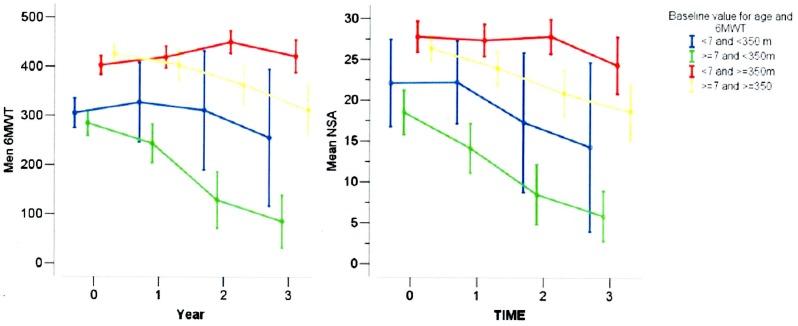
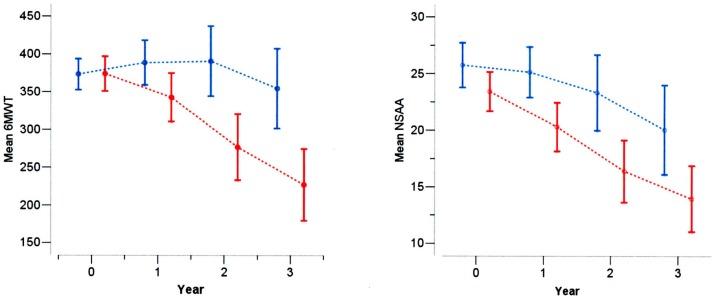
The 6 minute walk test has been recently chosen as the primary outcome measure in international multicenter clinical trials in Duchenne muscular dystrophy ambulant patients. The aim of the study was to assess the spectrum of changes at 3 years in the individual measures, their correlation with steroid treatment, age and 6 minute walk test values at baseline. Ninety-six patients from 11 centers were assessed at baseline and 12, 24 and 36 months after baseline using the 6 minute walk test and the North Star Ambulatory Assessment. Three boys (3%) lost the ability to perform the 6 minute walk test within 12 months, another 13 between 12 and 24 months (14%) and 11 between 24 and 36 months (12%). The 6 minute walk test showed an average overall decline of -15.8 (SD 77.3) m at 12 months, of -58.9 (SD 125.7) m at 24 months and -104.22 (SD 146.2) m at 36 months. The changes were significantly different in the two baseline age groups and according to the baseline 6 minute walk test values (below and above 350 m) (p<0.001). The changes were also significantly different according to steroid treatment (p = 0.01). Similar findings were found for the North Star Ambulatory Assessment. These are the first 36 month longitudinal data using the 6 minute walk test and North Star Ambulatory Assessment in Duchenne muscular dystrophy. Our findings will help not only to have a better idea of the progression of the disorder but also provide reference data that can be used to compare with the results of the long term extension studies that are becoming available.
6分钟步行试验最近已被选为国际多中心临床试验中杜氏肌营养不良症能行走患者的主要结局指标。该研究的目的是评估个体指标在3年中的变化范围,以及它们与类固醇治疗、年龄和基线时的6分钟步行试验值之间的相关性。来自11个中心的96名患者在基线时以及基线后12、24和36个月接受了6分钟步行试验和北极星动态评估。3名男孩(3%)在12个月内失去了进行6分钟步行试验的能力,另外13名在12至24个月之间(14%),11名在24至36个月之间(12%)。6分钟步行试验显示,12个月时平均总体下降-15.8(标准差77.3)米,24个月时为-58.9(标准差125.7)米,36个月时为-104.22(标准差146.2)米。在两个基线年龄组以及根据基线6分钟步行试验值(低于和高于350米),变化存在显著差异(p<0.001)。根据类固醇治疗情况,变化也存在显著差异(p = 0.01)。北极星动态评估也有类似发现。这些是在杜氏肌营养不良症中使用6分钟步行试验和北极星动态评估的首批36个月纵向数据。我们的研究结果不仅有助于更好地了解该疾病的进展,还提供了可用于与即将开展的长期扩展研究结果进行比较的参考数据。

 Zotero 插件